Whitman variants are Marvel, DC and Western issues printed for an off-newsstand channel: plastic bags of three comics sold in department stores, toy stores, gas stations, train stations and American airports. At Marvel, the marking begins in February 1977 and is read in the upper left corner block: first a diamond around the price with the barcode kept, then, from October 1977 to May 1979, the same diamond with a barcode box left blank. At DC, the landmark is the Whitman logo substituted for the house badge, often accompanied by a cover with no issue number. The name "Whitman" is almost never printed on a Marvel comic: it was on the bag, thrown away at purchase. Some of these versions are commonplace, others survive in only a few dozen copies.
A collector who opens a box of American comics dated 1978 or 1979 sooner or later comes across a copy that bothers him without his being able to say why. The illustration is the one he knows, the series logo is in the right place, the pagination does not budge. But the little rectangle in the upper left corner, the one that usually houses the price and the barcode, does not look like the one on his other copy of the same issue. The price is enclosed in a diamond there. Or the barcode box is perfectly white, without a single black bar.
It is neither a printing defect, nor a counterfeit, nor a foreign issue. It is the signature of a parallel distribution channel that operated for about three years, and whose existence almost no buyer of the time suspected. These copies never went on a newsdealer's rack: they arrived sealed by three in a heat-sealed bag, in a department store's toy aisle, next to puzzles and coloring books.
This guide is designed to be used with the comic in hand. It gives the precise chronology of cover blocks period by period, a seven-step examination method, the landmarks specific to DC and to the publisher's house series, then the most delicate part of the work: knowing whether the copy you hold is a real rarity or a curiosity of no consequence. Both cases exist, in very unequal proportions.
Where these copies come from, and why their cover changes
The story begins in Racine, Wisconsin, at a printer of popular children's books. The house had created there, around 1915, a brand intended for low-priced books, and signed in 1933 a license contract to publish books drawn from the cartoons of a major animation studio. In the 1960s, the same company launched its own comics line, operated from 1962 to 1984.
Its asset was not the newsstand but the aisle. It knew how to sell in department stores, groceries and toy shops, places the press distribution did not reach. And it sold there differently: not an issue placed on a spinner rack, but three issues sealed in a bag, non-returnable, bought firm by the retailer. Around the early 1980s, the house's comics line even abandoned its historic logo in favor of the Whitman brand, and was distributed only this way, in packs of three, in toy stores, big-box stores, gas stations, train stations and airports.
Marvel and DC entrusted part of their distribution to this network. And that is where the cover becomes a document. A newsstand unsold copy gets credited: the retailer sends back proof and gets his money back. A department-store bag, on the other hand, is sold firm. The two flows must above all not mix, otherwise a reseller could have claimed a refund on copies he had no right to return. Hence the modification of the cover block: it did not target the collector, it served as accounting marking. It is exactly the same logic that, a little later, will produce the edition intended for specialty shops, as our comparison between direct edition and newsstand edition explains.
The chronology of cover blocks at Marvel
Everything is played out on a few square centimeters, and the reading depends on the date. The same landmark does not mean the same thing in 1977 and in 1980. Here are the successive states, in order.
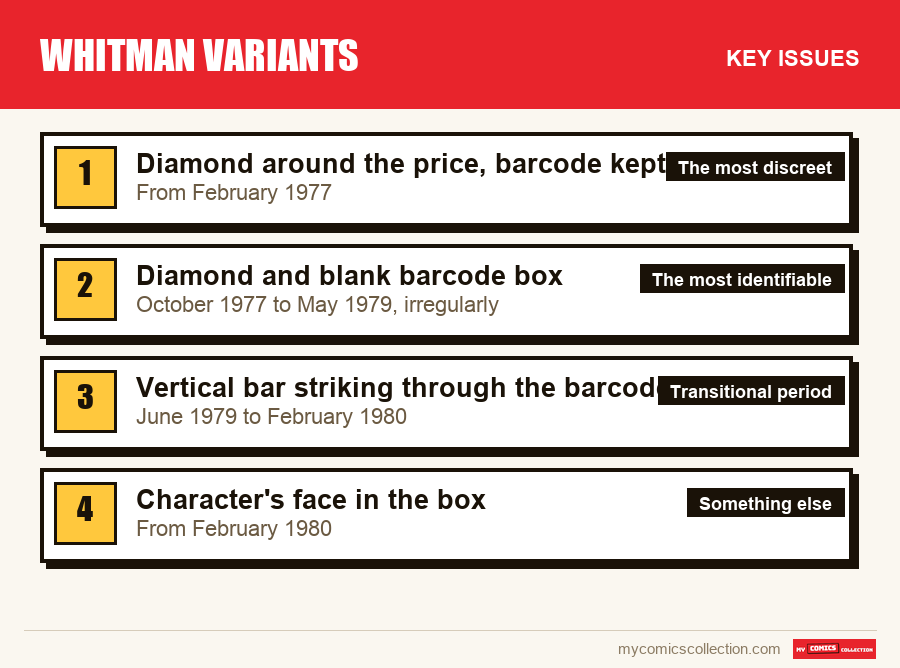
Diamond around the price, barcode kept
First generation. The price is no longer set in a rectangle but ringed by a diamond, while the barcode box remains normally filled with black bars. The gap with the ordinary copy is so slight it goes unnoticed at arm's length: you must look at the shape around the number, not the number itself.
Diamond and blank barcode box
It is the version commonly meant when speaking of a "Whitman variant," and by far the easiest to spot: at the barcode's location, a white void, perfectly clean, bordered like an empty form box. The price diamond remains. This combination leaves no room for hesitation, even on a mediocre photograph.
Vertical bar striking through the barcode
The barcode comes back, but a vertical bar runs through it to make it unusable at the register. This transitional solution matches the moment when Marvel takes back control of its off-newsstand distribution. Serious sources avoid asserting that these copies came exclusively from bags: they mostly mark the birth of the specialty-shop channel.
Character's face in the box
A stylized, white hero's face replaces the barcode. This copy is not a bag variant: it is the edition intended for specialty shops, which becomes at this date the norm of the direct channel. Confusing it with a department-store variant is the most widespread mistake on this subject, because the two occupy the same box.
An example makes the mechanics very concrete: the first issue of the adaptation of the great 1977 science fiction film went through seven distinct American printings within the year, which makes it the most multiplied Marvel issue of the period. It includes the initial newsstand print run at 30 cents, a test version at 35 cents distributed in only a handful of cities, a reprint showing the word "reprint" on the cover, then three diamond versions printed for the bags: the first with a barcode, the next two with the blank box, one of which announces its reprint status on the cover and the other only in the interior indicia. The detail of the test price is covered separately in our guide to 30 and 35 cent price variants, because it belongs to a different phenomenon.
Visual method, step by step
The procedure that follows works on any American issue dated 1977 to 1983. It is done in order: each step eliminates a hypothesis and conditions the next.
Read the cover date before anything
Note the month and year printed on the cover or in the indicia. Without this date, no visual landmark is interpretable: the white box of 1978 and the illustrated box of 1981 tell two opposite stories. If the date is missing on the cover, the first page's indicia almost always gives it.
Isolate the upper left corner block
Put your thumb on the rest of the cover and look only at this block. The illustration, title and series logo are identical on all versions: examining them only sows doubt. All the useful information fits in this square.
Describe the shape around the price
Rectangle or diamond? Formulate the answer aloud before moving on. The diamond, at Marvel, is the first serious clue of a print run intended for bags, and it remains across several successive states of the block.
Qualify the state of the barcode box
Four possibilities, and only four: complete black bars, black bars struck by a vertical line, framed white void, or illustrated motif. Choose one. Then cross with the step 1 date to conclude: white void before June 1979 points to the bag, illustrated motif after February 1980 points to the specialty shop.
Look for the issue number on the cover
Its absence is a strong signal, especially on a DC title of the period: some bag print runs were printed with no visible number on the front. The real number is then read in the indicia, which never lied. An issue with no number on the front but numbered inside is not incomplete: it is marked.
Check consistency between cover and interior
Compare wear, paper tint, spine color and staple condition. Since the difference between versions is entirely on the cover, a marked cover paired with an interior of another origin is enough to fabricate a fake. A cover clearly fresher than the pages it protects justifies examination under strong light.
Name your conclusion with the right words
Write in your inventory what you observed, not what you assume: "diamond, white box, November 1978" is better than "Whitman." This discipline of description protects you on resale day, when the buyer will want verifiable facts rather than a commercial label.
The DC case: a swapped logo, a vanished number
At DC, the marking is more talkative and easier to see, but its form varies from one title to another. The general principle consists of replacing the publisher's usual badge with the Whitman brand, sometimes written in a circle that occupies exactly the badge's place, sometimes set in block letters. On some issues, the operation is accompanied by removing the number from the cover, hence the importance of step 5 of the method above.
The channel was the same as at Marvel: packs of three sold in American department-store and bazaar chains, with an amusing physical consequence and a heavy one. In an opaque bag of three issues, the middle copy was invisible at purchase. Nobody chose what they took home, which explains both the very uneven distribution of print runs by issue and today's difficulty in reconstructing an exhaustive list.
This census scarcity produces late surprises. An issue of the anthology series where Superman met a different hero each month remained totally unknown to collectors until the early 2010s, before being identified as a bag print run. Only a few certified copies are documented, and its appearance turned the complete collection of this category into a nearly unattainable goal. The episode deserves to be remembered for a methodological reason: on this ground, the absence of a mention in established lists does not prove the nonexistence of a version.
Finally, these late-1970s DC print runs must be distinguished from later packs. DC continued selling multipacks well afterward, with other markings, and the copies concerned are then identified by a symbol housed in the barcode box. The bag copies of the 1980s and 1990s bear no relation to the Whitman brand, even if the commercial mechanism stayed identical. An issue of Batman dated March 1983, for example, exists in prepackaged-pack version while the Whitman brand had already disappeared from DC covers.
The publisher's house series: the opposite trap
On the comics published by the Racine house itself, essentially cartoon and cartoon-character licenses, the reasoning reverses. Here, the Whitman brand is not a marking added to a third-party publisher's cover: it is the line's logo, which succeeds the old one at the dawn of the 1980s. An issue carrying this logo is therefore not a variant of another issue, it is the normal edition of its period.
The sensitive point lies in the last months of 1980, where several issues were never sold other than in a bag. Production had been strongly reduced, some titles were distributed only as samples, others were never made despite their announcement. The issues concerned, all cartoon-character titles released between August and December 1980, are among the hardest American issues to find of the whole decade. Collector lists put forward estimates of a few dozen surviving copies for the rarest.
These estimates call for caution, however, and it is a useful lesson on the whole subject. Later censuses contested part of the announced figures, pointing to a more solid distribution than expected outside the United States, notably toward Australia and Canada. A scarcity figure put forward by a collector community is not printer data: it is an estimate based on what enthusiasts see pass, and it can be corrected abruptly the day a forgotten stock resurfaces. The same warning holds for the higher-priced versions meant for the neighboring market, covered in our guide to Canadian price variants.
Rare or commonplace: the question that decides everything
The greatest misunderstanding about these copies is believing the marking amounts to a certificate of rarity. It amounts only to a certificate of channel. Three documented facts suffice to measure the gap between the two ends of the spectrum.
First fact: diamond print runs represent a small but not negligible share of what circulates today for the issues concerned, on the order of a few percent of the copies observed on the secondhand market. On an issue that sold hundreds of thousands of units, a few percent still make many copies available. The marked version is scarcer than the ordinary, and yet perfectly findable.
Second fact: at the other end, some issues existed only in bags, with no newsstand counterpart. There, scarcity is no longer relative, it is absolute, and it is measured in dozens of known copies rather than thousands. Between these two situations, the gap is not one of degree but of nature.
Third fact, and the one that costs hurried buyers the most: many bags were filled with perfectly ordinary newsstand copies, with no particular marking. Having been sold in a pack therefore leaves no trace on the issue itself. A seller who presents a copy with no diamond, no white box and no substituted logo as a "bag variant" describes a distribution story he cannot prove.
- Marking present on a sought-after issue: it is the only case where real scarcity meets real demand. The marked version adds a floor to a desirability that already existed.
- Marking present on a commonplace issue: a completeness object for a specialist, with no significant value gap against the common copy.
- Issue that existed only in bags: the scarcity is documented, but the circle of buyers is narrow, so resale demands patience.
- Bag still sealed with its header card: a testimony piece, appreciated for its period integrity, whose opening destroys precisely what sets it apart.
One last physical parameter is worth knowing before any costly purchase. The bag's seal pressed the issues and durably marked the paper, often along the full height of an edge. Copies of this provenance therefore often cap quite low in grading, and the highest grades there are disproportionately hard. This has two practical consequences: a marked copy in very high grade justifies all the more severe an examination, and comparing the price of a bag copy with that of a newsstand copy without accounting for grade makes no sense.
What a certification label says
Since September 26, 2022, CGC indicates on its label the commercial provenance of the copies it certifies, with two distinct notices: one for newsstand copies, one for multipack copies. This decision ended years of vagueness, and above all settled a question of vocabulary collectors had been asking for a long time.
The service indeed chose a neutral wording for pack copies, specifying that the name commonly used in the community is imprecise: not all multipacks came out of Whitman's network, other distributors moved them. For the Marvel diamond copies of the 1977 to 1979 period, the official description evokes a modified cover where the price and number are placed in a diamond rather than in a rectangle, exactly the landmarks detailed above. The label can be obtained retroactively on a copy already certified before this date, by re-encapsulation.
Earlier labels used other wordings depending on the case: some stressed the absence of a month on the cover, others the prepackaged nature of the packaging. The population shares concerned remain modest: on the best-documented DC pack issues, marked copies weigh only a few percent of the issue's certified copies, which confirms the relative scarcity without turning it into unfindability. To know whether the operation is worth the cost on your copy, our guide on grading and certification details the decision method, and a prior estimate avoids incurring fees on an issue that will not make them pay off.
Above all remember the principle: the label certifies what is observable on the object, namely a cover state, and never the commercial route it took. It is also the limit of your own expertise. You can assert that a cover block corresponds to a given state, in a given period. You cannot assert, without a document, that a specific copy spent the winter of 1978 in a bag in the toy aisle. The first assertion is demonstrated, the second is told, and only the first has value on a market. To go further on this channel's scarcity mechanisms, our article on multipack editions and their valuation completes this identification guide.