An important part of Jim Valentino's work consists of writing stories that others draw, and this is the least known aspect of his bibliography. As of August 29, 2026, the advertisements crediting him as screenwriter display $9.99 median asking out of 107 ads, with no certified announcement. This is higher than its comic series, but the gap is largely due to the composition of the research: this figure does not establish a hierarchy between his two professions.
Separating what he wrote from what he drew is the most stubborn practical problem of this bibliography.
This article explains what this aspect covers, what the survey shows with its limits, what writing for others changes to one's work, and how to identify these publications.
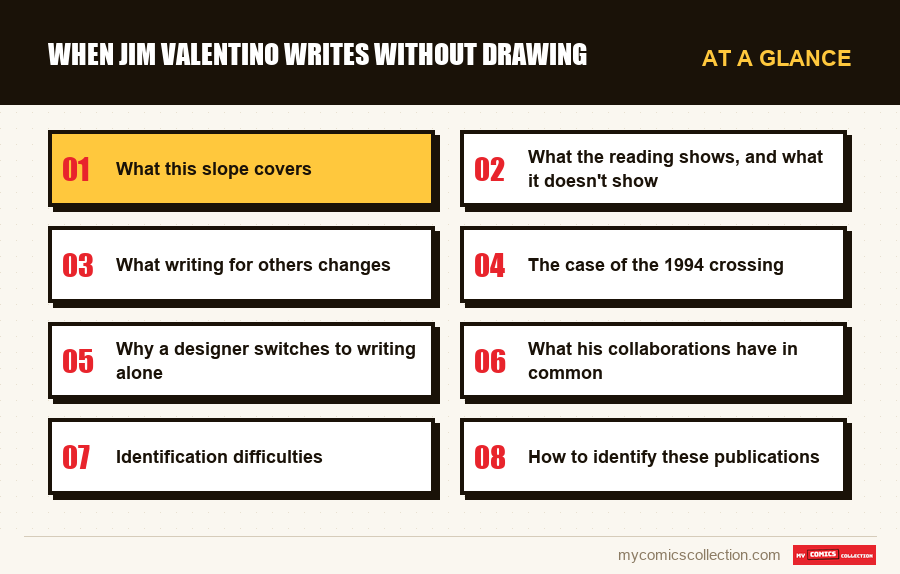
What this slope covers
Three distinct situations, which must be separated because they do not involve the same work.
The revival of his own characters. After drawing a series, he continues to write it while others draw it. The story remains its own, the page is no longer.
New series written for other designers. Projects designed from the start for another hand, which implies writing according to the strengths of someone you are not.
Crossings and occasional publications. Including a 1994 special issue bringing together his 1980s parody character with a comparable figure from another indie author: a curious object that today asks questions about $5.98 median out of 53 ads.
These three cases share a common difficulty: his name appears on the cover without anything indicating which of the two professions he exercises.
What the reading shows, and what it doesn't show
The following is from fixed price listings as of August 29, 2026, gross and certified counted separately. An asking price reflects a seller's expectation.
Advertisements crediting him as screenwriter
107 ads raw, of $1.24 to $99.99 requested, median $9.99. No certified ad for this search.
The highest median in his bibliography, which calls for careful explanation.
The method reserve
This search selects advertisements which mention his role as author, therefore sellers who detail the credits: a different profile from those who sell a lot by weight.
The gap describes a population of listings, not a work value.
The 1994 special issue
53 ads raw, of $1.79 to $67.99 requested, median $5.98. No certified announcement.
A constant that is confirmed
Zero certified copies on both searches. Throughout its bibliography, the certified market remains anecdotal whatever the aspect considered.
What writing for others changes
The transition from complete author to screenwriter concretely changes the way of writing, and the effects are visible.
We must describe what we were showing. A complete author draws what he has in mind without formulating it. Writing for someone else requires putting visual intentions into words, a different exercise that makes some things more explicit and others impossible.
You have to give up on rhythm. The division (how many boxes, what size, what sequence) is largely up to the designer. This is precisely the main quality of his drawn work, and he leaves it in other hands.
You have to write for strengths you don't have. A spectacular designer calls up scenes that a sober author would not have written for himself. Done well, it broadens the register; Done poorly, it produces a text that doesn’t suit anyone.
The result is paradoxical and deserves to be said: his scenarios for others are often more demonstrative than his own series, because he writes for cartoonists who are.
This side is the most difficult to judge fairly. When a book written by one and drawn by the other disappoints, it is almost impossible to know who to attribute it to.
The honest rule is not to conclude anything from a single title. It is by reading several collaborations with different designers that the writing constants emerge, and this is the only way to separate one's part from that of others.
The case of the 1994 crossing
This isolated publication deserves development, because it condenses an entire editorial history.
Two parody characters, born in the mid-1980s in the self-publishing circuit, among small publishers without means, find themselves brought together ten years later in an issue published by a structure with national distribution.
It’s the independent circuit catching up with its own past. Authors who printed a few thousand copies now have a publishing device, and they use it for an object without obvious commercial stakes.
The median raised to $5.98 also confirms the absence of an issue: this number has never been sought and is no longer sought today.
His interest lies elsewhere. It documents a continuity that nothing else materializes between the self-publishing of the 1980s and the author structure of the 1990s: two moments that are often presented as unrelated.
Why a designer switches to writing alone
Movement is frequent in this profession and its causes are worth exposing, because they are not what we suppose.
We can easily imagine an artistic choice: the author discovered that he preferred to tell stories than to draw. It happens and it’s a minority.
The real causes are more prosaic. Drawing takes a lot of time compared to writing.: a page takes hours, a twenty-two page screenplay takes a day. An author who takes on editorial responsibilities no longer has the weeks necessary for a monthly cartoon.
Added to this is physical fatigue, rarely mentioned. Drawing daily for twenty years leaves marks on the wrist and back, and many authors reduce their output for this reason alone.
Finally, writing allows you to multiply projects. A designer runs one series at a time; a screenwriter can accompany three, which changes the economic balance of a career.
These three causes combine here with a fourth, decisive one: the burden of an editorial label, which absorbs the time that creation required.
What his collaborations have in common
By reading several titles written for different designers, a few constants emerge, and this is the only valid method for isolating one's part.
Situations rather than concepts. His stories start from a concrete position, someone in a specific difficulty, and not from an idea to illustrate. It's a designer's reflex, who thinks in images before thinking in themes.
Functional dialogues. The text serves action and characterization without seeking literary effect. It ages well and never impresses.
A place left for drawing. His screenplays use silent sequences and wide shots, which a screenwriter with literary training often fills with text. He writes knowing what a designer needs space to do, a direct advantage of his other job.
This last constant is the most useful to identify. She explains that her collaborations are generally comfortable to draw, something the artists involved have little reason to say publicly but which shows in the pages.
Collecting this series?
Track what you own, what you are missing and what your collection is worth. 7 day trial.
Start my trial →Identification difficulties
A name without function
The cover bears his name without specifying whether he writes, draws, or both. Only the bear decides.
Roles that change during the series
On the same series, he can go from full author to sole screenwriter from one issue to another, without announcement.
The misleading cover credit
He sometimes signs the cover of an issue that he neither wrote nor drew inside.
Non-filtering searches
No request distinguishes his two professions. You have to sort ad by ad.
How to identify these publications
Three controls, from the most reliable to the fastest.
The bear of the number. The functions are listed explicitly: scenario, drawing, inking, colors, lettering. It is the only document that decides, and it requires having the copy.
The mention in the title of the ad. Some sellers specify the role, as shown in the statement where several listings explicitly state “writer” or “cover.” It's useful but rare.
The designer's identification. If another name appears as designer, he did not draw this issue: an indirect but quick method, and applicable from a simple cover photograph when the credits appear.
None of these controls can be automated. This is the characteristic of authors with multiple roles: their bibliography can only be reconstructed by hand.
Should you read this side
A frank answer is necessary, because this aspect is the most dispensable in his bibliography.
To discover the author, no. His scenarios for others do not carry what is unique about him, precisely because the cutting and the rhythm, his strong points, belong to someone else.
To understand his method, yes, and for one reason only. Comparing a story that he created entirely with a story that he only wrote isolates what the drawing brought. It's informative and requires two issues, not twenty.
For completeness, this is a considerable undertaking. The 107 announcements noted represent only a fraction of what exists, and nothing covers everything.
So the reasonable recommendation is sample rather than completeness:two or three titles with different designers are enough to grasp what this slope brings.
What to record
On this aspect, the sheet must bear a distinction that neither the coverage nor the market provides.
The function performed on each issue, noted in the title: scenario alone, drawing alone, complete author, or cover only. This is the only way to constitute two distinct bibliographies where the market only knows one, and it can only be established issue by issue.
Without this distinction, any attempt to judge his writing or drawing is based on a mixed sample, and therefore on nothing.
The name of the associated designer, when he writes alone: this is what allows us to compare several collaborations with each other and to identify his writing constants beyond the style of each partner.
These two fields transform a confusing bibliography into usable material. On an author with multiple roles, it's the only way.
Frequently asked questions
The median noted is higher: $9.99 compared to $4.96 to $7.99 for its comic series, but the difference is due to the composition of the research, which selects the sellers detailing the credits. This figure describes a population of advertisements, not a hierarchy between its two professions.
He must put into words visual intentions that he drew without formulating them, and above all he abandons the division (how many boxes, what sequence) which is precisely his main quality as a designer. His scenarios for others are often more demonstrative than his own series.
By the bear, where the functions are listed explicitly: this is the only document that decides. The cover bears his name without specifying the role, and he sometimes signs the cover of an issue that he neither wrote nor drew inside. Spotting another name as a designer is the quickest indirect method.
Not to discover the author: his scenarios for others do not convey what is unique about him. On the other hand, comparing a story entirely by him with a story that he only wrote isolates what his drawing contributed: it is instructive and it requires two issues, not twenty.
It brings together two parody characters born in the mid-1980s with small publishers without resources, ten years later under national distribution. Its median of $5.98 confirms the absence of a commercial issue; its interest is to materialize a continuity between self-publishing and the author structure, two moments that are often presented as unrelated.
Script, drawing, or both?
The cover does not say this, and the market only knows one bibliography where there are two.