Jim Valentino is the founder of Image Comics whose personal work is the least expensive and least read. As of August 29, 2026, its best-known series displays $7.00 median requested gross on 153 announcements, with entries at 1,22 $. And his 1980s superhero parody, published by another independent author's house, wonders at 7,99 $of median. Start with the latter: this is the work where one's own voice is best heard.
His name is on every story in American independent publishing, and almost no one knows what he drew.
This article situates the two sides of his work, explains what the survey says about it, indicates where to enter, and explains why his editorial career has eclipsed his work.
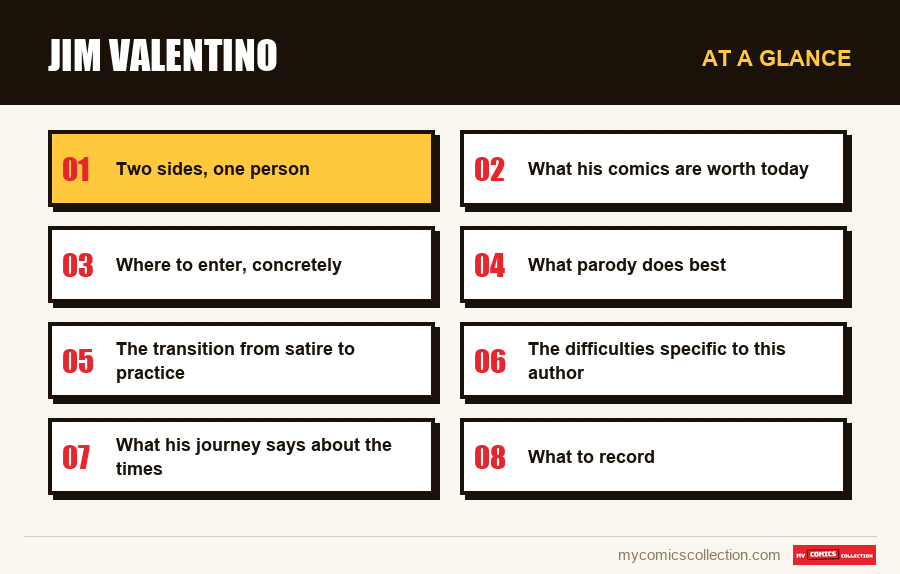
Two sides, one person
His career can be read in two stages which have almost nothing in common, and confusing the two is the source of all disappointments.
The first stage is that of the independent author. In the 1980s, he wrote and drew a superhero parody published by a small self-publishing house belonging to another author: the same one which then published an animal series which has since become a monument of the genre.
The second phase is that of the founder. At the beginning of the 1990s, he was part of the group of authors who left the big houses to found their own structure, and launched a superhero series there.
Between the two, the register changes completely: from a satire of the genre to a practice of the genre. A reader who discovers the second side gets an entirely false idea of what this author is capable of.
What his comics are worth today
Everything that follows comes from a fixed price listing report: these are asking prices observed on August 29, 2026, counted separately for raw copies and for certified copies. A seller displays an expectation, not a transaction.
La série de super-héros
Brut : 153 annonces, de 1,22 à 200,00 $demandés, médiane 7,00 $. Gradé : 4 annonces only, from $64.99 to $120.00.
A median lower than the current cover price of a new issue.
The 1980s parody
Brut : 176 annonces, de 1,39 à 67,99 $demandés, médiane 7,99 $. Gradé : une seule annonce, à 59,99 $.
Abundant supply, non-existent certified market, stable and low prices.
The relationship between the two
The medians are practically identical: $7.00 and $7.99: even though forty years, two registers and two diffusion scales separate them.
The market does not distinguish the two sides.
Lowest entries
Des numéros à $1.22, 1.25 and $1.39 requested, described in good condition. These are ordinary issues of both series, not damaged copies.
Why is it so cheap?
The explanation lies in a conjunction that few authors know, and it is not a judgment on the quality of the work.
Print runs in the early 1990s were considerable. The period saw massive printing, a significant portion of which has never been read and still lies dormant. The supply therefore remains overabundant thirty years later.
The recognition went to the role, not the work. This author is cited as a founder, rarely as a designer. Its notoriety does not carry over to its own pages, which is the opposite of the usual situation.
The parody suffers from a genre handicap. A satirical work does not age well with buyers, who classify it as minor: an appreciation which does not stand up to reading, but which weighs on prices.
The result is a situation favorable to the reader: the entire work is accessible for the price of a few modern issues, without any rarity complicating the search.
Don't look for a speculative first number here. The certified market is almost non-existent: four classified advertisements on one side, only one on the other.
This is the mark of a readers' market, where prices reflect usage. Buy to read, by grouping your shipments, and the question of value will not arise.
Where to enter, concretely
The recommendation goes against the grain of what we usually read, and it is justified.
Start with the 1980s parody. It is a complete author's work (written, drawn, carried by an identifiable voice) in a short form which requires no commitment. The numbers start at $1.39 and can be read individually.
Continue with the superhero series if you liked the first part. You'll see how an author who spent a decade mocking the genre goes about it when he practices it seriously, which is much more interesting than the series is in itself.
Don't attack in the other direction. The isolated superhero series reads like one production of its time among others, and nothing indicates what makes its author unique.
This order supposes accepting one thing: the most interesting work is the least known, a common situation among authors who become publishers.
What parody does best
It is worth clarifying why this slope deserves the recommendation, beyond its price.
A superhero parody can simply exaggerate: ridiculous costumes, emphatic dialogue, underlined implausibilities. This register is exhausted in a few issues and requires nothing from its author.
The work in question here proceeds differently. He takes seriously the consequences of what gender poses without thinking about it:what an ordinary man does in a world where the powerful fight over his head: and it is from this gap that comedy is born, not from caricature.
This method has a rare property: it ages well. A parody based on the tics of an era becomes illegible when these tics disappear. A parody based on a structural contradiction of the genre remains valid as long as the genre exists.
This is what makes these issues readable today by someone who is not familiar with the mocked productions. They don't require any erudition, just to have a general idea of what a superhero is.
Collecting this series?
Track what you own, what you are missing and what your collection is worth. 7 day trial.
Start my trial →The transition from satire to practice
One point deserves to be developed, because it is the real interest of the second side.
Spending ten years dismantling a genre and then practicing it seriously poses a problem that few authors face. We cannot forget what we have seen: the tricks we have mocked remain visible when we use them.
Two outcomes are possible. Either the author renounces his lucidity and produces an ordinary genre work, hoping that no one will remember. Either it integrates this lucidity, which gives a story conscious of its own conventions and generally darker.
The superhero series launched in the early 1990s leans on the second side, and that's what makes it readable for those who read the parody first. The recurring themes (the legitimacy of violence, the cost for those who asked for nothing) are exactly those that the satire pointed out ten years earlier, this time treated without comic distance.
In isolation, this series seems serious to the point of severity. Read in its place in the journey, it becomes an author's response to his own objections, which is infinitely more interesting.
The difficulties specific to this author
Le rôle éclipse l'œuvre
Research on his name traces his editorial career. His own publications are difficult to isolate.
Series that start from one
His superhero series has several relaunches numbered from one, separated by years.
Des crédits partagés
He has signed numerous publications as editor or co-author. The name on the cover doesn't say what he did.
A plethoric offer
More than three hundred advertisements are circulating for two series. Sorting takes more time than finding.
Purchasing precision arises from this abundance. With more than three hundred ads in circulation for just two series, sorting consumes more time than searching, and there are many sellers offering complete lots. In this area, aiming for a lot from the outset rather than isolated numbers saves on both counts, the unit price and the shipping, which is rarely the case elsewhere.
What his journey says about the times
Its trajectory illuminates a broader movement, and that is perhaps what makes it most interesting.
An author who begins in the most artisanal self-publishing, published by a colleague who prints his books himself, finds himself ten years later co-founder of a structure which weighs against the big houses.
This route is not an isolated individual climb: it is the scaling up of an idea already present in the independent circuit of the 1980s, that authors can own what they create.
The difference lies in the means, not in the principle. What a few authors did with confidential prints, a group later did with national distribution.
Reading his first publications is therefore reading the documented beginnings of a change of which we know the outcome. Few $1.39 items offer this.
What to record
On this author, the essential field concerns the nature of his contribution, a question which arises for almost no other.
Their exact role on each publication: full author, designer, screenwriter, editor, or simple mention. His name appears on hundreds of covers for entirely different reasons, and a listing that notes only "Valentino" doesn't distinguish a book he designed from one he supervised.
This is the only way to constitute a coherent whole rather than an accumulation of titles linked by a name.
The belonging series and its relaunch, since several successive series start from number one years apart.
These two fields answer what this case specifically asks: what is this author the author of, in a bibliography where his name means four different things?
Frequently asked questions
By the 1980s superhero parody, starting at $1.39 asking. It is a complete author's work, in a short form which does not commit to anything, and this is where his own voice is best heard. His series Image read in isolation resembles one production of his time among others.
Three causes combine: considerable print runs in the early 1990s, some of which have never been read, recognition given to its role as publisher rather than to its pages, and the commercial handicap suffered by satirical work. The medians noted are $7.00 and $7.99 requested.
Nothing indicates this. The certified market is almost non-existent (four graded ads in one series, only one in the other) which is the mark of a readers' market where prices reflect usage. Buy to read by consolidating your shipments.
By noting his role on each publication, because his name appears on hundreds of covers for different reasons: full author, designer, screenwriter, editor, or simple mention. A sheet that only notes its name does not distinguish a drawn book from a supervised book.
Not for the 1980s parody, predated by ten years and perfectly self-contained. It is useful, however, for the following series, the interest of which lies largely in seeing an author who has spent a decade mocking the genre take it when he practices it seriously.
Author, designer, or publisher?
His name appears on hundreds of covers for four different reasons.