On the booklets from the early 1990s linked to this character, the designer's name appears in almost all the ad titles, often before that of the hero and sometimes alone. It's not a prestige bonus: it's an identifier. It designates a period, a style and a family of series that nothing else allows us to name with a single word. The advertisement statement from August 29, 2026 confirms this in both directions: of the five cheapest proposals, four have the designer's name in their title, and yet the middle of the uncertified statement remains at $7.00 asking. The name is used to find, not to justify an amount.
When you open a page of results on these booklets, one thing jumps out at you above all the rest: it is not the numbers which structure the titles, nor even the name of the character. It's an author's surname. He opens the titles, he closes them, he sometimes completely replaces the mention of the series. A reader who discovers this corner of the market first believes in a prestige transaction: the seller would highlight a renowned signature to inflate the perceived value. This is a seductive reading, and it is false in most observed cases. The name does not serve as a commercial argument. It serves as a classification label.
This distinction is not a subtlety of language. It completely changes the way we must search, compare and evaluate. An identifying name demarcates a set: it says “this is the period, style and family of titles this is about”. A supplement name, on the contrary, claims to add something to the price. The two use the same letters, are written in the same place in the title, and yet have nothing to do with each other. The August 29, 2026 statement on the 1991 series launch makes it possible to make ends meet: 159 proposals without certification, distributed between $0.99 and $85.00 requested, with a midpoint at $7.00; and, apart, 16 proposals carrying a verified copy, between $29.99 and $250.00 asking, midpoint at $64.00. Let's remember what these figures are: amounts claimed by sellers on a given date, not concluded transactions.
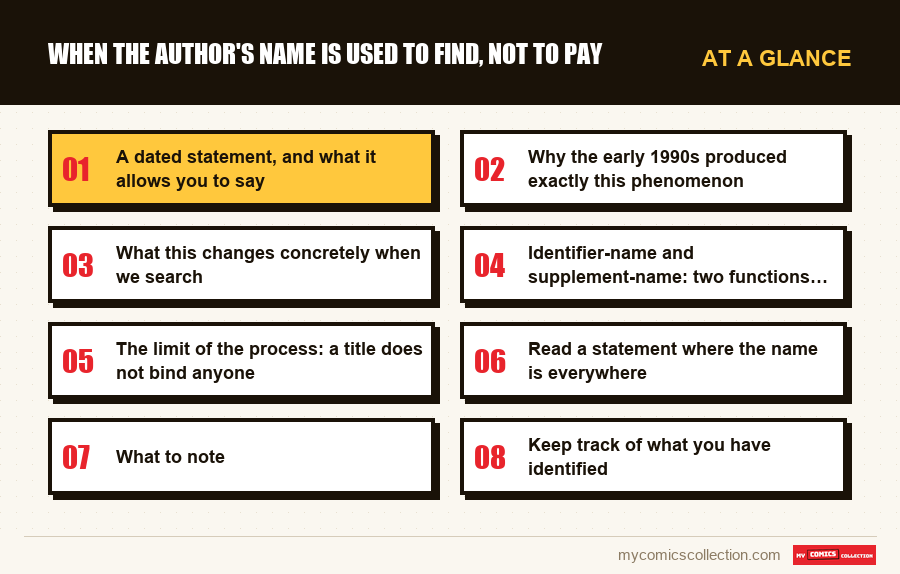
A dated statement, and what it allows you to say
Before any interpretation, it is necessary to state precisely what has been observed and refuse to make it speak beyond that. On August 29, 2026, a search for the 1991 series launch related to this character returned 159 entries without certification. The amounts requested range from $0.99 to $85.00, and the median value is $7.00. Counted separately, because they described a different object, 16 proposals carried a verified copy: from $29.99 to $250.00 asking, with a midpoint at $64.00. These four limits and these two medians are the entirety of what the survey establishes. Everything else is reading, and should be phrased as such.
The uncertified maximum at $85.00 says nothing about the market. An isolated amount at the top of a list reflects what a seller hopes to get, never what a buyer has agreed to pay. It should be treated as a point of noise, not as a signal. The median is robust: it indicates where the bulk of the offer is located, independently of the two or three extreme announcements that attract the eye. On this statement and on this date, the bulk of the uncertified supply remains very low.
Three qualitative observations, taken from the same survey, carry the entire article. The first: of the five cheapest proposals on the list, the name of the designer appears in four titles, and in two of them it is placed before the name of the character. The second: one of these titles offers a multiple selection of more than a hundred issues of the same series, a set designated not by a complete title but by the name of the designer accompanied by a range of years. The third: despite this omnipresence of the name, the median of the statement remains at $7.00. On this statement and on this date, the name is therefore everywhere in the titles without being associated with a high price level.
Why the early 1990s produced exactly this phenomenon
A style recognizable in a second
The generation of cartoonists who dominated this period imposed an immediately identifiable visual grammar: exaggerated anatomy, frontal cover poses, aggressive cutouts of boards, dense hatching. A reader recognizes the period without reading a single credit. A seller needs a word to designate this visual evidence. The name of the designer is this word.
Authors who have become arguments in their own right
This is the period when the graphic signature ceases to be a technical mention at the bottom of the cover to become a reason for purchase announced in advance. Publishers communicate about authors as if they were headliners. The public internalizes the reflex, and the second-hand market inherits it: thirty years later, we continue to search by the name because that is how we learned to talk about these titles.
Series launched around a name, not a concept
Several titles from these years do not have an identifiable pitch: their commercial promise is the creative team itself. The concept is the author. When the product is built like this, it makes sense that the vocabulary of the second-hand market aligns with it. We cannot summarize by a theme a series which did not have one; it is summarized by a signature.
A family of titles without a collective name
At this time, this character crosses a network of series, mini-series and crossover appearances which bear no common official name. No label, no collection, no editorial term covers everything. The name of the designer is the only shortcut available to designate this nebula in a word, and it is used for lack of anything better as much as out of conviction.
These four factors reinforce each other. A visible style, star authors, series designed around them, and no word to say it all: the proper name fills a lexical void. It does not replace the title out of snobbery, it replaces it because no title covers what the seller wants to describe. Actionable fact number two in the survey is the clearest demonstration of this mechanism: a multiple selection of more than a hundred issues from the same series, presented under the name of a designer and a range of years. An author name serves as a set delimiter, exactly as a collection reference would. It does not qualify a copy, it limits a perimeter.
The test is simple. If you remove the designer's name from the title and the ad becomes impossible to place, we no longer know what period or family of titles it is, then this name functioned as an identifier. If the ad remains perfectly clear without it, the name was there to add value.
Applied to the least expensive securities from the August 29, 2026 statement, this test leans massively towards the first side. Four of the five lowest proposals have the name, two place it before the character, and yet they are, by definition, the least expensive on the list. A price argument does not behave like this.
What this changes concretely when we search
Searching for the character brings back little
A query based solely on the hero's name misses all the ads that omitted it in favor of the signature. This is not an engine defect: the sellers really wrote something else. You are looking for a character string that is not in the targeted titles.
The name encodes a period
Adding the signature to the request amounts to applying an implicit temporal filter. She cuts out in the catalog a slice of years that neither a title nor a number delimits so quickly. This is the function fulfilled, in the statement, by the title which associates a name with a range of years.
The titles are free text
No standard constrains the writing of an ad. The spelling varies, the order of the words varies, the signature is sometimes alone and sometimes joined. Effective research tests multiple formulations rather than assuming only one is correct.
The lots are designated by name
Sets of several dozen or hundreds of numbers are almost always named by the author rather than detailed. Anyone who ignores this reflex will never see these lots appear in their results, even though they often constitute the densest offering in the segment.
The number alone is ambiguous
The same number exists in several different series of the same family, and nothing in an abbreviated title distinguishes them. Without complete identification of the series, an isolated number does not designate a single object: it designates several possible objects, at unrelated price levels.
The announced style is not the content
An announcement can invoke a signature for a cover, an isolated plate, or a simple graphic relationship. The title then describes an impression, not a verifiable credit. This is the main source of confusion in this segment.
Identifier-name and supplement-name: two functions that do not overlap
The most costly confusion consists of believing that the presence of an author's name in a title indicates a high price. The two uses are distinct and they must be separated methodically. The identifier name is used to find: it answers the question “what are we talking about”. The supplement-name is used to justify: it answers the question “why this amount”. The first is a navigation tool, the second a sales argument. Nothing requires the two to coincide, and on this segment they rarely coincide.
The reading of August 29, 2026 makes this dissociation observable. If the name functioned primarily as a supplement, one would expect to find it concentrated toward the top of the distribution of requested amounts. The opposite appears: it is present in four of the five lowest propositions, and twice in the opening position of the title. In other words, it occupies the most visible place in the cheapest ads. A seller who would like to promote his copy would not display it like this on an offer for a few dollars; he displays it because that is simply what these fascicles are called.
The third actionable fact closes the demonstration: the median of the uncertified statement remains at $7.00. On this statement and on this date, the name is therefore everywhere in the titles without being associated with a high price level. We must resist the temptation to draw a general law on the value of signatures: that is not the subject, and that would be going beyond the data. What we can say is narrower and more useful: about this period and this character, the omnipresence of the name is a matter of vocabulary, not pricing.
The practical consequence is clear. Seeing a signature in a title should not trigger any price anticipation, either upwards or downwards. It must trigger an identification question: what series is it, what number, in what condition, and does the credit announced relate to the inside of the booklet or only to its cover. These four questions decide the amount; the name only brought you before the object.
The separation also applies in the other direction. An announcement can perfectly mobilize a signature as a real supplement: when the print in question is objectively rare, when the copy is verified, when the entire series is built around a specific creative team. These cases exist. But they are recognized by something other than the presence of the name, since this name also appears in proposals for less than a dollar. They are recognized by the conjunction of the name and an independently verifiable element.
This is precisely what the second half of the survey shows. The 16 proposals carrying a verified copy range from $29.99 to $250.00 asking, with a midpoint at $64.00. It is not the same population of objects: certification transforms a booklet into an object whose condition is certified by a third party, which changes the nature of what is sold. Comparing these two medians would be like comparing two markets. We keep them separate, and we simply note that verification is a criterion that discriminates: unlike the name, present everywhere.
Collecting this series?
Track what you own, what you are missing and what your collection is worth. 7 day trial.
Start my trial →The limit of the process: a title does not bind anyone
An author's name written in an advertisement title has no contractual value and no guarantee of accuracy. This is free text, entered by a seller who is not required to check their credits. This obvious fact is constantly forgotten, because the presence of a surname gives the title an appearance of documentary precision which it does not have.
The first common difference concerns the scope of credit. A signature may be on the cover alone, while the interior is by another hand. It may concern a handful of plates in a collective booklet. It can designate an inking rather than a drawing, or the reverse. An abbreviated title crushes all these distinctions into a single word, and the buyer reconstitutes them at his own risk.
The second gap is that of influence. During a period when the style was massively imitated, a seller in good faith can use a name to say “it looks like”. The sentence is honest in its intention and misleading in its effect: it places a credit in the title that the booklet does not carry. Nothing visually distinguishes, in a list of results, an exact attribution from a stylistic evocation.
The third difference is due to the batches. When a set of more than one hundred issues is presented under one name and year range, that name obviously does not apply to every issue in the set. It characterizes an era of the series, not all of its content. The title is accurate as a reference and inaccurate as an inventory, and there is nothing dishonest in it, provided you read it for what it is.
The rule that follows from these three differences is simple: the name is used to arrive at the ad, never to conclude. Once in front of the sheet, the identification must be repeated from the series, the number and the edition, relying on the catalog rather than on the seller's wording. If the identification remains incomplete, we do not fill the gap with a hypothesis: we dismiss the ad or we ask the seller the question. A partial identity is always better than an invented identity.
Read a statement where the name is everywhere
When the same word appears in almost all the titles of a segment, it loses all sorting ability. This is an elementary statistical property: a universally present criterion separates nothing. We must therefore, in this segment, look elsewhere for the variables that really explain the difference between a proposal costing less than a dollar and another costing several dozen.
The first of these variables is the state, and who certifies it. The August 29, 2026 statement clearly separates the two populations: without certification, 159 proposals between $0.99 and $85.00 requested, middle at $7.00; with verified copy, 16 proposals between $29.99 and $250.00 requested, mid at $64.00. These are two different offers, with different buyers, and there is nothing to infer from one to the other.
The second variable is the nature of the object sold. A batch of more than a hundred issues and an isolated issue do not belong to the same logic, even if they appear side by side in the results. The displayed price of a lot cannot be compared to anything until it is compared to what it actually contains, which the title never fully says.
The third variable is identification accuracy. An advertisement which names its series, its number and its edition describes an object; an ad that simply contains an author's name and a decade describes an atmosphere. Both sell, but only the first can be compared to another. The apparent dispersion of a survey often comes from this: we compare things which are not described at the same level of detail.
The fourth variable, finally, is time. A statement is a snapshot of ad stock as of a date. It describes what sellers were asking for on August 29, 2026, nothing more. It does not allow any statement about a movement, either in one direction or the other, and a single measurement cannot by construction say anything about a trend. Any sentence that would turn these numbers into a trajectory would be an invention.
What to note
The name of the designer is your entry point, not your criterion. Over this period and this character, the signature is the word by which the market designates a family of securities which has no other name. Use it to display advertisements that the hero's name does not bring up, and in particular prizes, which almost always appear like this. Then forget about it when evaluating: it is present in four of the five cheapest proposals in the August 29, 2026 statement, which disqualifies it as an indicator of value in this segment.
A title that combines a name and a range of years describes a perimeter, not an item. This is exactly the structure of one of the proposals noted, which covers more than a hundred issues of the same series. Treat these announcements as inventories to open, never as item sheets. The name fulfills a temporal boundary function, and it does not guarantee anything about the content of each of the grouped numbers.
Always check what the advertised credit is for. Cover alone, interior boards, inking, or simple stylistic kinship: a title makes none of these distinctions, and nothing obliges a seller to make them. This verification is the only real work required by an ad in this segment, and it is the one that the reassuring presence of a surname most often causes to be skipped.
Never mix certified proposals and others in the same comparison. The August 29, 2026 statement gives an average of $7.00 for the 159 advertisements without certification and $64.00 for the 16 advertisements carrying a verified copy. These are not two levels of the same market but two markets, whose buyers, expectations and guarantees differ. Adding them together would produce a number that describes nothing.
Note in your tracking the name under which you found each piece. Over this period, it is search information in its own right: it will allow you to find the same segment in six months without rebuilding your queries, and to identify advertisements which use the signature as a shortcut rather than as a credit. A collection which keeps track of the vocabulary with which it was constituted can be re-examined much more quickly than a simple list of numbers.
Because it is more discriminating for research. The hero's name refers to decades of publications; that of the designer immediately cuts out a period and a family of series. Sellers place at the top the word they think will be typed by the buyer. On the statement of August 29, 2026, two of the five cheapest proposals thus open their title with the signature.
Not on this statement. The name appears in four of the five lowest bids, and the middle of the 159 non-certified listings is $7.00 asking on August 29, 2026. In other words, the name is everywhere in the titles without being associated with a high price level in this segment and on this date. This observation is dated and local, it cannot be transferred elsewhere.
Coming out of the ad. The title is free text and does not bind anyone; it is therefore necessary to identify the series and the number, then compare the credit with the catalog. If the advertisement does not allow this identification (incomplete series, ambiguous number, unspecified edition) it is better to ask the seller the question than to fill the void with a guess.
They are worth what the set really contains, which a title never fully says. The name and the range of years serve as a period marker, not as an inventory: the signature does not apply to each of the grouped numbers. These lots deserve to be opened and detailed before any comparison with booklets sold individually.
No, it reflects the certification. The 16 proposals carrying a verified copy ranged from $29.99 to $250.00 asked on August 29, 2026, with a midpoint at $64.00, compared to $7.00 for the other 159. What separates these two sets is the attestation of status by a third party, a criterion which really discriminates: whereas the name, present on both sides, separates nothing.
Keep track of what you have identified
In a segment where the same name opens almost all the titles, the only thing that really belongs to you is your own identification: what series, what number, what edition, in what condition. My Comics Collection saves this information piece by piece, along with your research notes, so you never have to rebuild the same work twice.