The marriage of The Wasp and her costumed partner, recounted in Avengers No. 60, is sold as an identifiable booklet: the ads name it by the event, not by the plot. Published on August 30, 2026 on a general auction site in the American market, this booklet is the subject of 28 unverified advertisements, amounts claimed by sellers and no sales concluded, between $7.15 and $110.00, with $30.16 in the middle of the pack. Copies accompanied by an external verification are counted separately: five advertisements only, from $69.00 to $235.00. Five observations do not allow any conclusion on this segment. The curiosity of this statement lies in one line: the 2018 reissue in very good condition is priced at $7.95 and $9.31, when the original copy in 0.5 condition is priced at $7.15. The reprint costs more than the original.
A collection is rarely built on a single category of events. We start with the first appearances, then we discover that the market names and searches for other moments: costume changes, handovers between bearers of the same identity, deaths, and, more discreetly, relationship events. Marriages, breakups, births, revelations of identity within a couple: these episodes form a coherent family, with its own codes of description and its own buyers. The Wasp offers the clearest case of this family, because its marriage is a dated event, located in a specific number, and cited as such in the title of the advertisements.
What makes this survey interesting is not the modest price level, but what it reveals about the functioning of the market. On the same page of results, two objects that bear the same story coexist: the period booklet, very damaged, and its recent, impeccable reissue. The second is claimed more expensive than the first. This is not a market anomaly, it is proof that we are looking at two different goods sold under a common keyword. Understanding why allows you to make an informed choice instead of being subject to coincidence.
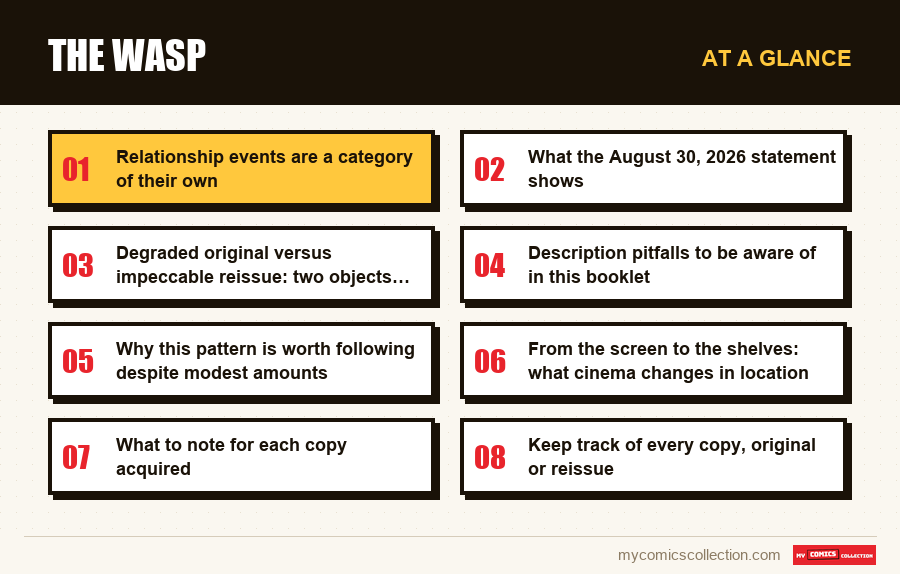
Relationship events are a category of their own
When a seller writes the title of an ad, he chooses the most recognizable hook. In this booklet, the hook chosen is systematically marriage: the five advertisements noted cite it, in one wording or another. None mentions a first appearance, none mentions a death. The relationship event is enough to identify the number, which means that the market recognizes it as having a benchmark value. This is the first lesson, and it is structural: marriages, breakups and births constitute a named motif, in the same way as the beginnings of characters, with a stable vocabulary that allows them to be searched for.
However, this recognition does not translate into high amounts. Of the 28 unverified listings found on August 30, 2026, the lowest claimed amount is $7.15 and the middle of the pack is $30.16. In other words, a reader who wants this episode can find it for a few dollars, and a collector who wants a decent copy remains within a very affordable range. The conclusion to be drawn from this is twofold: the market knows how to identify these events, and it does not pay dearly for them. The two facts go together and do not contradict each other: being sought-after and being expensive are two distinct properties.
The maximum of $110.00 observed for unverified advertisements does not change this observation. An isolated cap expresses what a seller hopes to get, not what a buyer has agreed to pay. None of these amounts are transactions: they are posted requests, entered on a given day. And since the reading was only done once, it says nothing about an increase or a decrease. A single photograph does not show movement; We would need at least two measurements spaced out over time to speak of evolution, and that is not what we have here.
For the collector, the practical interest lies elsewhere. A recognized but inexpensive category is exactly what is needed to build a coherent collection without committing large amounts of money. You can put together several relationship events across different series, each for the price of a meal, and get a whole that says something: where the same amount of money placed on a single major first appearance would buy only a fragment.
What the August 30, 2026 statement shows
28 unverified ads
On the query associating the character, the number and the word designating marriage, 28 advertisements without external verification were noted. Lowest amount claimed: $7.15. Middle of the pack: $30.16. Highest amount claimed: $110.00. These are seller requests posted that day, never closed sales.
5 verified ads, counted separately
The copies accompanied by verification by an external organization are isolated from the rest: five advertisements only, from $69.00 to $235.00, with $160.60 as the central value. Five observations is too few to say anything solid about the price level of this segment. We note the figure, we refuse to deduce a rule from it.
An original in condition $0.5 to $7.15
The lowest priced listing describes the original issue in the lowest declared condition on the scale. It is a very damaged period copy, and it is also the cheapest entry ticket to owning the object published at the time rather than a reproduction.
A 2018 reissue at $7.95 and $9.31
The same story republished in 2018, described in very good condition, appears at two different sellers for higher amounts than the defaced original. The consistency between the two advertisements indicates that this is not an isolated error but rather the price asked for this product.
Taken side by side, these four findings paint a clear picture. The booklet is easy to find, inexpensive in its defaced original version, and competed with a recent reproduction which costs approximately the same price. The difference between the unverified announcements and the five verified announcements is apparently significant, but the number of the latter is so small that it would be imprudent to see it as a measure of a gap. Five listings can be five exceptional copies, five optimistic sellers, or both.
All amounts cited here were recorded on August 30, 2026 on a general auction site covering the American market. These are amounts requested by sellers in current listings, not completed transactions. A price displayed is only binding on the person who displays it.
This survey was only carried out once. It describes a status of announcements on a date, without any indication of trend. Any reading in terms of an increase or decrease would be an extrapolation that the data does not support.
Degraded original versus impeccable reissue: two objects, two audiences
The gap that is obvious deserves to be addressed calmly. An original copy in 0.5 condition is an object that has been through its life: detached or very worn cover, weakened paper, multiple folds, sometimes missing pieces. It is handled with care and reads poorly. A 2018 reissue in very good condition is a new booklet: it opens without fear, reads comfortably, stores and lends itself. They are two different goods that only have the narrative content in common.
Therefore, the fact that the second is more expensive than the first is not absurd. It's for someone who wants to read the story or have it on a shelf in good looking condition. The first is aimed at someone who wants the object published at the time, with all that implies in terms of materiality and age, and who agrees to take it in the worst condition available because that is the only price level that suits them. Each audience pays for what interests them, and it turns out that the two prices intersect.
This crossover is only possible because the 0.5 original is really on the floor. As the condition of a vintage copy improves, it moves away from and well above the reissue price-this is suggested by the amounts higher up in the statement, with listings for originals at $11.50 and $18.00 remaining modest but already exceeding reprints. The crossover point is therefore narrow, located exactly where the original state becomes so bad that it no longer competes on the field of presentation.
This scenario is the best practical exercise there is for deciding what to buy. The question to ask yourself is not “which one is cheaper”, since they are on the same level, but “what exactly do I want”. If the goal is to read the episode and keep it readable, re-editing wins hands down. If the goal is to own a period issue, the 0.5 original is the least expensive entry point into this category of object, and no reissue replaces it.
A third case exists and deserves to be named: that of the collector who wants both. A period copy for the archive box, a reissue for reading. At this price point, double acquisition remains below the central amount of unverified listings, making it a reasonable option rather than an extravagance.
Description pitfalls to be aware of in this booklet
Two ways to name the couple
The announcements sometimes cite the civilian identities of the two characters, sometimes their costumed identities. Research carried out with only one of these formulations misses part of the offer. You must query both, separately, and compare the results obtained.
1968 or 1969 depending on the ad
Two advertisements date the issue to 1968, a third to 1969. The ordinary difference between the date printed on the cover and the actual sale is sufficient to explain this. No one is intentionally wrong, but filtering by year eliminates valid results.
Reissue not indicated at the top of the title
Some reprint announcements state this clearly, others mention it after a long teaser. Reading the entire title, and checking the year of the proposed booklet rather than that of the story, avoids buying a reproduction thinking you are taking an original.
A declared state is not a verified state
On listings without external verification, the condition rating is that of the seller. It can be sincere and remain subjective. The photographs count for more than the figure announced, and the absence of a photo of the back is in itself information.
A serial number alone does not identify anything
The same number exists in dozens of different series. A query for just the number brings back unrelated jumble. The title of the series, the number and the word designating the event must be combined to obtain a usable result.
The event keyword sorts
Adding the term that names marriage immediately restricts the results to the correct issue. This demonstrates that the market has properly integrated this event as an identifier, and it is also the most effective research lever for this type of reason.
Collecting this series?
Track what you own, what you are missing and what your collection is worth. 7 day trial.
Start my trial →Why this pattern is worth following despite modest amounts
A collection item cannot be judged by the unit price of its pieces. Relationship events have a rare quality: they are easy to define, easy to find, and tell something that first appearances do not. A collection of character beginnings is a collection of beginnings; a collection of relationship events is a collection of consequences. It documents what series do with their characters over time, which is an editorial angle as much as a collection angle.
The fact that these numbers remain affordable allows a requirement that expensive parts prohibit: that of condition. When a booklet costs a few dollars, you can reject a mediocre copy and wait for the next one without the wait costing anything. This is the opposite of the logic that applies to rare pieces, where we often accept the available condition due to lack of choice. On this ground, the collector has the luxury of choice.
We must also accept what these data do not say. They say nothing about the real rarity of the booklet, since the number of advertisements at a given moment depends as much on the mood of the sellers as on the availability of the object. They say nothing about the price at which the copies actually change hands. And they say nothing about a possible dynamic, for lack of a second point of measurement. What they establish, on the other hand, is solid: the pattern exists, it is named, it is available, and it is cheap in its ordinary forms.
There remains the verified segment, with its five announcements. It is tempting to compare $160.60 to $30.16 and conclude something about what an external audit provides. This would be a methodological error. Five observations does not constitute a measurement, and there is no guarantee that these five specimens are representative of anything. The honest observation can be summed up in one sentence: the verified segment is too sparsely provided in this booklet for us to be able to talk about it other than by pointing it out.
This reasoning applies beyond this single number. It applies to any relationship event one would want to track, and it is worth applying to other characters to check if the pattern repeats itself. The series companions of La Guêpe naturally offer the first points of comparison, and the hub devoted to Ant-Man key issues like the one who traces the editorial history of the Avengers provide the context necessary to choose the fascicles to observe.
From the screen to the shelves: what cinema changes in location
Cinema adaptations modify the vocabulary of advertisements much more than they modify the prices observed. When a character appears on screen, sellers adopt spellings and phrasings from the film, including designating installments decades old. This is an additional reason to multiply research formulations: the one that worked before an adaptation is no longer necessarily the one that brings the most results afterwards.
On this specific issue, the cohabitation of civilian identities and costumed identities in ad titles relates exactly to this phenomenon. Some sellers describe the couple as cinema audiences know them, others as readers of the time knew them. The two ad populations coexist without overlapping, and only a collector who queries both sees the full offering.
Comparing the published story and its transposition to the screen also has a direct interest for identification: it learns which episodes are cited, adapted or mentioned, therefore which ones are likely to receive a specific announcement keyword. The analyzes devoted to 2018 film versus the original booklets and to that of 2023 facing its raw material are used precisely for this: to identify what has been included and under what name.
However, a precaution is necessary. The fact that a booklet is cited in the wake of a film says nothing about its price. Our unique survey does not allow any before/after comparison, and it would be dishonest to suggest a cause and effect link that nothing here demonstrates. What adaptation definitely changes is the way you search. The rest is guesswork.
What to note for each copy acquired
The exact nature of the relationship event. Write what the booklet actually contains: a marriage, a breakup, a birth, a revelation of identity within a couple. Don’t settle for “key number.” This precision transforms an inventory line into an element of a collection axis, and later allows you to group your issues by motif rather than by series.
The status of the copy: origin or reissue. This is the most important data on this specific issue, since the two versions circulate at the same price level. Note explicitly whether this is the issue published at the time or a later reprint, with the year of the issue you are holding: not the year of the story. Without this mention, your inventory will become ambiguous as soon as you have both.
The printed date that you note yourself. Take the date on the subject, not the title of the ad. You have seen that the sellers sometimes indicate 1968, sometimes 1969, for a perfectly ordinary gap between printing and sale. Your personal statement is the only reliable version, and it will prevent you from propagating a third party's approximation in your own notes.
The condition noted upon receipt, described in your words. A copy announced in 0.5 arrives in a condition that must be checked yourself: cover, spine, corners, folds, paper, missing elements. Record what you see rather than the seller's figure. On a reason where the condition entirely determines the price difference with the reissue, this description is better than a note reproduced as is.
The price paid, including shipping, and the date of purchase. On booklets costing a few dollars, shipping often represents a major portion of the actual cost, and a purchase price without shipping is a misleading figure. Add the date: it is this which will one day give meaning to your figures, when several purchases spaced over time will finally allow what a single reading never allows, namely observing a movement.
Because it is sold to another audience. The 2018 reissue priced at $7.95 and $9.31 is described in very good condition: it can be read, stored and presented without precaution. The original marked at $7.15 is in 0.5 condition, the lowest of the scale, therefore very degraded. The second has its seniority, the first its ease of use. Two distinct goods can perfectly overlap in price.
No. All figures in this article come from current advertisements noted on August 30, 2026 on a general auction site in the American market. These are amounts claimed by sellers, not completed transactions. A displayed amount expresses an expectation; it does not prove that a buyer accepted it.
Nothing solid. Five observations are too small to establish a price level, and the range noted: from $69.00 to $235.00, with $160.60 in the center: may reflect five particular situations rather than a market reality. The figure can be noted, it cannot be concluded.
No, and no one is at fault. The booklets had a date printed in advance of their actual sale, and sellers retain one or the other depending on their source. The only practical effect is that a filter by year eliminates valid advertisements: it is better to search without date constraints, then check the object yourself.
By combining the title of the series, the issue number and the word designating the event, then repeating the operation with the other way of naming the characters. On this issue, the advertisements sometimes use civilian identities, sometimes costumed identities: questioning a single wording leaves part of the offer invisible. The number alone is useless, because it exists in countless series.
Keep track of every copy, original or reissue
On a ground where the reprint and the period booklet sell at the same price, an inventory which distinguishes the two is better than an approximate memory. Note the status, the observed condition, the date printed and the price including shipping: this is how a series of isolated purchases becomes a readable collection.