A series does not publish a single series of issues: alongside the current numbering, it publishes annual issues which start from one and are counted separately. The number 13 can therefore designate two different objects published under the same title, years apart, and nothing separates them except an abbreviation of two or three letters stuck in front of the number. The survey of advertisements carried out on August 30, 2026 around the first appearances linked to The Wasp shows this collision at work: among the five cheapest proposals, two are annuals and none is the issue sought. For a collection, the consequence is direct: the type of publication must occupy its own field, otherwise two distinct copies overlap and the list believes it has what it does not have.
We like to imagine that a series of comics advances in a straight line: a first issue, then a second, and so on until publication stops. The number then becomes a natural key, an identifier that we write down without thinking on a sheet or in a spreadsheet box. This representation is false as soon as a publisher decides to publish, in addition to the monthly schedule, thicker issues scheduled once a year. These additional publications are not inserted into the existing suite: they open their own counter, which starts at one and progresses at its own pace. From this point on, the same title hosts two regularly intersecting number sequences, and a "number 13" ceases to be a sufficient designation.
This ambiguity is neither exotic nor marginal. It manifests itself as soon as you type a request on a general auction site, where sellers copy by hand wordings inherited from their own notes. The statement from August 30, 2026 gives a clear illustration of this: when searching for the first appearance linked to The Wasp, the cheapest results do not contain any copy of the issue in question, but two annuals from the Avengers series, each bearing a number already used by the main numbering. No search by number clears up this confusion, because the searched character string is actually present in both cases. You have to read the entire wording, spot a tiny abbreviation, and know what it means.
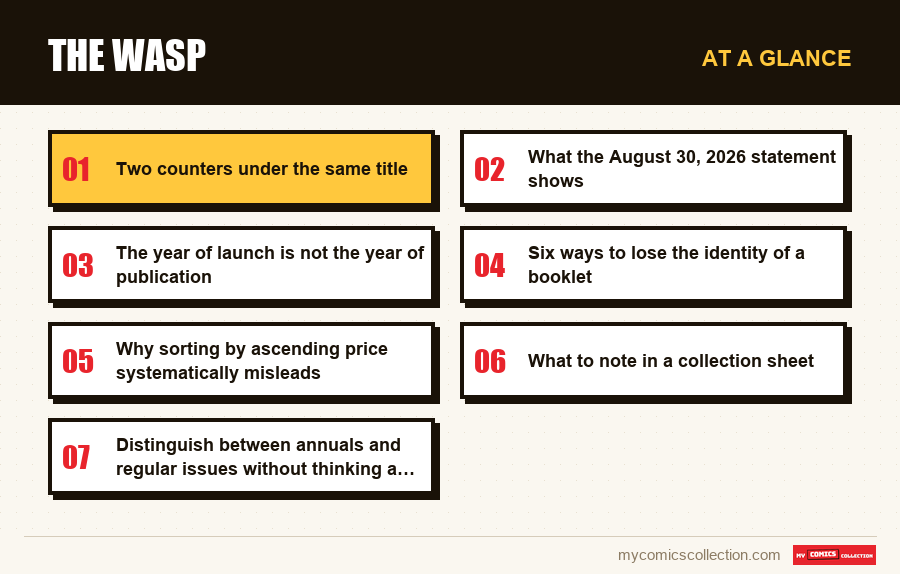
Two counters under the same title
The mechanics are simple to explain and formidable to manage. A series launched on a given date advances with its current numbering. A few years later, the publisher added an annual publication: an elongated format booklet, published once a year, which belongs to the same series but receives its own number. This annual issue starts at one. It then progresses by one unit per year, while the main numbering advances by twelve notches at the same time. The two sequences never come together but constantly overlap: each number reached by the annual counter has already been used, years earlier, by the monthly counter.
This is exactly what the reading shows. Two $2.50 ads designate issues from the Avengers series launched in 1963, one bearing the number 13 and the other the number 18. Neither belongs to the current series: they are annual issues, indicated by a three-letter abbreviation placed before the number. In the same list, a third advertisement at $2.40 designates an issue of the main numbering of this same series, number 178. The three descriptions share the title, the publisher and the year of launch. Only the presence or absence of the abbreviation distinguishes them.
This abbreviation is the totality of the discriminating information. It fits in two or three characters, it is placed before the number, it is not highlighted, and it has no reason to survive a copying operation. A collector who enters his acquisitions in the evening, from a receipt or a photo, will remember the title and the number. The abbreviation disappears. The issue then becomes indistinguishable from another issue in the same series, and this confusion can only be detected by taking the physical object back in hand.
It should be added that this second sequel is not the only one. Other formats go beyond the usual rhythm: special issues, offprints, publications on the occasion of an event. Everyone can open their own meter or borrow a hybrid designation. The reasoning developed here for annuals applies word for word for these formats: it is the type of publication, and not the number, which carries the distinction.
What the August 30, 2026 statement shows
160 regular ads, median $18.00
The query for the Wasp's first appearance in the 1963 Avengers series goes back 160 unverified listings, with a low of $1.99, a median of $18.00, and a single high of $3,600.00. These amounts are those that sellers requested on August 30, 2026; none correspond to a completed transaction, and a statement taken on a single date does not describe any market movement.
33 verified ads, counted separately
The copies passed by the verification organizations form a separate group: 33 advertisements, from $37.50 to $44,000.00, with a median of $680.89. Thirty-three is a low number; it indicates the position of a handful of sellers at a given time and is not sufficient to establish a price level for this segment.
Two annuals in the top five places
The least expensive advertisements include two annual issues of the same series, bearing the numbers 13 and 18, each at $2.50. They go back because their wording contains the title and year of launch sought. They have no relation to the copy in question and say nothing about it.
None of the five cheapest ads are the booklet
In addition to the two annuals, the lower list contains a shop announcement describing the entire series rather than a copy, a booklet of the main numbering published in December 1978, and an issue of a completely different series, the X-Men series also launched in 1963. Five results, five foreign objects in the search.
The displayed minimum of $1.99 is therefore not the low price of the item sought: it is the price of a store ad which does not describe any specific item. A lower limit built on an object which is not the one we are looking for does not provide information on anything. The same goes for the top: an isolated amount at $3,600.00 on the ordinary side, or at $44,000.00 on the verified side, reflects the expectation of a particular seller and not an observed level. These two extremities must be excluded from any reading, not because they are improbable, but because they each only rest on a single line.
The gap between the two medians: $18.00 on the regular ads side, $680.89 on the verified ads side: reads the opposite of what intuition suggests. It does not measure the premium that verification would bring to a given copy. It measures the fact that the ordinary segment, cluttered with annuals, issues of other series and shop announcements, simply does not contain the issue sought. The lower median describes the intruders, not the object.
It should be added that the 33 advertisements verified are too few to draw a conclusion. On a workforce of this order, one or two optimistic sellers are enough to move the median. This figure indicates where a few requests stand on August 30, 2026, nothing more.
The year of launch is not the year of publication
A second trap runs through the entire survey, and it is more insidious than that of annuals because it concerns information that everyone thinks they understand. The year 1963 appears in almost all of the texts cited. It does not designate the year of manufacture of the example offered: it designates the year of launch of the series. It is a naming convention, a way of distinguishing a series from another series with the same title but launched on a different date.
The demonstration is provided by the statement itself. A wording announces both the series launched in 1963 and a copy published in December 1978. The two dates coexist in the same line, and only the second describes the booklet that the seller will send. Another wording mentions the X-Men series launched in 1963 for an issue published much later. The year of launch is an attribute of the series; the year of publication is an attribute of the copy. To confuse them is to believe that all the issues in a series of several hundred issues came out in the same month.
This confusion produces very concrete collection errors. A collector who notes “1963” in a “year” field for a 1978 copy produces a record that is consistent in appearance and false in practice. It will remain so: nothing in the current use of the list will contradict it, since the title, number and series are correct. The error is only revealed when you want to sort by period, date an acquisition, or compare two copies of the same number.
The parade consists of an entry rule: two distinct fields, one for the series with its year of launch, the other for the date of publication of the copy. A single “year” field forces a choice, and the choice is almost always made in favor of the year most visible in the wording, that is to say the wrong one. The same reasoning applies to adaptations that put a character forward: guides devoted to 2018 film bringing together Ant-Man and The Wasp or to his sequel released in 2023 refer to booklets published decades earlier, under series whose year of launch has nothing to do with that of the film.
Collecting this series?
Track what you own, what you are missing and what your collection is worth. 7 day trial.
Start my trial →Six ways to lose the identity of a booklet
Search by number alone
A request relating to a title and a number goes back indiscriminately through the current numbering issues and those of the annual counter. Both contain the searched string. Sorting by increasing price then brings the annuals, less in demand, before the targeted object.
Take the launch year for the release date
It appears in almost all labels and appears to describe the copy. She describes the series. The survey provides a case where the series launched in 1963 offers a copy from December 1978: fifteen years separate the two dates in a single line.
Lose the abbreviation when recopying
Two or three letters before the number are enough to separate an annual from a current issue. They do not survive a memory entry, nor a partial copy and paste, nor a note taken on a ticket. Without them, the copy becomes anonymous again.
Confusing a store ad with copy
The cheapest ad in the report, at $1.99, describes an entire series offered by a dealer, not an identified issue. However, it occupies first place when sorting by price and sets a lower limit which does not correspond to any purchasable object as is.
Let in another series
An issue of the X-Men series launched in 1963 appears in fifth place in a query about the Avengers. The common launch year is enough to bring it up. A filter built on the year does not protect anything when several series share this year.
Merge two issues into a single line
A collection that only stores the title and number cannot simultaneously host current issue 13 and annual 13. The latter overwrites the former or refuses to be added. In both cases, the list asserts false possession.
Why sorting by ascending price systematically misleads
The most common reflex when faced with a list of advertisements is to sort from least expensive to most expensive and look at the top of the list. This gesture seems prudent: it avoids extravagant requests and gives the impression of hitting the floor price. The August 30, 2026 reading shows why it produces exactly the opposite of useful information. The first five lines bring together a shop announcement, a booklet from another decade, two annuals and an issue from an entirely different series. The sorting did not bring up the best deals: it brought up the objects which are not those we are looking for, precisely because they are worth less.
This bias is structural. A keyword search engine retains everything that contains the requested terms, with no hierarchy between attributes. Sorting by price then orders this mix according to a variable that has nothing to do with relevance. The intruders, less sought after, are mechanically less expensive, therefore mechanically placed at the top. The noisier a query, the lower its floor, and the more attractive it appears.
The practical consequence is that a low price must always trigger an identity verification before being retained as a benchmark. The right question is not “why is this one so cheap?” » but “is it really the same object?” ". In all five cases in the survey, the answer is no, and it fully explains the price difference. No market analysis is necessary: all you have to do is read the wording.
A methodological remark arises from all this. The medians cited above only make sense in relation to what they aggregate. A median calculated on 160 lines, an indeterminate part of which describes other objects, does not measure the price of the issue: it measures the composition of the request. The only honest use of such a figure is to say that it is unusable until the list has been cleaned ad by ad.
What to note in a collection sheet
A “publication type” field separate from the number. Three values are enough to cover the essentials: regular issue, annual issue, special issue. This field does not replace the number, it qualifies it. It is he who allows the annual 13 and the current number 13 to coexist in the same collection without overlapping, and it is he who makes it visible, at a glance, that a title contains two sequences of numbers.
The original abbreviation kept as is. The two or three letters that precede the number in the seller's wording are the only written trace of the distinction. Copying them into a note field, without translating or interpreting them, costs three seconds and allows you to return to a questionable entry months later. An abbreviation reconstructed from memory has no evidentiary value.
Two dates, never just one. The year the series was launched and the publication date of the copy occupy separate fields. The statement provides the counterexample that makes the rule obvious: a December 1978 issue sold under a series launched in 1963. Merging the two into a single “year” field guarantees an error, and that error will never report itself.
Verification status as an attribute, not a price category. Whether a copy has passed through a verification body is a fact to be recorded on the form. But the gap between the 33 verified ads and the 160 others, noted on August 30, 2026, cannot be interpreted as a bonus: the two sets do not contain the same objects. Note the status, yes; deduce a value, no.
The statement date attached to any recorded amount. The figures cited here are amounts claimed by sellers on August 30, 2026, not sales concluded. An amount without its date loses all meaning after a few weeks, and a measurement taken on a single date says nothing about developments. A card which bears a price must bear the day on which it was observed, and the mention that it was a request.
By an abbreviation of two or three letters placed just before the number. In the statement dated August 30, 2026, two advertisements at $2.50 bear this mark in front of the numbers 13 and 18. This is the only element that separates them from the issues of the same number belonging to the current numbering. No other part of the wording (title, publisher, year of launch) differs.
Yes, and this is normal operation as soon as a series publishes annuals. The annual counter starts from one and progresses separately, while the current numbering has already crossed these numbers years earlier. The two suites therefore constantly overlap. This is not a catalog anomaly but a direct consequence of the way the publication is organized.
No, in most cases it designates the year the series was launched. The statement contains a wording which mentions the series launched in 1963 for a copy published in December 1978: the two dates appear in the same line. Reporting the year of launch in a “date of publication” field produces a false record which will never be reported.
Nothing until the identity of the object has been verified. The minimum of $1.99 noted on August 30, 2026 corresponds to a store announcement describing an entire series, not an identified issue. The following four lines are also not the copy you are looking for. A floor built on objects foreign to the request does not provide information on any price level.
No. The difference between a median of $680.89 on the verified side and $18.00 on the regular side does not compare two prices of the same item: the regular segment is cluttered with annuals, issues of other series and boutique announcements. It should be added that 33 announcements constitute too small a number to establish anything, and that these amounts are one-day requests, not sales.
Distinguish between annuals and regular issues without thinking about it
My Comics Collection separates the release type from the issue and records the issue date alongside the series date. An annual and a current issue bearing the same number remain two separate entries, and your list no longer tells you that you have an issue that you have never had in your hands.