The War of Jokes and Riddles reading order covers eight issues of Batman (2016), #25 to #32, published in 2017 and written by Tom King, with Mikel Janín on art and Clay Mann on two issues. Prepare with I Am Suicide (#9 to #13) and then I Am Bane (#16 to #20, #23 and #24, with Annual #1), then read the eight issues of the arc back to back. The series picks up again at #33: no tie-in is required.
Few Batman arcs tell a war through a memory. Here, the story is one long flashback: Batman remembers the time when the Joker and the Riddler fought over Gotham, a year after Zero Year. This article gives you the order to read that conflict with the context that makes it readable, issue by issue, without getting lost in the series' side trips.
As always in this guide, we only state verified facts (creators, issues, dates); the analysis is our own, with no reproduction of protected pages or dialogue.
What to read before
The simplest approach is to start from the launch of the series. The third Batman volume begins in 2016 with Tom King writing, and its first issues are built around three arcs, I Am Gotham, I Am Suicide and I Am Bane, interspersed with shorter stories. The arc we are covering comes right after. Without that first cycle, you will understand the conflict between the Joker and the Riddler, but you will miss what Batman is going through at the moment he remembers it.
Here is the recommended lead-in, from most useful to most optional:
- Batman: Rebirth and Batman #1 to #6 (I Am Gotham): the launch one-shot is co-written with Scott Snyder and links back to All-Star Batman; the next six issues set the tone of the run.
- Batman #9 to #13 (I Am Suicide): Batman's mission against Bane, followed by Rooftops (#14 and #15), a two-parter drawn by Mitch Gerads.
- Batman #16 to #20, #23 and #24, plus Batman Annual #1 (I Am Bane): the end of that confrontation, as the trade paperback collects it.
For the Joker's tone in the continuity that precedes this, our Joker reading guide puts the major milestones back in place, and the page on Death of the Family shows how another creative team handled the character a few years earlier.
You do not need to have read all of Zero Year, but the arc takes place a year after those events: that is the calendar marker the story itself gives, and all you need to know is that Gotham is coming out of a troubled period.
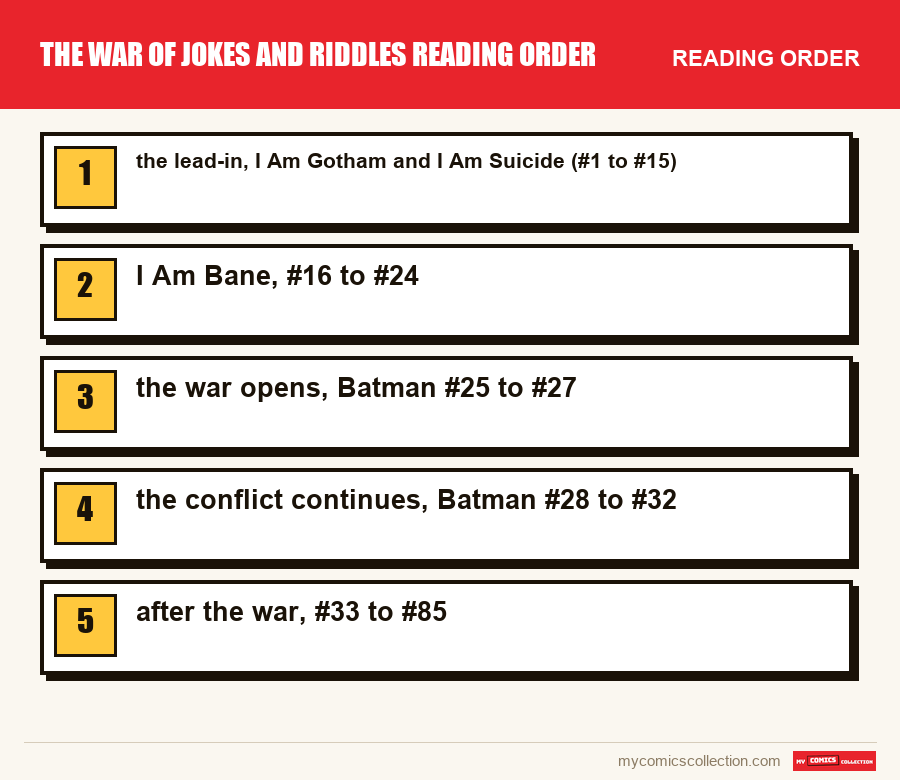
Phase 1: the lead-in, I Am Gotham and I Am Suicide (#1 to #15)
Start with Batman: Rebirth, then Batman #1 to #6. The I Am Gotham trade paperback gathers them in one volume released in 2017. The run then alternates artists: David Finch and Mikel Janín illustrate Tom King's stories in turn, which explains why the art changes from one arc to the next. Note this detail now, because it will stay with you through #32: you will read issues that look very different without the writer ever changing.
Two issues of the series, slotted into this first stretch, belong to the Night of the Monster Men crossover: #7 and #8, written by Steve Orlando and drawn by Riley Rossmo. The I Am Gotham collection stops at #6 and the next one resumes at #9: those two issues are collected separately, in the volume devoted to the crossover. Whether you follow the series in trade paperbacks or single issues, you can read them or skip them, as nothing that follows depends on them.
Continue with Batman #9 to #13: that is I Am Suicide. The volume of the same name, released in 2017, adds Rooftops, issues #14 and #15 drawn by Mitch Gerads, for seven issues in all. For our order, it is the last step before Bane becomes the main adversary.
Phase 2: I Am Bane, #16 to #24
The third collection of the series, I Am Bane, gathers Batman #16 to #20, #23 and #24, as well as Batman Annual #1. Two issues are missing from that list, #21 and #22: together with The Flash #21 and #22, they form the The Button crossover (2017), written by Tom King and Joshua Williamson and drawn by Jason Fabok on the Batman side. It has its own collection, Batman/The Flash: The Button. On the art side, Mitch Gerads draws #23 and Clay Mann draws #24.
To read in publication order, then, go through #16 to #20, then The Button alternating between the two series (Batman #21, The Flash #21, Batman #22, The Flash #22) if you want the crossover, then #23 and #24. Annual #1 is collected in the same volume: read it with this part of the run if you want the complete ending of the confrontation.
This phase is the most important part of the lead-in, because it closes the first big cycle of the King era. When you start #25, you leave the series' present for a retrospective story: the shift is deliberate, and it lands better when the previous cycle has just wrapped up before your eyes.
Phase 3: the war opens, Batman #25 to #27
The arc begins with Batman #25. It is an eight-part story, set a year after Zero Year and told in flashback by Batman. The Joker and the Riddler split up Gotham's territory between them; the city and its inhabitants are caught between the two camps. The reference collection is Batman volume 4, The War of Jokes and Riddles, released in 2017, which gathers issues #25 to #32.
This first third sets up the pieces: the two criminals dig in, alliances take shape, and a younger Batman is still working out how to step in. Mikel Janín draws #25 and #26; #27, drawn by Clay Mann, shifts the focus to Kite Man, a minor figure of the rogues gallery who gives this corner of the universe its strange color.
A reading tip: do not rush. The first three issues read well in one sitting, but #25 is worth rereading after #27, once you have seen every side take shape. If you collect single issues, keep these three together: it is the most memorable sequence when it comes to the setup.
Phase 4: the conflict continues, Batman #28 to #32
The last five issues of the arc, #28 to #32, deepen the conflict. Other Gotham criminals line up behind one banner or the other, and the city pays the price for every escalation. This is not a checklist of appearances: read these issues in order, without skipping, because the story's appeal lies in the sequence of camps and in how Batman gets drawn in.
On the art side, Mikel Janín carries the arc, and Clay Mann draws #30 after #27: two visual breathers in a war with very crisp linework. For collectors of original art or covers, keep this breakdown in mind before buying a single issue.
Issue #32 closes the arc. Once you have read it, you have the whole story: there is no hidden issue in the following episodes that completes it. If you do not want to continue the series right away, you can stop here without frustration.
Do you collect this series?
Track what you own, what you are missing and what your collection is worth. 7-day trial.
Start my trial →
Phase 5: after the war, #33 to #85
The series then continues in order, from #33 onward. Tom King's run goes up to #85, passing through The Rules of Engagement (#33 to #37). Two main milestones mark what follows: #50, called The Wedding, devoted to the marriage of Batman and Catwoman (be careful, this issue contains a major reveal: read it in context), and the City of Bane arc, #75 to #85, which closes the run.
To gauge the difference with another saga of the Dark Knight, compare it with Batman R.I.P., laid out issue by issue; the Batman reading guide places the King era in relation to the other runs.
The tie-ins you can skip
The good news is that there is no tie-in to hunt down: the arc reads entirely within Batman. The two crossovers in the first part of the run, Night of the Monster Men (#7 and #8) and The Button (#21 and #22, with The Flash), are optional for understanding the war, as is the Rooftops two-parter. They give the series life, but the story of the Joker and the Riddler does not lean on them.
Batman Annual #1 is collected with I Am Bane: read it if you want the complete ending of that part, but if time is short, you can get to #25 without that issue. None of these elements is a flaw: they widen the setting without closing the door on the hurried reader.
Single issues or trade paperbacks: how to read it
In single issues, the reading is direct: #25 to #32, eight issues to follow one after the other. The advantage is the pleasure of the serial; the drawback is a series whose issues are spread across several artists, which gives a less uniform look.
In a trade paperback, the The War of Jokes and Riddles volume gathers exactly #25 to #32: it is the most economical choice for reading the whole arc without any numbering questions. For preparation, three volumes come before it on the shelf: I Am Gotham (Rebirth and #1 to #6), I Am Suicide (#9 to #15), then I Am Bane (#16 to #20, #23, #24 and Annual #1). Keep in mind that these volumes leave out #7, #8, #21 and #22: they appear in the Batman: Night of the Monster Men and Batman/The Flash: The Button collections, or in single issues.
Our method: read the arc in a trade paperback, then fill out your collection in single issues for the ones that appeal to you.
The key issues to know
This is not an arc of major first appearances: here, the interest of the key issues comes from their place in the narrative and from the art. The mental picture to keep:
- Batman #25: the opening of the arc, setting up the flashback. It is the natural entry point to start collecting the arc.
- Batman #21: the opening of The Button, the crossover with The Flash drawn by Jason Fabok, an issue that stands apart in the series.
- Batman #27: the chapter devoted to Kite Man, drawn by Clay Mann.
- Batman #32: the conclusion of the arc, useful for completing a sequence.
- Batman #50: the wedding issue, often treated apart from the rest of the run.
Before buying one of these single issues, examine the corners and the spine, identify the exact cover (the arc's cover or a variant), then compare completed sales. On a recent run, the price difference comes down to demand around a specific chapter, not to a supposed print-run scarcity.
Summary: the complete order
- Batman: Rebirth and Batman #1 to #6 (I Am Gotham), 2016-2017.
- Batman #7 and #8 (Night of the Monster Men), optional.
- Batman #9 to #13 (I Am Suicide).
- Batman #14 and #15 (Rooftops).
- Batman #16 to #20 (I Am Bane, first part).
- Batman #21, The Flash #21, Batman #22, The Flash #22 (The Button), optional.
- Batman #23 and #24 (I Am Bane, continued), with Batman Annual #1 collected in the same volume.
- Batman #25 to #27: opening of The War of Jokes and Riddles.
- Batman #28 to #32: the rest and the end of the arc.
- Batman #33 and onward: the rest of Tom King's run, with #50 and City of Bane (#75 to #85).
Frequently asked questions
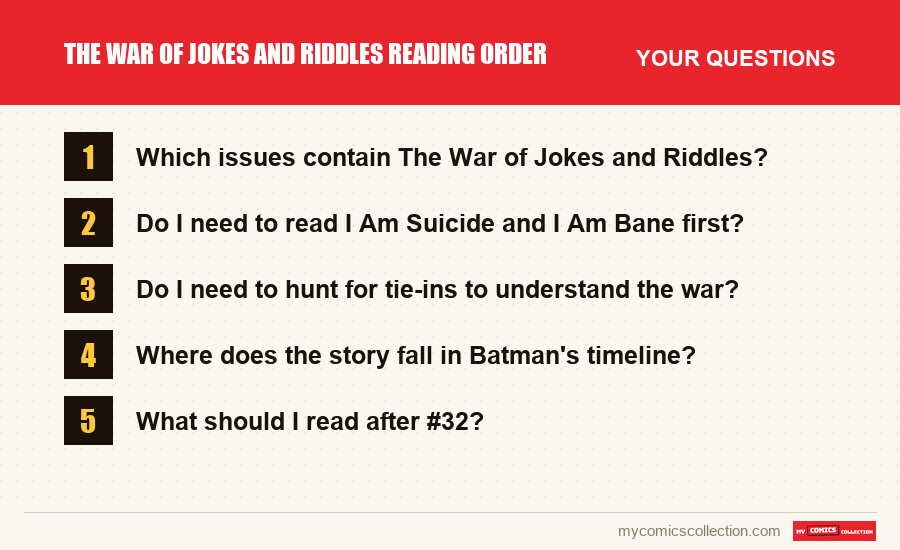
The arc occupies Batman (2016) #25 to #32, eight issues published in 2017. It is collected in the fourth volume of the series, which carries the title of the arc. Tom King writes it; Mikel Janín draws the war, and Clay Mann takes over for #27 and #30.
It is not mandatory to follow the war itself, which is told in flashback. But those two arcs (#9 to #13, then #16 to #20, #23 and #24) close the first cycle of Tom King's series: reading them first gives the arc its context and its tone within the continuity of the run.
No. The arc reads in the main series only. The detours at the start of the run, such as the Night of the Monster Men and The Button crossovers, do not affect your understanding of the war between the Joker and the Riddler.
It takes place a year after Zero Year, but Batman tells it in flashback from the series' present. That is why the arc is read in the middle of Tom King's run, while you travel into Gotham's past for these eight issues.
Continue the series in order from #33. Tom King's run ends at #85, with #50 (the wedding) and the City of Bane arc (#75 to #85) as milestones. Nothing forces you to keep going: the war arc stands on its own.
Found Batman #25 to #32 in your boxes? Estimate the condition and value of your single issues before you put them away.
Estimate my comic