Two consecutive issues of Iron Man are sold as "the first appearance of War Machine", and neither seller is lying: one is talking about the armor, the other about the character by that name. The list of advertisements carried out on August 30, 2026 on a general American auction site shows it in black and white: of the five cheapest advertisements returned by the query "War Machine Iron Man 282", three actually relate to the number 281 and explicitly claim the first appearance of the armor, while two others are not booklets at all. The formula “first appearance” has no meaning until it is completed: first appearance of what?
There is a category of purchasing mistakes that do not come from any deception. No one lied, no one disguised a condition, no one invented a rarity. The buyer simply read three words, “first appearance of”, and considered the sentence complete, even though it called for a complement. War Machine is the textbook case of this mechanism, because its editorial birth is spread over several neighboring issues and each of them constitutes a first for something different. The market has only one commercial formula at its disposal, and it applies it to both.
The following is not a hunt for bad sellers. It is a careful reading of what a dated advertisement statement says, and especially of what it does not say. The amounts cited below are sums claimed by sellers on August 30, 2026, on advertisements then in progress: these are requests, not completed transactions. No conclusion about a “market” price can be drawn from it, and no evolution either: a reading taken on a single date is a photograph, and a photograph shows no movement.
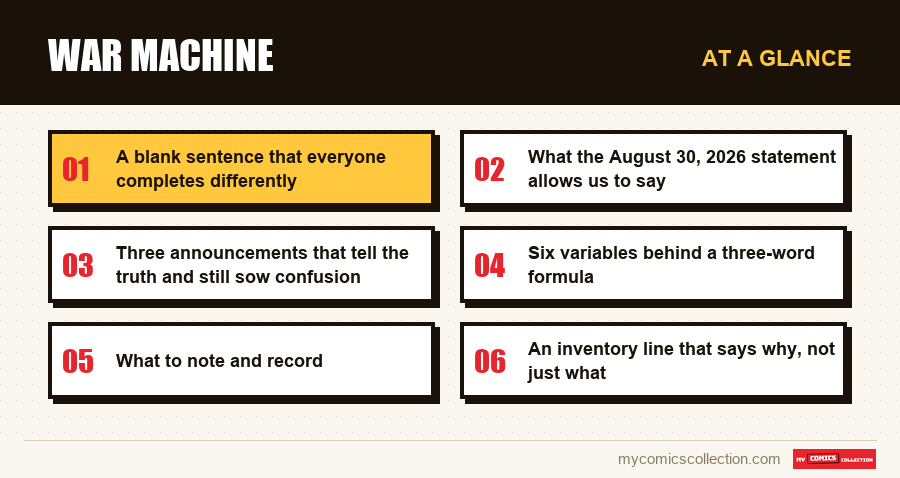
A blank sentence that everyone completes differently
“First appearance” behaves grammatically like an attribute of the fascicle, when in reality it is a relation between a fascicle and a named thing. Remove the thing, the sentence becomes a typo: it sounds like information, it is received as a guarantee, and it says nothing. However, the candidate things, in a character in armor, are at least four, and nothing obliges fiction to make them coincide in the same number.
The first is the equipment: a chassis, a silhouette, an armor design that appears on a board. The second is naming: the moment when a verbal identity is spoken and attached to someone. The third is the costume in the sense of clothing worn over a long period of time, which supposes that the wearer ceases to be occasional. The fourth is the character under this identity, that is to say the moment when an individual already known to the reader officially becomes someone else. These four questions have four possible answers, and these answers can fall on distinct numbers.
This is exactly what the reading reflects. The ads for issue 281 claim the first appearance of the armor and say it in full: "1st Appearance War Machine Armor". Those of number 282 are based on the short formula. Both camps describe the same editorial object seen from two angles, and commercial vocabulary does not have a different word for each. The collision is not fraudulent, it is lexical.
The practical consequence is brutal: a buyer convinced of acquiring "the first appearance of War Machine" can receive, in good faith on both sides, a number which documents the armor and not the character under that name, or vice versa. It was not stolen. He bought something other than what he thought, which is a different situation and much more difficult to recover from, since there is no recourse against an accurate ad.
What the August 30, 2026 statement allows us to say
108 listings, median $90.00
The query « War Machine Iron Man 282 » returns 108 unverified listings on August 30, 2026, the lowest at $19.99 and the highest at $6,999.99. These are sums requested, never sales concluded. The $90.00 median describes the level at which sellers are positioned that day, not where a buyer has paid.
87 exemplaires vérifiés, comptés séparément
The copies passed by a verification body form a second set: 87 advertisements, from $69.00 to $5,999.99, median $183.99. They are deliberately isolated from the previous ones, because mixing a raw booklet and an encapsulated copy amounts to comparing two objects, one of which includes the cost of a service.
A maximum is not a price
The two raised ceilings, $6,999.99 and $5,999.99, measure nothing other than the hope of two isolated sellers. An ad can stay online indefinitely without ever meeting a buyer. Using a ceiling as a reference means mistaking an individual intention for a collective consensus.
A single date, no movement
All of the above were observed on the same day. A single statement does not by construction contain any information on an increase or a decrease: there are no two points to connect. Any phrase like “it’s going up” or “it’s going down” would here be a pure invention, whatever the extent of the differences observed.
These four observations stand together and form the honest basis of the discussion. They say where the demands are located, they distinguish between two populations of objects, they refuse to set up an extreme as a benchmark, and they forbid any temporal reading. Nothing spectacular, but this is precisely what is missing from most purchasing reasoning: awareness of the status of the data we are handling.
The most instructive point of the statement is not a number, it is a composition. Of the five cheapest ads returned by a query for issue 282, three are for issue 281 and two are not comics. In other words, none of the five is a copy of the number you are looking for.
A buyer who sorts by ascending price and stops at the first page therefore sees, at the top of the list, five proposals, not a single one of which corresponds to what he thought he was looking for. Sorting by price is not sorting by relevance, and the apparent entry level of a query is often what is not the subject matter.
Three announcements that tell the truth and still sow confusion
The three announcements in number 281 deserve to be looked at closely, because they constitute a useful counter-example to the received idea according to which market confusion presupposes an intention to deceive. The first is offered at $19.99 under the title “IRON MAN #281 1st Appearance War Machine Armor [...] 1992 282”. The second, at $24.99, is “Iron Man #281 NEWSSTAND!” Before 282! [...] 1st APPEARANCE WAR MACHINE! ". The third, at $29.99, has the same structure: “IRON MAN #281 1st Appearance War Machine Armor Newsstand [...] 282”.
Two of them go so far as to cite the number 282 in their own title, not to pretend to be it, but to situate themselves in relation to it. “Before 282” is a position indication, not a camouflage. The seller explains where his copy fits in the sequence, which is exactly the service one would expect from an honest description. He even specifies what he's talking about: armor, a word present in two out of three titles.
And yet confusion thrives. It thrives because a busy buyer's actual reading stops at the "1st Appearance War Machine" motif, which is present in all three headings, and ignores the word "Armor" which qualifies them. The complement of the sentence is there, printed, three words away, and it is skipped. It is not a lack of information, it is a lack of attention, which makes the parade entirely individual.
It is also necessary to note the third category present in these five advertisements: two objects which are not booklets. A 9 by 12 inch decorative metal plaque for $21.88, and an 11 by 17 inch cover illustration reproduction for $24.98. These two articles repeat the imagery of issue 282 and therefore go back in a textual query, but no collector will mistake them for a copy: provided they read. An automated statement counts them like the others if no one removes them by hand.
This lesson applies well beyond War Machine: as soon as an issue has a recognizable cover, it generates a descendant of derivative objects which bear its name and number without being it. Any statistic built on a raw query mechanically includes this noise, and the noise almost always resides at the bottom of the price scale, where the eye lands first.
Six variables behind a three-word formula
De quoi parle-t-on ?
Armor, name, costume worn over the long term, character under this identity: four distinct objects, potentially four numbers. Until the question “of what” has a written answer, the purchase is based on an unspoken assumption that cannot be validated.
What date is the statement?
The amounts cited here date from August 30, 2026 and only have meaning when attached to this day. A figure copied without its date becomes a permanent statement, which it never was. The date is part of the data, not its packaging.
Vérifié ou brut ?
108 listings on one side, 87 verified copies on the other, with medians of $90.00 and $183.99. Two populations, two scales. Merging them together would produce an average that would not describe any items actually available for purchase.
Is it just a comic?
Two of the five cheapest listings are a decorative plaque and an artwork reproduction. They have the correct number in their title and are not booklets. Discarding derivatives is the first operation of any serious counting.
Quel numéro exactement ?
Three of the five cheapest ads are for 281 while the query was for 282. The number displayed in an ad title is not always the one you think you are looking for: you have to reread it separately, digit by digit.
Which broadcast channel?
The mention “Newsstand” appears in two of the three advertisements for 281. The same issue therefore circulated through several channels, which adds an additional variable to any comparison between two apparently identical copies.
Collecting this series?
Track what you own, what you are missing and what your collection is worth. 7 day trial.
Start my trial →Why do two neighboring numbers not replace each other?
An objection often comes up: since the two issues recount the same editorial moment one issue apart, why not take the cheaper one and consider the matter closed? The argument is attractive and it is sometimes valid: provided it is explicitly accepted, which requires knowing what we are exchanging for what. However, the buyer in question here does not make this arbitrage: he is unaware that there is an arbitrage.
The difference is what each issue documents. Whoever shows the armor documents a drawn object; whoever installs the character under that name documents an identity. Depending on the reason for which a collection is created (to follow a piece of equipment, to follow an identity, to follow a series, to follow an author) one of the two is relevant and the other is a neighboring piece, interesting but incidental. No general rule decides for the collector, because the relevance depends on his project.
This reasoning extends to any reading of a character over time. An editorial trajectory has thresholds (appearance, nomination, autonomy, own series) and the market summarizes all these thresholds with the same label because it sells. Reconstructing the actual order of the steps is a reader's job, not a buyer's job, and it is done before purchasing. THE best War Machine bows et les crossovers in which the character participates give this chronology without going through a commercial announcement.
The same mechanism is replayed on the scale of the host series. A character who is born in the title of another inherits a numbering which is not his own, and his story is read in two superimposed frames of reference: that of the host series and that of his own trajectory. This is what makes the story of Iron Man in comics essential to understand why the question “first appearance of what” arises here with this particular acuteness.
Finally, this is not an isolated case. Every time an identity holder changes, a piece of equipment passes from hand to hand, or a name is taken over by someone else, the same ambiguity is reborn, and it produces the same exact ads and the same disappointed buyers. L'story of Captain America in comics offers a comparable terrain, where identity, costume and shield have never stopped circulating between several people.
What to note and record
Write the complement of the sentence, not the sentence. An inventory line bearing « première apparition » is unusable after six months: it says neither what nor why this number rather than its neighbor. The useful notice is written in full (« première apparition de l'armure », « premier numéro où le personnage porte ce nom ») because it is this formulation which will later make it possible to justify a value, to explain a choice to a buyer or to find one's own reasoning.
Save the neighbor number as data, even without owning it. In this file, 281 and 282 are defined in relation to each other: two out of three announcements say this explicitly in their title. A file that ignores the neighbor condemns its owner to repeat the comparison at every opportunity. Noting "neighbor claiming first appearance of armor" next to the main line costs ten seconds and is worth an entire search.
Record the nature of the item, not just its title. Two of the five cheapest listings in this survey are a decorative plaque and an illustration reproduction. An inventory that does not distinguish the fascicle from the derivative will end up mixing the two in a total, and this total will no longer represent anything. The category of the object is primary information, to be entered at the time of entry into the collection.
Date all price observations, without exception. The amounts collected here are valid for August 30, 2026 and for nothing else. A number without a date silently transforms into permanent truth in the mind of the person who rereads it, and then becomes the worst of benchmarks. A line “read on [date], advertisements in progress, not sold” permanently defuses this drift.
Separate the verified copies from the rest in your own accounts. The statement has 108 listings on one side and 87 verified copies on the other, with medians of $90.00 and $183.99. Reproducing this separation in a personal inventory avoids artificially inflating an overall estimate and allows each piece to be compared to objects of the same nature: which is the only comparison that makes sense.
No. The advertisements noted claim the first appearance of the armor and specify this in their title, sometimes by placing themselves explicitly before 282. This is a different assertion, not a false assertion. The problem only appears when the reader remembers the first three words and drops the complement that qualifies them.
The statement does not provide an answer. It records sums claimed on August 30, 2026 on announcements then in progress, never completed transactions. The median of $90.00 across 108 unverified listings describes the level of demand from sellers that day; it does not say what a buyer actually paid, nor what he or she will pay.
Because a copy passed by a verification body is no longer the same commercial object: its price includes a service and packaging. Merging the 87 verified listings, with a median of $183.99, with the other 108 would produce an intermediate figure that would not correspond to any copy actually offered.
It indicates that the same number circulated through several broadcast channels. Concretely, this adds one more variable to the comparison between two copies that everything seemed to make identical: to the number, the state and the verification status is added the channel. An inventory sheet that omits it loses a distinction that the market spontaneously mentions.
By entering in the inventory the reason for conservation expressed in full, and noting the neighboring number as well as what it claims. A line that reads "first appearance of the armor, near the number where the character takes this name" makes the duplicate impossible, while a line that says "first appearance" makes it probable.
An inventory line that says why, not just what
My Comics Collection allows you to attach to each issue the precise reason why you keep it, the neighboring issue to which it compares, the exact nature of the object and the date of each price observation. It's this level of detail that transforms a stack of booklets into a collection where you can explain every line: to a buyer, to an insurer, or simply to yourself in two years.