An automated want list takes the guesswork out of the hunt for missing comics. Instead of searching through bins hoping to come across the right number, a collection app automatically generates a list of your missing items by series, which can be viewed conveniently from your phone.
Want List comics: how to automate the hunt for missing issues
All serious comic collectors end up keeping a want list: that list of issues they're missing to complete a run, close a story arc, or simply check the box for a key issue they've been looking for for months. The problem is that most want lists are kept on paper, in a notebook, or in an Excel file that stays at home when you need it most: at a convention, in a store, in front of a back issues bin. This guide shows you how to go from a homemade want list to an automated system that works for you.
What exactly is a want list?
A want list is the list of comics you are actively looking for. It may contain missing numbers in a run currently being completed, key issues that you have been coveting for a long time, or the first series numbers that you want to start. This is your acquisition roadmap.
Most collectors start with a mental want list, "I'm missing issues 45-52 of Uncanny X-Men", then move on to a written list as the collection grows. But even a written list has its limits.
The limits of the manual want list
A want list on paper or in a spreadsheet suffers from three fundamental problems.
It is static. When you buy a number from your list, you should remember to cross it off manually. If you forget, you risk buying it a second time: exactly the problem the want list was supposed to solve.
It is incomplete. To draw up an exhaustive want list, you need to know the complete list of numbers in a series. For Amazing Spider-Man, it's over 900 issues in volume 1 alone. Who will manually check the 900 numbers to identify the 37 that are missing? Person. Result: the want list only contains the most obvious missing items, and the others fall through the cracks.
She is inaccessible at the right time. Your Excel file is on your computer. You are at a convention, phone in hand, in front of a bin of Fantastic Four from the 70s. Your want list is of no use to you if it is not in your pocket.
The automated want list: how it works
The principle of an automated want list is simple: instead of manually creating and maintaining a missing list, the app automatically deduces what you lack from what you have.
Concretely, with My Comics Collection, the process is as follows:
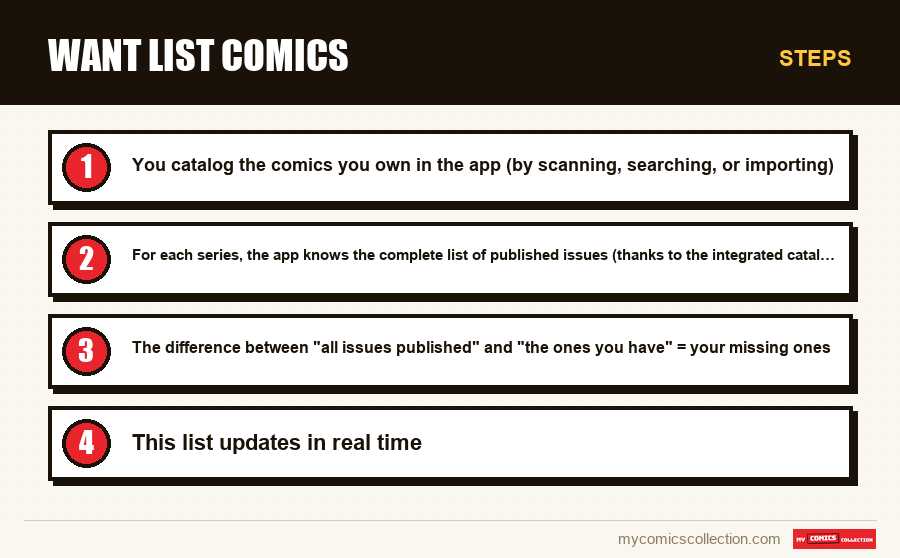
- You catalog the comics you own in the app (by scanning, searching, or importing).
- For each series, the app knows the complete list of published issues (thanks to the integrated catalog).
- The difference between "all issues published" and "the ones you have" = your missing ones. Automatically.
- This list updates in real time: as soon as you add a new comic to your collection, it disappears from the want list.
You no longer have anything to maintain. The want list is built and updated on its own.
In convention: the want list in your pocket
It is in convention that the automated want list takes on its full value. The classic scenario without tools: you arrive at Paris Manga or Comic Con, you vaguely know that you are missing issues of Daredevil and Thor, but you no longer know which ones exactly. You snoop around, you buy by feeling, you come home and discover that you missed three issues you were looking for and bought two that you already had.
With an automated want list: you open the app in front of the seller's bin, you display your missing numbers for Daredevil, and you immediately know which numbers to look for in the bin. Do you find them? Perfect, you buy them and check them in the app. They disappear from the want list in real time. Does the seller next door also have Daredevil? Your want list is already up to date: no duplicates possible.
The targeted journey strategy
Some experienced collectors prepare their convention according to their want list. Before the big day, they consult the list of their priority missing items: the key issues, the difficult to find numbers, the series they want to complete as a priority. They come to the convention with a specific objective, not just “snooping through the bins”.
This targeted approach is extremely effective. Instead of spending three hours browsing all the stands, you go directly to the sellers specializing in the series that interest you, you check what you are missing, and you leave with exactly what you needed. The ratio of time spent / numbers found is incomparably better.
Online: the want list as a purchase filter
Online purchases now represent a significant portion of back issue acquisitions. eBay, Catawiki, Facebook groups, LeBonCoin: the sources are numerous, and the temptation to buy “because it’s cheap” is permanent.
The want list acts as a rational filter. When you come across an interesting ad, the reflex is simple: is this number on my want list? If so, it's a legitimate purchase. If not, it's an impulse buy: perhaps justified, but at least you're aware of it.
For lots, the want list is even more valuable. A seller is offering 50 Batmans for €80. You display your missing Batman numbers in the app, cross-reference them with the contents of the lot, and you instantly calculate how many numbers in the lot are actually useful. If you are missing 8 numbers out of 50, your real cost per useful number is €10. Is it worth it? The want list gives you the answer in 30 seconds.
Prioritize your want list: not everything is searched in the same way
A want list of 200 missing numbers can seem daunting. The key is to hiérarchiser.
High priority: key issues
Early appearances, pivotal issues, death issues: these comics generally increase in value over time and become harder to find in good condition. If your want list contains an Amazing Spider-Man #252 (first symbiote), a New Mutants #98 (first Deadpool), or a Batman #497 (Knightfall), these issues should be at the top of your acquisition list.
Medium priority: completion numbers
Issues that complete a major story arc or close a run that you almost completely own. They don't necessarily have a high market value, but they provide the satisfaction of completion which is at the heart of the hobby.
Low priority: fillers and secondary series
Fill numbers in series of which you only have a few copies. They will eventually be found, often in low-priced lots. No need to actively search for them: let chance work for this category.
The virtuous circle: want list, purchases, and satisfaction
One of the most underestimated effects of an automated want list is the impact on the pleasure of collecting. When you find a number you've been looking for for months and check it in the app, the completion percentage of your run increases. Going from 87% to 89% on a run of Uncanny X-Men provides measurable satisfaction: your collection is progressing, and you can see it concretely.
This positive feedback creates a virtuous circle: the more you use the tool, the more effective the hunt for missing items becomes, the more numbers you find, the more satisfaction increases. This is the exact opposite of the frustration that blind hunting without tools provides.
Beyond the missing: the want list as a budget tool
A well-managed want list is also a financial planning tool. If you know the approximate value of each missing number, you can estimate the budget needed to complete a run. Are you missing 12 issues of Amazing Spider-Man from the 80s, including 3 key issues? The estimate is possible: around €150 for keys, €40 for current numbers. Total budget: €190. This visibility allows you to plan your purchases over several months instead of spending everything at once on a convention.
Questions fréquentes
In collectors' jargon, the two terms are often interchangeable. Technically, a "want list" refers to missing issues in a run that you are actively seeking to complete, while a "wishlist" can include comics that you would like to own without actively seeking them out (an Amazing Fantasy #15, for example). In My Comics Collection, the functionality covers both cases: automatically detected missing comics and comics manually added to your wish list.
Yes, and it is one of the most powerful uses. If you share your want list with a collector friend, they can check their duplicates to see if they have what you are looking for. At conventions, some collectors exchange their want lists to facilitate bartering. My Comics Collection allows you to share your missing list by link, without the other person needing to create an account.
The key is prioritization. Divide your want list into priorities (key issues, completion of priority runs, secondary numbers) and focus on one category at a time. An app like My Comics Collection displays your missing items by series, which allows you to work series by series instead of dealing with a monolithic list of 500 issues. As a convention, filter by series to only see the relevant missing items in front of each bin.
It depends on your level of collecting. If you only collect the main covers, the want list is based on the numbers. If you want to follow the variants, the app allows you to distinguish between different editions of the same number. However, most collectors choose to focus on numbers rather than variants, except for specific series where variants are of particular importance.
Setup time corresponds to the time it takes to catalog your existing collection. Once your comics are registered in the app, the want list is automatically generated: there is nothing more to do. For a collection of 500 comics, allow half a day of initial cataloguing. Afterwards, each new purchase takes 10 seconds to add, and the want list updates instantly.