A collector well prepared at a convention finds 3 to 5 times more useful issues than a collector who improvises. The key: having your inventory and your want list on the phone, a budget defined by category, and a route strategy. This guide gives you the complete checklist.
Preparing for your comic convention: the organized collector’s checklist
Every year, comic conventions attract thousands of collectors. Paris Comic Con, Comic Con Paris, Angoulême, Lyon BD Festival, Paris Manga: there is no shortage of opportunities. But the difference between a collector who comes home with exactly the numbers he was looking for and another who comes home with a bag of duplicates and an empty wallet is preparation. This guide gives you a complete method to maximize every minute and every euro spent at a convention.
Why Convention Is Both the Best and Worst Place to Buy
Conventions concentrate in one weekend what you would take months to find in stores or online. Dozens of specialized sellers, thousands of back issues, rarities that never go through eBay, and prices that are often negotiable. This is the ideal hunting ground for completing runs and finding key issues.
But it's also an approximatelyment designed to make you buy impulsively. The festive atmosphere, the social pressure ("if I don't buy it now, someone else will"), the prices displayed as bargains, the prizes that seem irresistible: all these factors lead to rapid and often regrettable decisions.
The prepared collector neutralizes these biases. He knows what he's looking for, he knows market prices, and he has his inventory in his pocket. He does not submit to convention: he exploits it.
D-7: the week before the convention
Check that your inventory is up to date
It is the basis of everything. If your digital catalog is not up to date, your preparation is for nothing. Take 30 minutes to check that your latest purchases are saved in the app. Every uncatalogued comic is a potential convention duplicate.
If you don't already have a digital inventory, the week before the convention is a great time to start. You don't need to catalog everything: start with the series you're actively completing. These are the ones for which you are most likely to buy duplicates.
Consult your want list
With My Comics Collection, your missing items are automatically generated from your inventory. Go through the list and identify your priorities. Divide your missing items into three categories:
- Must-have: the key issues and rare numbers that you have been looking for for a long time. These are your primary targets: if you find them, you buy them.
- Nice-to-have: completion numbers that would improve your runs without being urgent. You take them if the price is right.
- If I come across it: current numbers, easily found elsewhere. No need to actively look for them, but if you come across them at a good price, why not.
Define a budget by category
A global budget (“I don’t spend more than €200”) is not enough. You have to distribute. Concrete example for a budget of €200:
- 100€ for key issues and rare parts (must-have)
- 60€ for completing runs (nice-to-have)
- 40€ margin for unexpected finds
This distribution prevents you from spending your entire budget on batches of fillers for €1 each and having nothing left when you come across the key issue you have been looking for for two years.
Search for sellers present
Most conventions publish the list of exhibitors in advance. Identify vendors who specialize in back issues: some are known for stocking Silver Age, others for indies, others for '90s DC. If a vendor specializes in the series you're completing, plan to stop by their booth first, before the best issues are gone.
The big day: the route strategy
First hour: the key issues
The best numbers go first. If you have must-haves on your want list, the first hour of the convention should be dedicated to them. Go directly to the identified stands during your preparation, look for your targets, check condition and price, negotiate if necessary, buy. Don't dawdle: the first hour is a sprint, not a stroll.
Second phase: methodical completion
With the must-haves secured (or absent, which happens), move on to completing runs. Stand by stand, bin by bin, display your shortages for the series concerned on your phone and browse the seller's stock. This series-by-series method is much more efficient than random browsing: you only look at what you're looking for, and you immediately identify what you're missing.
When you find a missing issue, check the condition (spine, staples, corners, interior) and price. If the price is within your range, buy it and immediately add it to your catalog in the app. This real-time update is crucial: if another seller has the same number, your app will tell you that you just bought it.
Third time: good deals
Your key issues and completion budget is spent (or you didn't find what you were looking for). You still have your margin for unexpected finds. It's time to browse freely in the low-price bins, the end-of-day sale lots, or the stands that you hadn't spotted.
Even in this “exploration” phase, keep the reflex of checking your inventory before each purchase. A €1 comic book of which you already have a copy remains a wasted euro.
The 10-second reflex: check before buying
This is the most important rule in this guide, and it applies to chaque purchase by agreement, without exception:
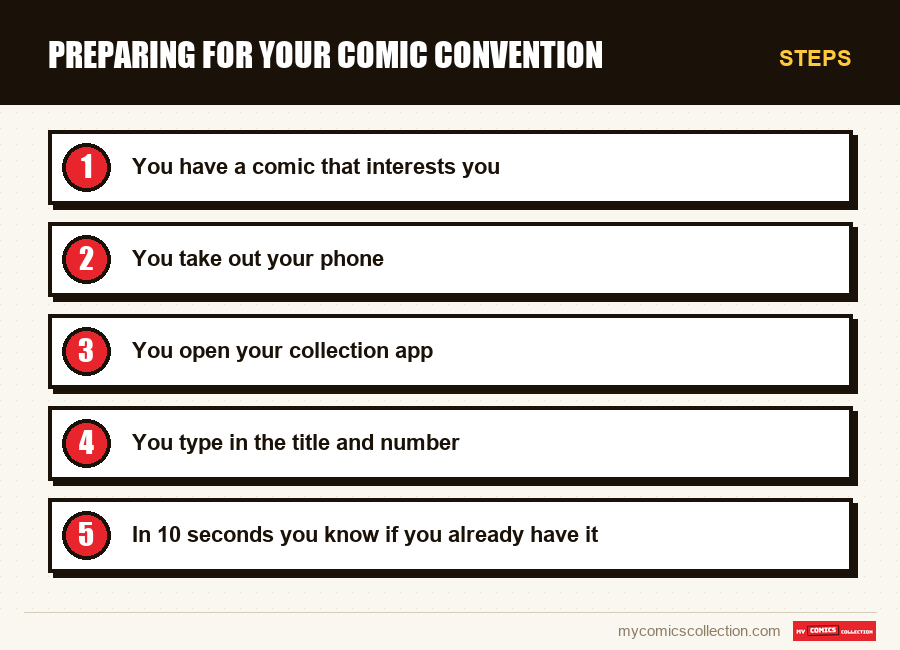
- You have a comic that interests you.
- You take out your phone.
- You open your collection app.
- You type in the title and number.
- In 10 seconds you know if you already have it.
This reflex, practiced systematically, eliminates almost 100% of involuntary duplicates. And it takes 10 seconds. Not 10 minutes: 10 seconds. This is the most immediate profitability of any collection management tool.
Negotiation in agreement
Most convention sellers expect to negotiate, especially at the end of the day and on multiple purchases. Some basic rules:
Groupez vos achats. Instead of buying one comic at a time, make a pile of everything you're interested in from a seller, then negotiate the lot. “I have 8 numbers for €45 displayed, will you give me a price of €35 per lot?” is a reasonable request that often passes.
Connaissez les prix. If you use an app with market quotes, you know if the price listed is fair, high, or a bargain. This knowledge gives you negotiating power. “This number is listed at €8 on the market, you sell it for €12: can we agree at €9?” is a factual argument, not an attempt at horse trading.
Restez fair-play. The sellers are also passionate. Respectful negotiation succeeds much more often than aggressive bargaining.
After the convention: immediate cataloging
You come home with a bag of comics. The temptation is strong to put them in a corner and deal with them “later”. Don't do it. Post-convention cataloging must be done the same day, or at the latest the next day.
Why this urgency? Because if you wait, you might forget what you bought. And the next time you're in a store or in front of eBay, you buy a number you already have: the one you brought back from a convention without cataloging it. The vicious cycle of duplicates begins again.
The process is quick: take out your purchases one by one, scan them or add them manually in the app, note the state of conservation and the price paid. For 15 comics, allow 5 to 10 minutes. A small investment of time that protects all your future purchases.
The complete convention collector’s checklist
Avant la convention
- Update your digital inventory (check latest purchases)
- Consult your want list and identify priorities (must-have / nice-to-have)
- Define a total budget and divide it by category
- Search for advertised sellers and exhibitors
- Charge your phone to 100% (the app is useless without battery)
- Bring a bag or box to protect your purchases
- Carry cash (some sellers do not accept cards)
Pendant la convention
- Check your inventory before EACH purchase (10 second reflex)
- Add each purchase to the app immediately after payment
- Track your budget by category
- Inspect the condition of each comic before purchase
- Negotiate group purchases
Après la convention
- Catalog all remaining purchases the same day
- Store new comics in their sleeves and boxes
- Update retention statuses in the app
- Faire le bilan : budget dépensé, issues trouvés, runs complétés
Questions fréquentes
It depends on your goals. For completing runs in common back issues, €50 to €100 allows you to find around twenty numbers. If you are looking for key issues or old comics in good condition, plan on spending €150 to €300 minimum. Experienced collectors targeting specific pieces can exceed €500 over a major convention weekend. The important thing is to set a ceiling before you go there.
If you are looking for key issues or rare numbers, yes. The best copies leave within the first hour. If you come mainly to complete runs in common numbers, the arrival time matters less: the stock of low-cost back issues remains abundant throughout the day. Some collectors even prefer to come at the end of the day to take advantage of last minute discounts.
Methodically examine: the cover (creases, tears, discoloration), the spine (stress marks, spine rolls), the staples (rust, shifting), the corners (dog ears, dents), and leaf through the interior (stains, missing pages, cuts). Always ask the seller before handling a valuable comic book. Under conventional lighting, some defects are difficult to see: use your phone's light for important issues.
Yes, this is common and expected, especially on multiple purchases and at the end of the day. A 10 to 20% discount on a batch of several comics is a reasonable request. For valuable coins, the trading margin is lower, but it exists. Stay courteous and factual: quoting market quotes is a more effective argument than excessive haggling.
Bring a hard backpack or cardboard box with dividers. Comics purchased must be transported vertically, never stacked flat in a soft bag where they risk folding. For valuable coins, immediately slip them into protective pouches (bring a few blank ones). Avoid thin plastic bags from sellers for final transport: they offer no protection against impact.