Duplicates are expensive for unorganized collectors: on average 15 to 20% of the annual budget. The only reliable method for eliminating them is a digital inventory that can be consulted in real time, on the phone, at the time of purchase.
Managing duplicates in your comic collection: the foolproof method
Every comic collector has experienced this moment: returning from a convention or garage sale with an issue bought with enthusiasm, then realizing while sorting through his longboxes that he already owned it. Once is annoying. Ten times a year is a real financial drain. This guide explains why duplicates are a structural problem, not just an oversight, and how to eliminate them permanently with the right method.
Why duplicates are inevitable without tools
Duplicates are not a sign of negligence. They are the logical consequence of the way we buy comics. Risk situations are numerous, and each of them is repeated dozens of times per year.
The convention trap
You are at Paris Comic Con, in front of a bin of backs from Amazing Spider-Man. The seller has a beautiful lot from the 80s, well preserved. You flip through, you spot some interesting numbers: 238 (first Hobgoblin), 252 (black symbiote), 298 (first Todd McFarlane). You buy them. Problem: you already had the 252 in a longbox at home. Without your inventory in front of you, it's impossible to check.
The convention context amplifies the risk: the crowd, the noise, the excitement of the find, the fear that someone else will pick up the comic before you. All these conditions encourage people to buy quickly, without thinking. And the verification time: “do I already have this number?”: is the one sacrificed first.
The trap of buying in bulk
On eBay or LeBonCoin, someone is selling a set of 40 X-Men for €60. Great deal. You know you're missing numbers in this series. But how much exactly? And which ones? Without this information, you buy the lot hoping that it contains your missing items. Result: out of 40 comics, 12 are duplicates. The prize is no longer as attractive: your real cost per useful number increases from €1.50 to €2.14.
The memory trap
With 200 comics, memory is enough. With 500, she falters. With 1,000, it's impossible. You can't remember all 1,000 numbers you have, especially if some are stored in longboxes you haven't opened in months. Human memory is not a collection management tool. This is a cognitive fact, not a criticism.
The variant trap
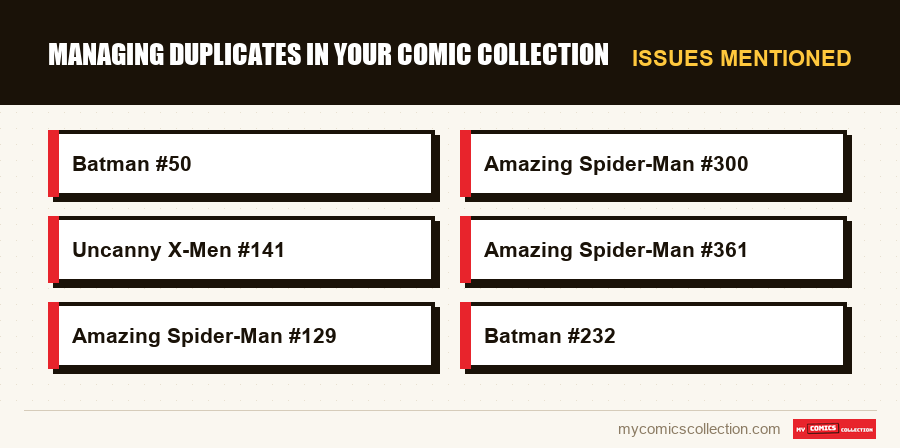
You have Batman #50 on cover A. You come across a Batman #50 at a convention: it's a variant cover that you hadn't seen. Is this a duplicate or a different variant? If you have not noted precisely which version you have, you risk either purchasing a duplicate or missing out on a variant that you were missing. Both mistakes are frustrating, and both are avoidable.
The real cost of duplicates
Let's do the math. An active collector spends on average €500 to €1,500 per year on comics (new purchases, back issues, conventions, online). If 15% of these purchases are unintentional duplicates, that represents 75 to 225€ per year wasted. Over ten years of collecting, the total has reached €750 to €2,250: the equivalent of an Amazing Spider-Man #300 in CGC 9.4.
And this calculation does not take into account the time lost: identifying duplicates, reselling them (often at a loss), storing them while waiting to get rid of them. Duplicates aren't just a financial problem: they physically clutter your collection and dilute the joy of collecting.
La méthode anti-doublons en 4 étapes
Étape 1 : Inventorier l'existant
The first step is the longest, but it's the one that makes everything else possible. Catalog Every Comic You Own in a digital tool: not in a notebook, not in your head, in a tool accessible from your phone.
With an application like My Comics Collection, which integrates a worldwide comics catalog, the process is considerably accelerated. Instead of manually entering each title, number and date, you search for the series and check off the numbers you have. For a collection of 500 comics sorted by series, allow half a day. It's a unique investment of time: once your collection is cataloged, each new purchase is added in seconds.
Step 2: Systematic verification before purchase
This is the golden rule, and it is non-negotiable: check your inventory before each purchase. Not when you get home: right there, at the time of the purchasing decision.
In convention: you hold an Uncanny X-Men #141 (Days of Future Past) in your hands. Before you take out your wallet, open the app on your phone, type in “Uncanny X-Men 141”. In 10 seconds you know if you already have it. It's the most cost-effective audit you'll ever do.
Online: before validating a basket on eBay or responding to an ad, consult your digital catalog. It's even simpler than in a convention since you are already in front of a screen.
Étape 3 : Identifier et traiter les doublons existants
Once you have taken your inventory, you will probably discover duplicates that you were unaware of. Mark them in the app (most allow you to tag a copy as "duplicate" or "for sale") and decide what to do with them.
Revendre: duplicates in good condition or key issues sell well on eBay, LeBonCoin, or in collectors' Facebook groups. The money recovered finances your missing items.
Échanger: forums and collector groups allow number for number exchanges. Your duplicate of Amazing Spider-Man #361 (first Carnage) can become the issue 375 you were missing.
Donner: a friend who is starting his collection will be delighted to receive your duplicates. It's also a good way to introduce someone to the hobby.
Étape 4 : Maintenir la discipline
The tool is useless if you don't use it systematically. Each new comic purchased must be added to your catalog le jour même: not “when I have time”, not “this weekend”. The same day. If you let a cataloging backlog build up, you're back to exactly the original problem: buying without knowing what you have.
The good news: with a built-in catalog, adding a comic literally takes 10 seconds. It's not an effort: it's a reflex to build.
The special case of lots
Bulk purchases are the favorite hunting ground for duplicates. A set of 30 comics for $40 may seem like a bargain, but if you already have 25 out of 30, your actual cost per missing issue is $8: not that great.
The method: before buying a lot, list the numbers it contains and cross-reference it with your inventory. If the seller does not provide the detailed list, ask for it. This is a normal request between collectors.
With an app that displays your missing items by series, the calculation is immediate. You see the numbers you are missing in the series, you compare them with the contents of the lot, and you make an informed decision whether the lot is worth it financially.
Intentional duplicates: when it's strategic
Not all duplicates are errors. Some collectors intentionally buy a second copy of an issue, and this is perfectly rational in some cases.
Le doublon de lecture. You have an Amazing Spider-Man #129 (first appearance of the Punisher) in Very Fine that you do not want to handle. Buying a Good reading copy for €30 is a legitimate choice: you read the Good and you keep the French version.
Le doublon d'upgrade. You have a Batman #232 (first Ra's al Ghul) in Fine, but you would like a copy in Very Fine to complete a high-end collection. The old copy will be resold once the new one is acquired.
Le doublon de spéculation. You think that a number will increase in value (adaptation announcement, death issue, limited variant). Buying a second copy to resell later is an investment choice, not a mistake.
In all these cases, the key is that the duplicate is intentional and documented. The app allows you to mark an item as "reading", "for sale" or "speculating" to distinguish it from your main item. A tagged duplicate is no longer a duplicate: it is a management choice.
The convention reflex: 10 seconds that change everything
The convention is the most dangerous ground for duplicates. The atmosphere, the sellers quoting prices, the piles of comics to rummage through: everything encourages you to buy quickly. Here is the reflex that will save you dozens of unnecessary purchases per year.
Avant de payer: take out your phone, open your collection app, look for the number. 10 seconds. If you already have it: you put it back and move on to the next one. If you don't have it: you buy it with peace of mind and add it to your catalog immediately.
This 10-second reflex, practiced systematically, eliminates almost 100% of involuntary duplicates. This is the most immediate benefit of a collection management tool, and the reason why collectors who use an app report a near-zero duplicate rate.
Questions fréquentes
Returns from collectors converge towards 15 to 20% of involuntary duplicate purchases per year for those who do not have a digital inventory that can be consulted on the move. On an annual budget of €800, this represents €120 to €160 wasted. Collectors who use a management app report a rate of unintentional duplicates close to zero.
The best platforms are eBay (for value numbers), LeBonCoin (for lots and low prices), collectors' Facebook groups (for exchanges), and conventions (to sell volume). For low-value duplicates, putting together thematic lots (an X-Men lot, a Batman lot) is often more effective than selling issue by issue.
Yes. If you save the same issue twice in My Comics Collection, the app will report this. But the real value is preventive: by checking your inventory before each purchase, you avoid creating duplicates upstream. Detection is a safety net; pre-purchase verification is the main method.
After receiving the batch, catalog each issue in your app. The tool will automatically identify duplicates. Mark them as "for sale" or "for trade" and put together a resale batch with your accumulated duplicates. Some collectors hold convention trading sessions specifically to sell their duplicates: it's a great way to turn a problem into an opportunity.
Each copy has its own market value and must be included in the inventory submitted to your insurer. However, owning two copies of the same issue does not automatically double the cover: each copy is valued individually according to its condition. An accurate digital inventory greatly facilitates insurance procedures, whether your comics are originals or duplicates.
Absolutely. Cataloging duplicates allows you to know the true total value of your collection (including duplicates), mark them for resale, and avoid accumulating more. My Comics Collection allows each copy to be distinguished with tags (main, reading, for sale) to maintain a clear and usable inventory.