In short
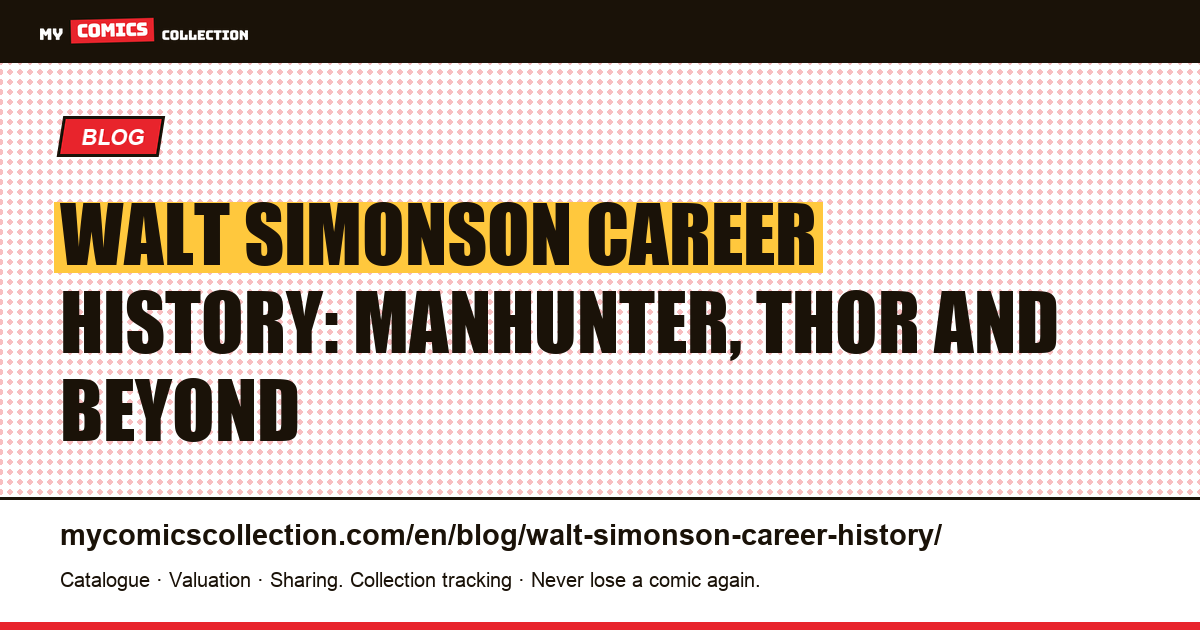
Walt Simonson reached print in 1973, with a war story in Weird War Tales #10 and then the Manhunter backups in Detective Comics with Archie Goodwin. Three runs define the career: Thor #337 to #382 (1983 to 1987), written and mostly drawn by Simonson; X-Factor as penciller from #10 (1986); and Fantastic Four from #334 (1989 to 1991). After the 1990s came Orion at DC (2000 to 2002) and the Norse epic Ragnarök at IDW.
Few careers in superhero comics trace such a clear line from apprentice work to a run that readers still measure other Thor stories against. Walt Simonson started as an art-school student with a space-opera booklet, passed through DC, Marvel, Dark Horse and IDW, and kept returning to the same Norse material decades after the famous run ended.
Every credit, issue number and year below was checked one by one against published bibliographies; the reading of what each period changed in Simonson's method is our own analysis.
Student years and the first printed pages (1971 to 1973)
Simonson's earliest sustained project was Star Slammers, a science-fiction saga that appeared first as ashcan booklets between 1971 and 1973, produced as a promotion for the 1974 science-fiction convention DisCon II. A Rhode Island School of Design thesis was completed in 1972. The pattern is already visible: the author who would later write and draw a monthly Marvel series began by inventing a universe on the page and packaging it personally.
The first professional publication followed in January 1973, when "Cyrano's Army," written by Len Wein, ran in Weird War Tales #10. A short war story with an established writer is a modest debut, but it put Simonson in front of DC editors at the moment the company needed new artists. Simonson also drew for Sword of Sorcery in 1973, issues #4 and #5, which gave an early taste of the fantasy adventure that would define later decades.
Manhunter and the DC apprenticeship (1973 to 1977)
The breakthrough of the decade was the Manhunter backup feature in Detective Comics, written by Archie Goodwin with Simonson as artist, running across issues #437 to #443. Three of these stories won Shazam Awards: "The Himalayan Incident" in #437, "Cathedral Perilous" in #441 and "Götterdämmerung" in #443. Later visits to the character followed in Detective Comics #450 and #469 to #470, and a return in the anniversary issue #1027 in 2020.
What Simonson changed here was the idea of a backup strip. Compact, tightly paced chapters with a lead character in a plain costume, treated the eight-page format as a place for serious design work instead of filler.
During the same years Simonson was working steadily outside DC. Savage Sword of Conan carried art in issues #7, #8, #12 and #15 to #17 between 1975 and 1977, and Metal Men issues #45 to #49 in 1976 gave Simonson plot input on some issues as well as the art. Simonson was also the original artist of the Marvel black-and-white magazine The Rampaging Hulk, launched in 1977.
Freelance in every direction: Thor once, then space opera (1977 to 1983)
The first Thor assignment came in 1977 and 1978, when Simonson penciled Thor #260 to #271 and Annual #7 with Len Wein as writer. In 1978 Simonson drew Batman #300 with David Vern Reed, and Doctor Phosphorus is credited to Simonson with Steve Englehart.
Marvel then used Simonson heavily for licensed science fiction. Star Wars issues #16, #49 to #63 and #65 to #66, across 1978 to 1982, were penciled by Simonson, who also wrote #56 to #63 and #65. On Battlestar Galactica Simonson penciled and co-wrote with Roger McKenzie from 1979, then wrote the book alone from #19 to #23. In 1979 Simonson and Goodwin adapted the film Alien for Heavy Metal, the start of a long partnership with the letterer John Workman.
The business side shifted too. In late 1978 Simonson co-founded the New York studio Upstart Associates with Howard Chaykin, Val Mayerik and Jim Starlin. A 1982 crossover between the X-Men and the Teen Titans paired Simonson with Chris Claremont, and Marvel Graphic Novel #6 (1983) brought Star Slammers to a professional printing under Simonson's own pen.
Thor, 1983: Beta Ray Bill and the war with Surtur
Simonson took over Thor with issue #337, cover-dated November 1983, building on a story about Surtur and the Odinsword first sketched in college in 1967. The opening arc introduced Beta Ray Bill, a Korbinite warrior found worthy to lift Mjolnir; Bill and Thor knock each other out in a duel at Skartheim, and Odin then orders a new hammer, Stormbreaker, for Bill. Issues #337 to #340 carry that sequence, after which Bill joins the Asgardians against the fire demon Surtur, whose actions had killed most of the Korbinite people. Bill is the first being outside the Norse pantheon introduced as worthy of Mjolnir.
The change in method matters more than any single plot beat. Simonson wrote and drew the series, so the character designs, the lettering of sound effects and the page rhythm all came from one hand. The monster-faced alien who might have been a villain was designed so readers would be unsure which side Bill was on, and the story then resolved by making the two warriors equals instead of enemies.
Next came the first storyline built around Simonson's own creation of a villain: Malekith the Accursed appears in Thor #344, cover-dated June 1984, in a story that runs through #349 and ends with the villain destroying the Casket of Ancient Winters, which releases its ice on Earth. Collectors tracking the career should treat #337 and #344 as the two creation points, one hero and one adversary, both from the same writer-artist. The collector guide to Thor #337 covers the editions in detail.
Thor, 1985 to 1987: Hel, a bridge, and a change of hands
The middle of the run turns darker. The setup for the Hel mission comes in Thor #360 (October 1985), where Malekith has trapped souls in Hel, and Skurge's last stand at the bridge Gjallarbrú falls in #362 (December 1985). The Asgardian in question debuted twenty-one years earlier, in Journey into Mystery #103 (April 1964) by Stan Lee and Jack Kirby, so Simonson handed a long-standing supporting figure the emotional peak of the run. That choice shows the method: build the high points from material the shared universe already held, then pay it off.
Malekith returns in #363 (January 1986) and again across #366 to #368 (April to June 1986). In #367 the villain disguises as Balder the Brave and is apparently killed when Algrim sees through the trick. Simonson wrote and drew the series through #367 (May 1986), and then Sal Buscema took over the art while Simonson continued as writer through #382, dated August 1987. The ranking of Thor runs places this cycle at the head of the series.
X-Factor, Avengers and Fantastic Four (1986 to 1991)
In 1986 Simonson joined X-Factor as penciller, starting at #10 and working with the series writer Louise Simonson. Three company-wide crossovers passed through the book during that stretch, the last of them "Inferno." In issue #25 the two Simonsons turned Angel blue and fitted metal wings, a redesign that brought the codename Archangel. The best X-Factor runs page places the Simonson years in context. Here the working method is a collaboration, with a penciller drawing to another writer's plots at a monthly pace.
Next, The Avengers in 1988 and 1989: Simonson wrote issues #291 to #299 and Annual #17, then wrote and drew the landmark #300. The same period produced the four-issue miniseries Havok and Wolverine: Meltdown in 1989, co-written with Louise Simonson. By late 1986 Simonson had also left Upstart Associates, the shared studio of the previous decade.
The Fantastic Four run began in December 1989. Simonson wrote from #334, penciled and inked from #337, and left after #354 in July 1991. Arthur Adams collaborated on issues #347 to #349, which introduced a "New Fantastic Four" with Wolverine, Spider-Man, Ghost Rider and the Hulk. On this title Simonson was again both writer and visual lead, which makes the run a close cousin of the Thor years.
Do you collect this series?
Track what you own, what you are missing and what your collection is worth. 7-day trial.
Start my trial →
The 1990s: independents and returns to old worlds
After Marvel, the pattern is variety. In 1992 Simonson wrote and drew Superman Special #1, drew RoboCop vs. The Terminator #1 to #4 for Dark Horse, and drew the four-issue Armageddon Inferno. In 1993 Simonson wrote the Jurassic Park series for Topps, and in 1994 co-plotted and wrote the Iron Man 2020 one-shot and the three-issue Legends of the World's Finest for DC.
Creator-owned work returned as well: Star Slammers continued in 1994 under Malibu's short-lived Bravura label, with Simonson among its founders, and Weapon Zero appeared at Image in 1995 and 1996, co-written with Joe Benitez.
Two other late-decade credits link to older material. Simonson wrote The Avengers volume 2 issues #8 to #12 during the Heroes Reborn year of 1997, and wrote and drew parts of Jack Kirby's Fourth World (issues #9, #10, #11 and #13) in 1997 and 1998. That Fourth World job is the bridge to the next decade: by working directly on Kirby's characters, Simonson prepared the ground for the Orion series. For the Kirby side of that story see the Jack Kirby author page.
Orion and a decade of DC writing (2000 to 2010)
The DC series Orion ran for 25 issues from 2000 to 2002, written and drawn by Simonson from #1 to #25. The hero belongs to Jack Kirby's Fourth World, so the series continued directly from the Jack Kirby's Fourth World work of the late 1990s. For a writer-artist, a full solo series on a Kirby creation was a rare chance to carry another creator's cosmology at monthly length, and to set the visual tone for it alone.
What changes in this period is the status of Simonson: from Marvel's marquee Thor creator to a steward of Kirby's DC mythology. Other work followed. Simonson wrote Wonder Woman volume 2 #189 to #194 in 2003, drawn by Jerry Ordway, and drew Elric: The Making of a Sorcerer, a four-issue miniseries written by Michael Moorcock and published between 2003 and 2006.
From 2006 to 2007 Simonson wrote Hawkgirl issues #50 to #66, wrote and drew JSA Classified #21 and #22, and wrote The Spirit #7. At WildStorm the licensed series World of Warcraft ran for 25 issues from 2008 to 2010, with Louise Simonson co-writing #15 to #25, and in 2009 Simonson wrote the Demon and Catwoman serial in Wednesday Comics. The decade is the period when Simonson becomes a writer first and a penciler second.
Ragnarök and the return to Thor (2010 to today)
Recognition arrived in 2010 with the Hero Initiative Lifetime Achievement Award at the Harvey Awards. In 2012 Simonson wrote and drew The Judas Coin, a graphic novel for DC, penciled issues #25 to #30 of The Avengers volume 4, and received an Eisner Award for IDW's Thor Artist's Edition in the archival category. The Marvel film Thor: The Dark World credited Simonson as creator of Malekith in 2013.
Then came a long-form return to Norse myth: Ragnarök at IDW, twelve issues from July 2014 to 2017, written and drawn by Simonson, followed by Ragnarök: The Breaking of Helheim in six issues between 2019 and 2020. Here the author who once had to fit Marvel's continuity could shape the world freely. Other recent items include The Mighty Thor #700 in 2017, a variant cover for Thor: The Worthy in 2020, and Thor volume 6 #24 in 2022, written and drawn by Simonson.
Simonson also returned to X-Factor material in 2021 through X-Men Legends, providing covers and art for a two-issue story written by Louise Simonson and contributed a Star Slammers story, the first return to the property since the 1990s, to the 2022 charity anthology Comics for Ukraine: Sunflower Seeds. The latest pattern is circular: the freshest work returns to the very first creations.
The key issues across the career
- Weird War Tales #10 (January 1973): the first professional story, "Cyrano's Army," written by Len Wein.
- Detective Comics #437 (1973 run): the start of the Manhunter backups with Archie Goodwin.
- Thor #337 (November 1983): Beta Ray Bill appears and takes Mjolnir.
- Thor #344 (June 1984): Malekith the Accursed makes his debut.
- Thor #362 (December 1985): Skurge's last stand at the bridge Gjallarbrú.
- Fantastic Four #334 (December 1989): Simonson begins writing the series.
- Orion #1 (2000): Simonson writes and pencils Kirby's New Gods hero for DC.
- Ragnarök #1 (2014): the IDW series written and drawn by Simonson.
How to collect Simonson's career
Begin with the Thor cycle from #337 to #382, because it is a continuous run and every issue after the first arc links to the next. If the originals prove difficult, the same material has been collected repeatedly, and the IDW Artist's Edition presents the art at a larger scale. Decide early whether you collect by title or by creator, since several Simonson credits are penciling only.
Watch the numbering. The Thor run sits in the first series, and a later restart brought new numbers, so a "#1" is not the place to begin. The separate reading-order guide handles that question. When you log copies, record cover date, printing and any variant; a comparison of Thor #337 with a later reprint is easiest when each entry is complete.
Frequently asked questions
Simonson's first professional story, "Cyrano's Army," written by Len Wein, ran in Weird War Tales #10, dated January 1973. Simonson had already produced the promotional Star Slammers ashcan booklets between 1971 and 1973, and the Manhunter backups in Detective Comics with Archie Goodwin followed soon after.
The run covers Thor #337 (November 1983) to #382 (August 1987). Simonson wrote and drew through #367 (May 1986), and then wrote while Sal Buscema handled the art. Earlier, in 1977 and 1978, Simonson penciled #260 to #271 with Len Wein as writer.
Both characters come from Walt Simonson. The hammer-wielding alien debuts in Thor #337 (November 1983), and the Dark Elf ruler Malekith the Accursed follows in #344 (June 1984). Both belong to the Simonson Thor run, and Malekith later became a recurring Thor villain far beyond that period.
Simonson wrote Fantastic Four from #334 in December 1989, penciled and inked from #337, and left with #354 in July 1991. Arthur Adams collaborated on issues #347 to #349, which introduced a "New Fantastic Four" built from Wolverine, Spider-Man, Ghost Rider and the Hulk.
Simonson wrote and drew The Judas Coin in 2012, then Ragnarök at IDW (twelve issues from 2014) and Ragnarök: The Breaking of Helheim (2019 to 2020). In 2022 Simonson wrote and drew Thor volume 6 #24, and also returned to Star Slammers in a charity anthology.
Holding a Thor issue from the Simonson years? Get a quick idea of what your copy is worth.
Estimate my comic