
In short
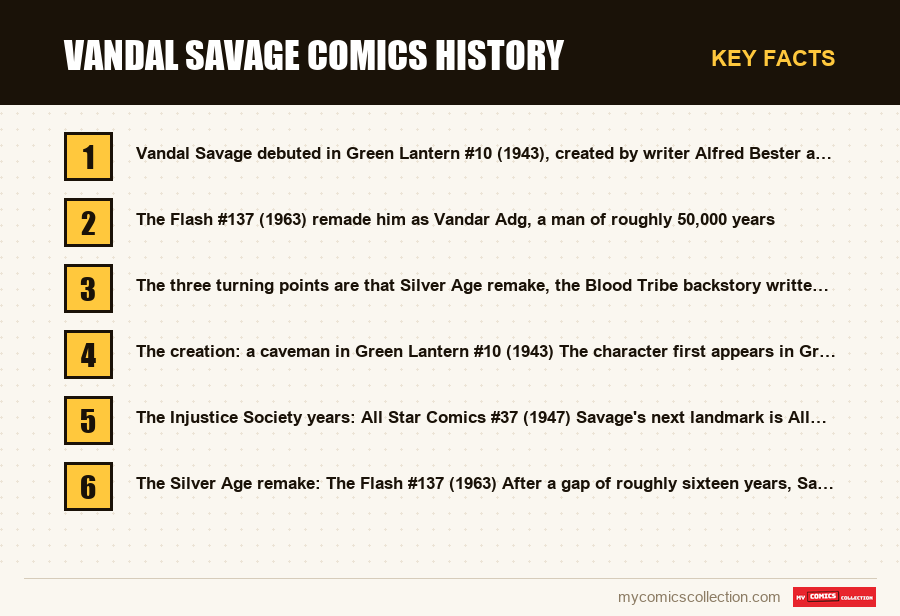
Vandal Savage debuted in Green Lantern #10 (1943), created by writer Alfred Bester and artist Martin Nodell, as a caveman made immortal who claims to be a million years old. The Flash #137 (1963) remade him as Vandar Adg, a man of roughly 50,000 years. The three turning points are that Silver Age remake, the Blood Tribe backstory written after Crisis on Infinite Earths, and the 2008 miniseries Final Crisis: Revelations, which revealed him to be Cain.
Few DC villains have been on the stands for as long as Vandal Savage, and fewer still have been rewritten as often without ever being retired. His career is a chain of reinventions stretched over eight decades, each one answering the needs of a different generation of editors.
Every title, credit and cover year below was checked against published records, with months kept only where confirmed; what each era means for Savage, and the shelf-building advice near the end, is interpretation.
The creation: a caveman in Green Lantern #10 (1943)
The character first appears in Green Lantern #10, cover-dated 1943, written by Alfred Bester and drawn by Martin Nodell, the artist who co-created Alan Scott. At this point Savage is a Golden Age antagonist in the plainest sense: a Cro-Magnon of enormous age, made immortal by a meteor, who claims to be one million years old. The story ends with the hero dropping him into a pit, a way of removing the villain that suits a series still finding its tone.
What matters for a collector is how little of the later character exists yet. There is no Cain, no Blood Tribe, no Immortal Man, no secret society pulling strings across history. There is a name, a scowl, a prehistoric origin and the one idea that would keep him alive: a man who cannot die is a gift to any writer who needs an enemy who can return. The debut is the foundation of everything below, but it is a thin foundation, and reading it for the later mythology will disappoint.
The Injustice Society years: All Star Comics #37 (1947)
Savage's next landmark is All Star Comics #37, cover-dated 1947, which introduces the Injustice Society, the team created by Sheldon Mayer and Robert Kanigher to battle the Justice Society. Savage is part of that gathering of villains, and the story targets Hawkman. This is where the long link between Savage and the Hawk heroes begins, a thread that later writers would pull until it became a reincarnation feud.
The importance of this appearance is structural rather than dramatic. It places Savage inside the Justice Society's rogues gallery rather than as a Green Lantern foe alone, and it gives him an Earth-Two home. When DC later split its universe into two Earths, the Savage of the 1940s belonged to the older world, which sets up the problem the next editors had to solve: how to bring him to a new readership without a continuity he had never been given.
The Silver Age remake: The Flash #137 (1963)
After a gap of roughly sixteen years, Savage returns in The Flash #137, cover-dated June 1963. The return takes place in the Silver Age Flash title rather than in a Green Lantern book, so the villain now belongs to a second family of heroes.
The remake is what makes the issue a pillar. Savage's age drops from a million years to about 50,000, and he is given a birth name, Vandar Adg. A character who was a one-off threat of the 1940s becomes a figure with a defined past, which is the real beginning of the Savage that later writers use. For a reader following the trajectory, this is where the villain stops being a prop and starts being a history.
Immortal Man and the Bronze Age: from Strange Adventures #177 to Action Comics #552 (1965 to 1984)
Savage gets a lasting opponent in Strange Adventures #177 (1965), which introduces Immortal Man, Klarn, whose amulet is a fragment of the same meteorite that touched Savage. A hero who shares the villain's source of life gives the writers a mirror, and it gave Savage a kind of rival he had not had before.
The feud is cemented in Action Comics #552 and #553 (1984), a two-parter with Marv Wolfman writing and Gil Kane drawing, which sets the pair against each other through the centuries. Before that, Savage shows up in smaller beats: Action Comics #515 and #516 (1981) show him healing from severe injuries, and Action Comics #542 (1983) confirms that he can reform even after near-total destruction. Read together, those issues sketch the power set the later writers rely on. Several of these stories run in Action Comics, which is why Savage is also filed with Superman's enemies even though he was born in a Green Lantern comic.
After Crisis: the Blood Tribe and a rebuilt past (1985 to 1990)
Crisis on Infinite Earths (1985 to 1986) merged Earth-One and Earth-Two, and a villain whose two eras lived on different worlds needed a single biography. History of the DC Universe #1 supplied it: Vandar Adg's people became the Blood Tribe. The post-Crisis version is the one most later stories assume, which is why the issue matters even though Savage is not its star.
The same period fills in the plot logic of the conspiracy villain. If Savage has lived across millennia, he has touched every empire, and the writers who followed treated him less as a conqueror and more as an architect of events from the background. This is the move that ties him to secret societies, and it reaches its most developed form in the next decade.
The 1990s: Time Masters and Resurrection Man
Time Masters #1 to #8 (1990) is the eight-issue time-travel miniseries of this decade in which Savage figures. His backstory of the period also has him founding a secret society, the Children of the Light, while living in ancient Atlantis, and the title is the best illustration of what a time-travel story can do with a man who is present in every era. That Atlantean material adds mythology that later stories mention in passing.
Resurrection Man, the 1997 series by Dan Abnett and Andy Lanning with Jackson Guice, gives Savage a different job. The series runs 27 issues to 1999, and its hero, Mitch Shelley, cannot stay dead. Savage is an immortal villain he has opposed across many lifetimes. Savage funded the Lab, the clandestine organization that hunts Shelley, and the Lab experiments on blood samples taken from Savage and from Immortal Man; the closing issues, #23 to #27, reveal tektites as the source of Savage's immortality. A story that connects the villain to a scientific program and to the reincarnating Hawk heroes belongs to the same thread as the 1947 Hawkman link, a point worth noticing if you read both. Our history of Hawkman shows the other side of that reincarnation feud.
Do you collect this series?
Track what you own, what you are missing and what your collection is worth. 7-day trial.
Start my trial →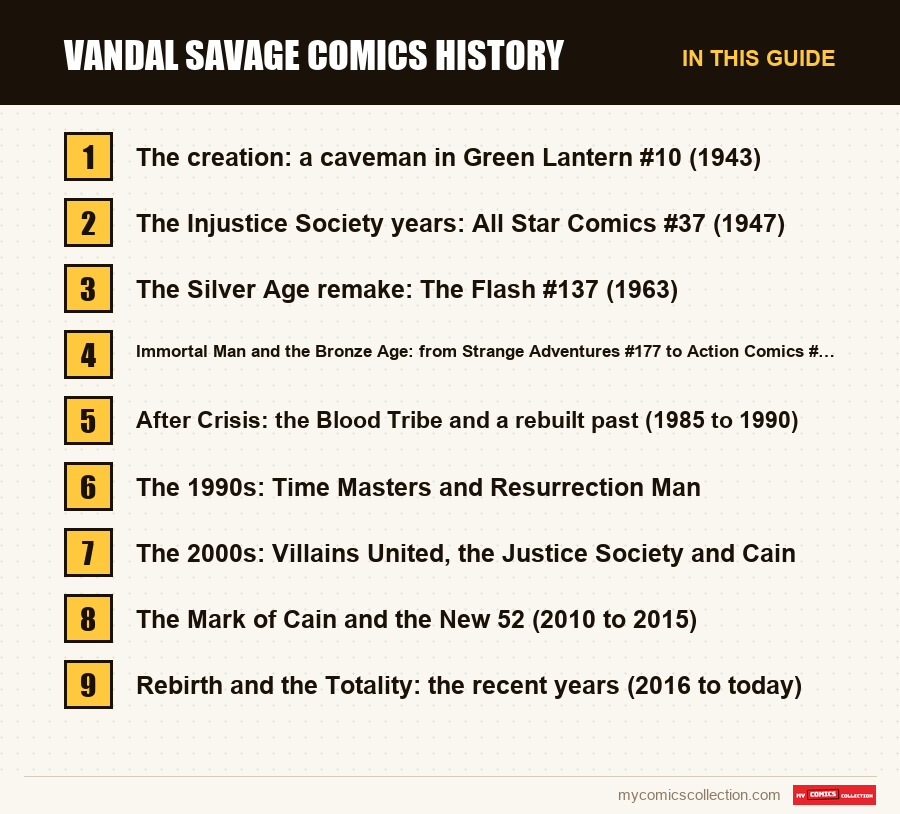
The 2000s: Villains United, the Justice Society and Cain
In Villains United #1 to #6 (2005 to 2006), Savage clashes with the Secret Six, the team his adult daughter Scandal Savage joins against the Society's agenda, which puts him back in the foreground of the DC line rather than behind the scenes. The same decade brings JSA: Classified #10 (2006), where his Thanatos asteroid plot is the main idea.
The Justice Society returns in Justice Society of America volume 3, which begins in 2007 and covers the Fourth Reich storyline in its first four issues. In that arc the Fourth Reich attacks the heirs of Golden Age heroes, and it gives a modern reader a compact picture of the villain. For readers who want a modern entry point, this arc is what most collectors reach for first.
Then comes the reveal that changes the whole character. Final Crisis: Revelations runs five issues, October 2008 to January 2009, scripted by Greg Rucka over Philip Tan's pencils and the inks of Jeff De Los Santos and Jonathan Glapion. In it, Sister Wrack, ringleader of the Religion of Crime, impales Savage with the Spear of Destiny. The spear reveals him to be Cain. Cain defeats the Spectre, enslaves him with the Spear and makes him recite the Anti-Life Equation. Renee Montoya, the Question, purifies the Spear by using it to heal a soul rather than destroy one, and Crispus Allen is given peace. The freed Spectre cannot kill Cain, so he casts him out, where he can no longer hide his mark. The effect on the character is enormous: an immortal who had been a collection of different origins now has a single biblical one.
The Mark of Cain and the New 52 (2010 to 2015)
The Cain curse does not end in 2009. In Detective Comics #863 (2010) and Detective Comics Annual #12 (2010), Savage passes the Mark of Cain to Renee Montoya, who removes it. The sequence ties his story to the Gotham side of the DC line, and it ends the idea that his fate rested on a single big event.
The New 52 reboot (2011) remakes the origin once more, this time around a comet. In Demon Knights #4 (2012), he fights evil alongside Etrigan and others in the Dark Ages. These are stories where the character is used as a historical presence rather than a plotter, and Superman volume 3 #50 (2016) returns to the comet, which Superman drives away. If you only read the Savage of this era, you will see a version that differs in origin from both the 1963 and the post-Crisis ones.
Rebirth and the Totality: the recent years (2016 to today)
DC Rebirth (2016) places Savage among the five immortals forming the Council of Immortals, an idea reinforced in Dark Days: The Forge and The Immortal Men (2017 to 2018). In Justice League volume 4 #1 (2018), Lex Luthor seemingly beats him to death with a doorknob made from a piece of the Totality, and in Dark Nights: Death Metal #7 (2021), Savage is restored to the present and joins the Totality. The recent era treats him as a pillar of a vast cosmic structure rather than a man with a single plan.
For a fan of the character, the pattern across eighty years is consistent. Each era redefines the origin, and each keeps the one idea that works: the man who will not die and who is always present when history turns. That is why the same villain can appear in a 1940s Green Lantern story, a 1960s Flash story, a time-travel miniseries and a Justice League opening issue without feeling out of place.
The key issues across his history
- Green Lantern #10 (1943): first appearance, by Alfred Bester and Martin Nodell, with Alan Scott dropping him into a pit.
- All Star Comics #37 (1947): Savage is a founding member of the Injustice Society and targets Hawkman.
- The Flash #137 (1963): the remake that sets his age at about 50,000 years and reveals his original name, Vandar Adg.
- Strange Adventures #177 (1965): Immortal Man, Klarn, arrives with an amulet from the same meteorite.
- Action Comics #552 and #553 (1984): Marv Wolfman and Gil Kane establish the Savage and Immortal Man rivalry across history.
- Time Masters #1 to #8 (1990): an eight-issue time-travel miniseries that suits a villain present in every era.
- Justice Society of America volume 3 #1 to #4 (2007): the Fourth Reich storyline, in which the heirs of Golden Age heroes come under attack.
- Final Crisis: Revelations #1 to #5 (2008 to 2009): Greg Rucka and Philip Tan reveal him as Cain.
How to collect Vandal Savage
There is no Vandal Savage title, so a collection is built across series, and the useful method is to work by era. Start with the modern, accessible books, Justice Society of America volume 3 and Final Crisis: Revelations, which are the easiest to find and read. Add Time Masters, an eight-issue set that is simple to complete, then work backward to the Silver Age The Flash #137, which is a single issue to chase inside the first Flash series. The Golden Age issues, Green Lantern #10 and All Star Comics #37, belong to long runs, so verify the exact series before buying.
Two practical points reduce mistakes. First, Savage appears in different origin versions: the 1943, 1963, post-Crisis and New 52 accounts do not match, so label each issue by the version it presents. Second, several appearances are cameos, so check that he is a main figure in the story before treating an issue as a Savage key. For a ranked reading order, the companion Savage starter guide sorts the stories by accessibility, and the blog gathers other villain timelines.
Frequently asked questions
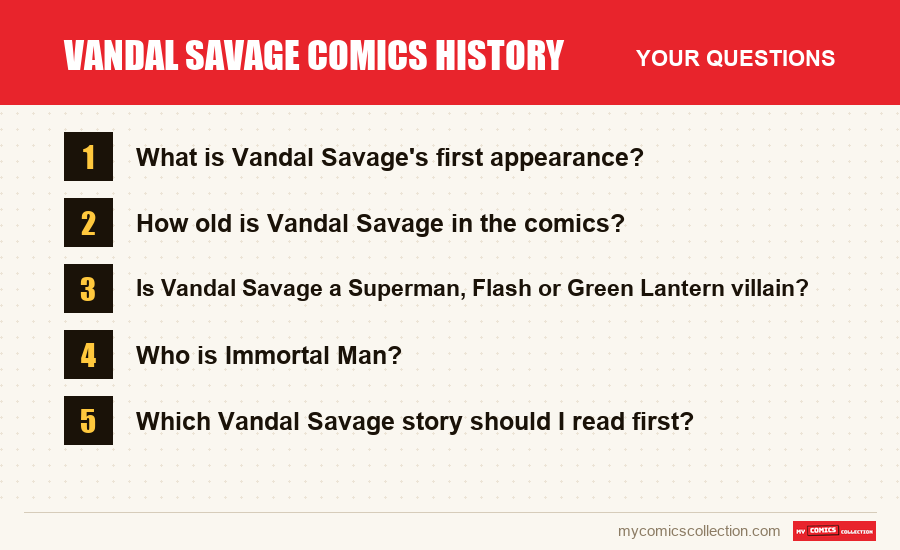
Vandal Savage first appears in Green Lantern #10, cover-dated 1943, written by Alfred Bester and drawn by Martin Nodell. Alan Scott defeats him by dropping him into a pit. Savage claims to be one million years old in that story, a figure that later writers revised, so the debut is best seen as the seed of the character rather than his definitive version.
It depends on the era. In 1943 he calls himself one million years old. The Flash #137 (1963) revises that to about 50,000 years and gives his original name as Vandar Adg. The post-Crisis account builds a Blood Tribe backstory, and the 2008 miniseries Final Crisis: Revelations adds the idea that he is Cain.
He belongs to all three families. He debuts against Green Lantern in 1943, returns in The Flash #137 (1963), and turns up in 1980s Action Comics stories such as the 1984 two-parter with Immortal Man. The Justice Society is the one group that links his major appearances most consistently.
Immortal Man, also called Klarn, is introduced in Strange Adventures #177 (1965). His amulet is a fragment of the same meteorite connected to Savage's immortality. Action Comics #552 and #553 (1984), written by Marv Wolfman and drawn by Gil Kane, establish the two as archenemies across history, which makes him Savage's closest counterpart.
For a modern entry, read the Fourth Reich arc in Justice Society of America volume 3 #1 to #4 (2007), then Final Crisis: Revelations (2008 to 2009) by Greg Rucka and Philip Tan. Add Time Masters (1990) if you like time travel. Go back to The Flash #137 afterward to see how the character was remade.
Found a Vandal Savage key such as The Flash #137 or Green Lantern #10 in your boxes? Get a market-based estimate in seconds.
Estimate my comic