
In short
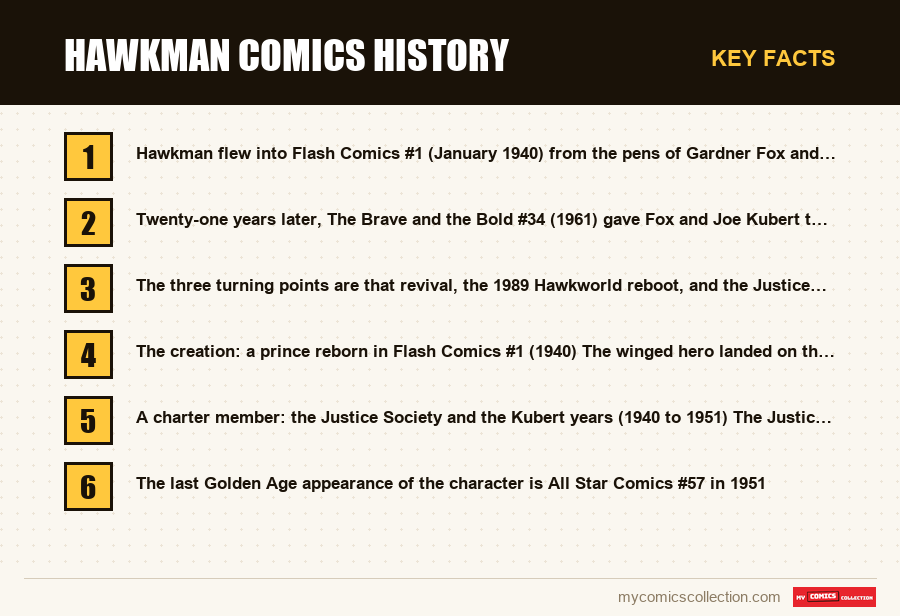
Hawkman flew into Flash Comics #1 (January 1940) from the pens of Gardner Fox and Dennis Neville, as archaeologist Carter Hall, who recalls a past life as an Egyptian prince. Twenty-one years later, The Brave and the Bold #34 (1961) gave Fox and Joe Kubert the chance to remake him as Katar Hol, an alien lawman from Thanagar. The three turning points are that revival, the 1989 Hawkworld reboot, and the Justice Society era that rebuilt Carter Hall as a man who keeps being reborn.
A Golden Age founder, a Silver Age space cop, a reboot, a merger and a reincarnation all answer to the same name, and each leaves a different trail in the back-issue bins.
Names, numbers and cover years in the timeline below were each checked; the closing advice on assembling a Hawkman shelf is our own judgment, and months are named only when confirmed.
The creation: a prince reborn in Flash Comics #1 (1940)
The winged hero landed on the stands with Flash Comics #1, dated January 1940, scripted by Gardner Fox and drawn by Dennis Neville. The premise was bold for a debut: Carter Hall, an archaeologist, is the reincarnation of the ancient Egyptian prince Khufu, who was murdered along with his consort Chay-Ara by the priest Hath-Set. Hall regains those memories, takes up the wings and the weapons of his past life, and hunts the reincarnation of his killer.
The wings work through "Nth metal", a material first called "ninth metal" in those early stories.
Neville drew the first three adventures. Sheldon Moldoff took over the feature afterward, and Joe Kubert followed him. That relay of artists is worth remembering when you look at early covers, because the look of the character changes more than once before the Golden Age ends. The same Flash Comics run carries other debuts that collectors chase, such as the one covered in our guide to Black Canary's first appearance.
A charter member: the Justice Society and the Kubert years (1940 to 1951)
The Justice Society of America counted Hawkman among its members from All Star Comics #3 (Winter 1940), and by issue #8 he was chairing its meetings. The last Golden Age appearance of the character is All Star Comics #57 in 1951. For a historian of the character, this decade defines the "Earth-Two" Hawkman that later writers keep returning to.
The costume evolved with the art. Joe Kubert redesigned the mask in Flash Comics #85 (July 1947), then replaced it with a simple yellow cowl in #98 (August 1948). Those two redesigns are why collectors treat the late 1940s covers as a distinct, more streamlined phase of the character.
Across these eleven years the hero moves from lone avenger with a mythic backstory to senior figure of a team, the veteran later Justice Society books lean on.
Katar Hol arrives: The Brave and the Bold #34 (1961)
When DC revived its heroes in the late 1950s, Hawkman returned in a new form. The Brave and the Bold #34, cover dated February-March 1961, introduced Katar Hol, a police officer from the planet Thanagar, in a story created by Gardner Fox and Joe Kubert. In this version Katar and his partner Shayera Thal are sent to Earth to capture the shape-shifting Thanagarian criminal Byth Rok, and they remain as museum curators under the cover names Carter and Shiera Hall.
The design shifted from archaeology to science fiction. Instead of reincarnation, the Silver Age Hawkman relies on Thanagarian technology and police training, a change that suited the era's appetite for space-age heroes. Kubert, who had drawn the Golden Age feature, now helped define the new look, which gives the 1961 issue an unusual continuity of hand between two generations of the same hero.
From this issue on the character splits in two: Carter Hall and Katar Hol are both Hawkman, yet they are different men with different origins, and publishers would spend decades deciding how they relate.
His own title and the merger with The Atom (1964 and after)
The Silver Age Hawkman earned a series of his own in 1964. Murphy Anderson took over the art for it, with Gardner Fox continuing as writer, and the same year's Hawkman #4 introduced Zatanna in a story scripted by Gardner Fox, an arrival our Zatanna first-appearance guide explores in detail. Hawkman also joined the Justice League of America in issue #31 in 1964.
The solo series was canceled at issue #27, less than five years after its launch, and Hawkman then teamed up with the Atom. The combined book, The Atom and Hawkman, lasted seven issues, numbered #39 to #45.
In this stretch Hawkman is a Justice League member and the headliner of his own book, the classic Thanagarian chapter that later reboots would erase.
Crisis, Hawkworld and the reboot of Katar Hol (1985 to 1996)
In the mid-1980s the character's history became a problem. The Shadow War of Hawkman was a four-part miniseries whose fourth issue is dated August 1985, and the League's story of that era includes Fel Andar, a Thanagarian agent who joined it pretending to be a hero while spying for Thanagar. Then Crisis on Infinite Earths (1985) merged the separate Earths, and the Golden Age and Silver Age Hawkmen suddenly had to share one world. For the event on its own terms, see the Crisis on Infinite Earths issue guide.
A two-Hawkmen history now had to fit on one Earth, and the fix that followed created a larger tangle than the problem.
In 1989 Timothy Truman decided to reboot the Silver Age Hawkman in a three-book series titled Hawkworld. In this version Byth manipulates Katar into killing his own father, and Katar later defeats him.
An ongoing Hawkworld series of the same name followed, numbered #1 to #32 and running from 1990 to 1993. A third Hawkman series then carried the story from 1993 to 1996.
The consequence is the whole point of this chapter. DC rebooted Hawkman continuity after the 1989 miniseries, so the Silver Age adventures no longer fit cleanly, and each later repair added a new layer. For a collector, Hawkworld is the dividing line: before it, one continuity; after it, an increasingly knotted one.
Zero Hour and the JSA untie the knot (1994 to 2000)
In 1994, Zero Hour: Crisis in Time! turned the Hawkman characters into one being: Katar Hol was merged with Carter, Shiera and a "hawk god" creature in a new Hawkman version.
The late-1990s JSA series then did the quieter work. Opened in August 1999 by James Robinson and David S. Goyer, it ran for 87 issues to September 2006, with Geoff Johns joining Goyer as co-writer and then continuing alone. In this book Hawkman is established as Carter Hall, a man who has been reincarnated dozens of times across the centuries. That answer put the Egyptian origin of 1940 back at the center and gave the character a stable meaning that readers could follow.
The Justice Society thread continues in our Justice Society guide and on the Geoff Johns author page.
Do you collect this series?
Track what you own, what you are missing and what your collection is worth. 7-day trial.
Start my trial →
A fresh volume under Robinson, Johns and Morales (2002)
A new Hawkman series, volume four, launched in 2002. James Robinson and Geoff Johns wrote it at the start, with art by Rags Morales, and Justin Gray and Jimmy Palmiotti took over in the third year. It is the book that puts the Johns-era reincarnation story into a solo format and confirms Carter Hall as the center of the franchise.
In 2006 the title changed shape. Issue #50 brought the "One Year Later" relaunch and a new name, Hawkgirl, with Walt Simonson and Howard Chaykin at the helm; the run closed at #66 in July 2007. Hawkman is also a major character in the Rann-Thanagar War miniseries.
One run of issues therefore carries two protagonists, and a set builder must decide where the Hawkman story ends and the Hawkgirl story begins. Our Hawkgirl guide follows that second half.
Death, Black Lantern and the New 52 (2009 to 2011)
The late 2000s tested the character in several directions. Hawkman is killed during Final Crisis, while Hawkgirl survives. In Blackest Night #1 (July 2009) he is killed again and reanimated as a Black Lantern, and in issue #8 (March 2010) the white light resurrects him and Hawkgirl. The sequel, Brightest Day, picks up Carter and Shiera's thread from issue #7 (August 2010) to #24 (April 2011), including a portal to the Zamaron homeworld and the revelation that the Hawks are Elementals, guardians of the forest in Star City.
The 2011 reboot then reset the board. In The Savage Hawkman #1 (September 2011), Carter Hall tries to shed the Hawkman armor, but it re-bonds with him. The series ran #0 and #1 to #20, and in this version Hawkman is Katar Hol, though he uses the name Carter Hall.
The reincarnation hero becomes, for a time, a reluctant man bound to his equipment.
Venditti, Hitch and the present day (2017 onward)
The real Carter Hall returns to the DC Universe in Dark Days: The Forge, and Dark Nights: Metal #4 (February 2018) shows him as the Keeper of the Dark Forge. A new Hawkman series, volume five, helmed by Robert Venditti and Bryan Hitch, followed that event. It was collected in four volumes: Awakening (#1 to #6), Deathbringer (#7 to #12), Darkness Within (#13 to #19) and Hawks Eternal (#20 to #29).
Carter Hall is the lead of this run. His Thanagarian partner Shayera appears in Dark Crisis #2 (September 2022) as a member of the Justice Society.
The layered identity, a reincarnated prince beside an alien police officer, is the reason his collecting history repays patience.
The key issues across his history
- Flash Comics #1 (January 1940): Carter Hall debuts, created by Gardner Fox and Dennis Neville.
- All Star Comics #3 (Winter 1940): Hawkman becomes a member of the Justice Society of America.
- Flash Comics #85 (July 1947): Joe Kubert redesigns the mask, the first of two costume changes before the series ends.
- The Brave and the Bold #34 (1961): a second Hawkman lineage begins with the Thanagarian lawman Katar Hol.
- Hawkman #4 (1964): Zatanna appears for the first time in a script by Gardner Fox.
- Justice League of America #31 (1964): Hawkman joins the League.
- Hawkworld (1989): Timothy Truman's three-issue reboot of Katar Hol.
- Blackest Night #8 (March 2010): the white light resurrects Hawkman after his time as a Black Lantern.
How to follow Hawkman in a collection
Start by deciding which Hawkman you want, because the answer determines the series. For Carter Hall, the 1940 Flash Comics run and the JSA series of 1999 are the backbone. For Katar Hol, the The Brave and the Bold issues from #34 and the 1964 Hawkman series are the Silver Age backbone, with Hawkworld as the modern reboot.
In reprint form, the Silver Age debut of Katar Hol sits in the opening volume of the Hawkman Archives, while the 1940s adventures have their own Golden Age Hawkman Archives books built from the Flash Comics run. The numbering traps are the 2002 series, which becomes Hawkgirl at #50 and runs to #66, and the several volumes titled Hawkman, which need a volume number and a year to be told apart. Our where-to-start guide shows a practical reading order, and the Golden Age collecting guide covers the early issues.
Catalog by series and volume, not by title alone: a shelf of "Hawkman" books can hide five different series, and only the cover year and the creative team tell you which is which.
Frequently asked questions
Carter Hall appears in Flash Comics #1, dated January 1940, created by Gardner Fox and Dennis Neville. Katar Hol comes from Thanagar and stars in The Brave and the Bold #34, cover-dated 1961, which Fox made with Joe Kubert. These are separate debuts for separate Hawkmen.
Carter Hall is the 1940 Hawkman, an archaeologist who is the reincarnation of the Egyptian prince Khufu. Katar Hol is the 1961 Hawkman, a police officer from Thanagar who poses as a museum curator on Earth. The Justice Society books of the late 1990s later reestablished Carter Hall as a recurring reincarnation.
Two separate versions debuted twenty-one years apart, then Crisis on Infinite Earths forced them onto one Earth. Hawkworld in 1989 rebooted Katar Hol, Zero Hour in 1994 merged the Hawkman characters, and JSA restored Carter Hall. Each fix produced new questions, and the later reboots added more.
Carter Hall joined the Justice Society through All Star Comics #3 and chaired it from #8. Katar Hol entered the Justice League of America with issue #31, in 1964. They are different versions of the character in different teams, so they sit in different parts of a collection.
For Carter Hall, start with the 1999 JSA series, then the 2002 Hawkman series by James Robinson and Geoff Johns. For the Thanagarian, pick The Brave and the Bold #34 or Timothy Truman's 1989 Hawkworld miniseries. Robert Venditti and Bryan Hitch's series that followed Dark Nights: Metal is a modern entry point.
Own an early Flash Comics or The Brave and the Bold issue and want a sense of where it stands before you buy or sell?
Estimate my comic