
In short
Warren Publishing's Vampirella #1 (September 1969) introduced her, with Forrest J Ackerman credited as creator, Trina Robbins as costume designer and Frank Frazetta on the cover. She began as a horror host, became the lead under Archie Goodwin, then passed from Warren to Harris Publications (1983 assets, 1991 relaunch) and to Dynamite Entertainment in 2010. Her three turning points are the Warren magazine, the Harris comics of the 1990s, and Christopher Priest's Dynamite run.
Few characters have changed hands as often as Vampirella, and few collections are as easy to scramble. A black-and-white magazine, a run of Harris comics and a long Dynamite catalog all carry the same name on the cover, and each one follows its own rules about format, numbering and tone. This article follows the character through those changes, period by period.
We checked every Vampirella credit, issue range and cover date in this history before writing it, and left out any month we could not confirm for that series. What each change means for a shelf is our own reading, offered without any valuation.
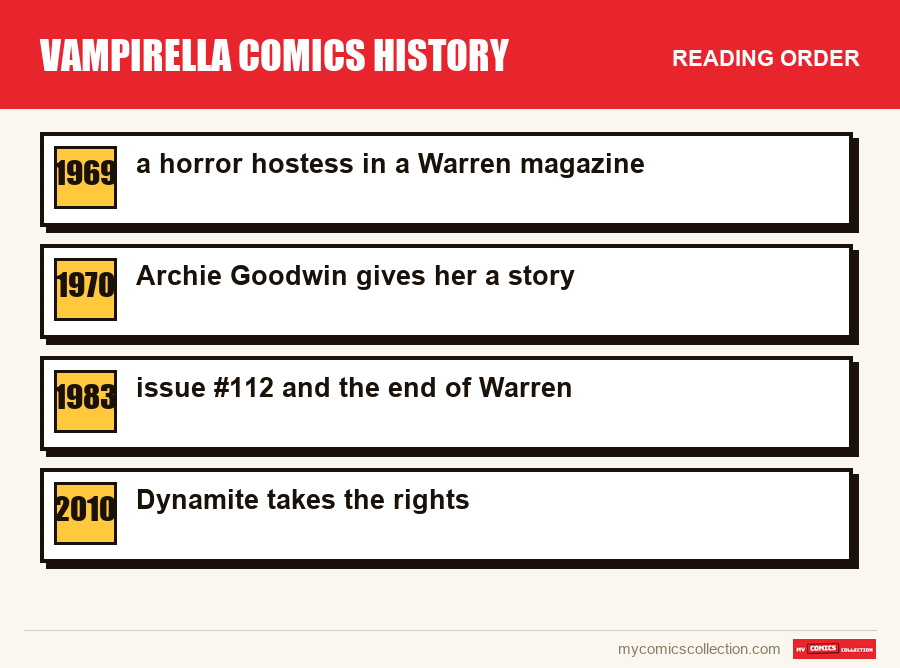
1969: a horror hostess in a Warren magazine
Vampirella was born in a magazine, not a comic book. Vampirella #1 appeared from Warren Publishing with a September 1969 cover date, as a sister title to the publisher's Creepy and Eerie. Those two magazines already had their own hosts, Uncle Creepy and Cousin Eerie, and the new title needed one too. Forrest J Ackerman is credited with the creation, and Trina Robbins designed the costume and the hairstyle that the character still wears.
Frank Frazetta painted the cover of that first issue, replacing a cover originally done by Aslan. Tom Sutton drew the character's first stories. Inside, Vampirella was a presenter more than a protagonist: she introduced short horror tales told by other casts, in the manner of her fellow hosts. That detail matters to collectors, because a Warren issue is a horror anthology that happens to carry a heroine on the cover.
The format also explains why the early run is read and stored differently from a standard comic. It is a black-and-white magazine, and it sits closer to the horror magazines of the period than to the superhero shelf. The same publisher's other magazines are the nearest comparison, not the color comics of Marvel or DC.
From 1970: Archie Goodwin gives her a story
The editorial turn came when Archie Goodwin began writing her. Under his hand Vampirella stopped being only a host and became the lead of her own continuing story, with an origin of her own. By the time the host role faded, she had hosted through issue #8, dated November 1970, and the narrative stories began to carry the book.
The origin that settled in those years is the one many readers still treat as the baseline: Vampirella comes from Drakulon, a world where the vampiric Vampiri face extinction because of droughts, and she reaches Earth after an American space shuttle crashes there. It is a science-fiction frame wrapped around gothic horror, and it separates her from the Dracula tradition that her name suggests.
José González became the primary artist from issue #12, and his line is the look most readers associate with the Warren decade. Other artists passed through, among them Esteban Maroto, José Ortiz, Rudy Nebres and Pablo Marcos, and the editor's chair changed hands several times over the run: Bill Parente at the start, Goodwin for a stretch, then Billy Graham, Bill DuBay and Louise Jones. For a collector, a run of issues from #12 onward is a coherent body of work with a recognizable draftsman.
The mid-1970s and the extras around the main run
Warren did not only publish the monthly numbering. A 1972 annual reprinted earlier stories and a 1977 special reprinted González stories in color, and Vampirella crossed into the sister magazines: Eerie #94 and #95 brought her together with Pantha and the Rook, and Eerie #130 hosted a company crossover special. These are side doors into the character, and they are useful for a collector who wants the full Warren picture rather than the main run alone.
The long middle of the run is where the character spreads out. Editors and artists rotated, stories moved between horror, fantasy and science fiction, and the main numbering kept climbing. This is also the period that gives the Warren run its reputation for variety: no single creative team defines it the way a long Marvel run is defined, and a collector reading it in order meets many hands.
1983: issue #112 and the end of Warren
The Warren series ended with Vampirella #112, dated March 1983. Warren ceased operations the same year, and its assets were sold at auction. Harris Publications acquired them in August 1983, which is the link in the rights chain that every later period depends on. The later legal disputes returned Creepy and Eerie to James Warren, but not Vampirella, who stayed with Harris.
For a collector this break has a consequence: the Warren magazines are a closed set of 112 numbered issues, with the annual and the 1977 special beside them, while everything after belongs to another publisher and another format. Nothing links the two numbering systems directly.
1991 to 1996: Harris relaunches her as a comic
Harris returned to the character through Vampirella: Morning in America, four issues dated September 1991 to April 1992, with Kurt Busiek as writer and Louis La Chance as penciler. It brought the character back to the comics shops of the early 1990s. A new Vampirella series followed, numbered #1 to #5 plus a #0, from November 1992 to December 1994, with Busiek plotting, Tom Sniegoski scripting and Louis Small Jr. penciling.
The same decade added spin-off volume. The 25 issues of Vengeance of Vampirella appeared from 1994 to 1996, written mainly by Sniegoski, with Amanda Conner among the pencilers. Vampirella Strikes filled seven issues between October 1995 and October 1996, passing through several writers, Mark Millar among them. In the Harris telling, Vampirella is the daughter of Lilith, a retcon of the Warren origin that later stories reworked again, placing Drakulon in Hell and having Lilith manipulate her memories.
On the shelf, this is where one heroine turns into several overlapping series that all have to be told apart. It is also the period that Dynamite's later runs partly answer, since the Harris telling of Lilith is the baseline Priest later rewrote.
1995 to 2008: crossovers, Warren Ellis and the magazine formats
Harris used crossovers to place Vampirella next to other characters. Vampirella/Shadowhawk: Creatures of the Night appeared in February and March 1995, Catwoman/Vampirella: The Furies in 1997 as a DC crossover, and Vampirella/Dracula: The Centennial in October 1997, written by Alan Moore. Vampirella Lives put Warren Ellis and Conner together on three issues between December 1996 and February 1997.
The rest of the Harris era went through several formats: Vampirella Monthly from 1997 to 2000, a third Vampirella series from August 2001 to August 2003, Vampirella Comics Magazine, and Vampirella Quarterly from March 2007 to September 2008. Limited series such as Vampirella of Drakulon (1996), Vampirella: Blood Lust (1997) and Vampirella: Revelations (2005 to 2006) filled the gaps.
Seen from the shelf, these are many short-lived formats with different sizes and release patterns. The practical lesson is that a title containing the word Vampirella is not a safe guide to which period a book belongs to: the series name, the volume and the cover date have to be read together.
Do you collect this series?
Track what you own, what you are missing and what your collection is worth. 7-day trial.
Start my trial →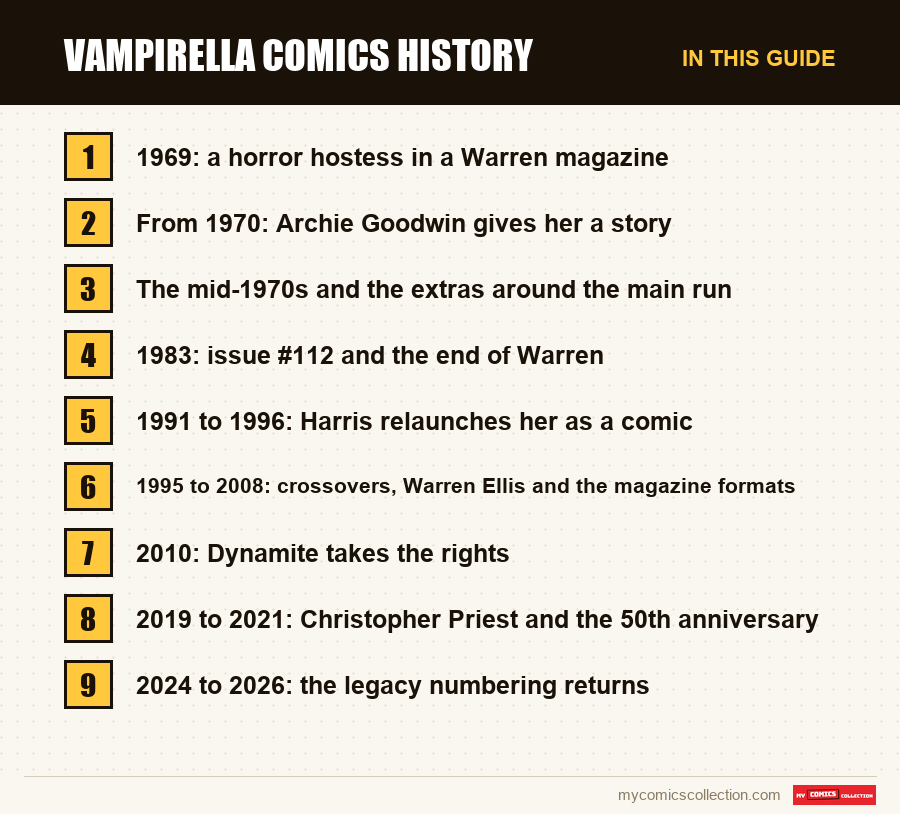
2010: Dynamite takes the rights
Dynamite Entertainment acquired the rights from Harris in March 2010, and published a new Vampirella #1 in November 2010. That first Dynamite series ran 38 issues until 2014, written by Eric Trautmann and Brandon Jerwa, with Wagner Reis and Fabiano Neves among the artists. Joe Harris wrote Vampirella and the Scarlet Legion in 2011 and the crossover Vampirella vs. Dracula in 2012.
Each following volume brought a new creative voice and a new number one. Nancy A. Collins wrote the second volume, 13 issues from June 2014 to June 2015. Kate Leth wrote six issues in 2016 with Eman Casallos on art. Paul Cornell and Jeremy Whitley wrote the fourth volume, issues #0 to #11 from February 2017 into 2018. For readers who follow a character through writers, this is the stretch with the widest tonal range: horror, humor and superhero-adjacent adventure in turn.
The Dynamite approach also multiplied crossovers with its other licenses, the one with Red Sonja among them, which is why the publisher's own history is a useful companion to this one.
2019 to 2021: Christopher Priest and the 50th anniversary
The fifth Dynamite volume began in July 2019 with Christopher Priest writing and Ergun Gunduz drawing, running issues #0 to #25 until November 2021, and it marked the character's 50th anniversary. It is the run that most openly rewrites the mythology: in Priest's version, Lilith is no longer the first woman but a woman from the planet Drakulon, which undoes the Harris telling of the character as Lilith's daughter.
Priest also wrote related projects: Sacred Six (2020 to 2021), Draculina (2022 to 2023), Vampirella: Year One (2022 to 2023) and the crossovers Vampirella/Dracula: Unholy (December 2021 to June 2022) and Vampirella/Dracula: Rage (August 2023 to April 2024). Spin-offs from other writers included Nyx by Christos Gage, Pantha by Tom Sniegoski and Jeannine Acheson, and Victory by David F. Walker.
The same period brought two crossovers with Dynamite's other flagship heroine: Vampirella/Red Sonja (September 2019 to December 2020, written by Jordie Bellaire) and Vampirella versus Red Sonja (November 2022 to March 2023, with Dan Abnett and Alessandro Ranaldi). The 2021 miniseries Vampirella vs. Purgatori, by Ray Fawkes, added one more pairing to the list.
2024 to 2026: the legacy numbering returns
The most recent period borrows a numbering trick. Volume 6 began in February 2024 with a legacy number of #666, running to #675 in March 2025, to mark the 55th anniversary, with Priest, Gunduz and Ivan F. Silva. Volume 7 followed in March 2025 as a new #1 that carried legacy number #676, running twelve issues to February 2026. Volume 8 began in April 2026 with Priest and Davis Goetten, and its first issue carries legacy number #688.
For collectors the legacy number is both a convenience and a trap. It lets a reader place a recent issue in an overall run, but a cover with #688 and a cover with #1 can describe the same book. A catalog entry has to record both, or two copies of one issue can look like two different issues.
The key issues across her history
- Vampirella #1 (Warren, September 1969): the debut, with the Frazetta cover and the first stories drawn by Tom Sutton.
- Vampirella #12 (Warren): the issue from which José González becomes the primary artist of the magazine.
- Vampirella #112 (Warren, March 1983): the last issue of the original Warren series.
- Vampirella: Morning in America #1 (Harris, September 1991): the return of the character as a comic, by Kurt Busiek and Louis La Chance.
- Vampirella/Dracula: The Centennial (Harris, October 1997): the crossover written by Alan Moore.
- Vampirella #1 (Dynamite, November 2010): the issue that opens the Dynamite era after the March 2010 rights deal.
- Vampirella #0 (Dynamite, 2019): the opening of the 50th anniversary run by Christopher Priest and Ergun Gunduz.
- Vampirella #666 (Dynamite, February 2024): the legacy-numbered start of the 55th anniversary volume.
How to follow Vampirella in a collection
Start by deciding which layer you are collecting. The Warren magazines, issues #1 to #112, are one closed set. The Harris comics of 1991 to 2008 are a second, built from many short series. The Dynamite catalog from 2010 is a third, with each volume restarting at #1. Cataloging each layer under its own publisher and volume prevents the most common error, which is merging unrelated issues that share a number.
Record the cover date, the volume and, for the recent run, the legacy number. Keep variant covers separate from the standard cover of the same issue. Because the early books are magazines rather than standard comics, plan storage for the size, and read the comic preservation guide before choosing sleeves. For the broader picture of the publisher that holds the rights today, the Vampirella collecting guide and the Dynamite history are the natural next reads.
Frequently asked questions
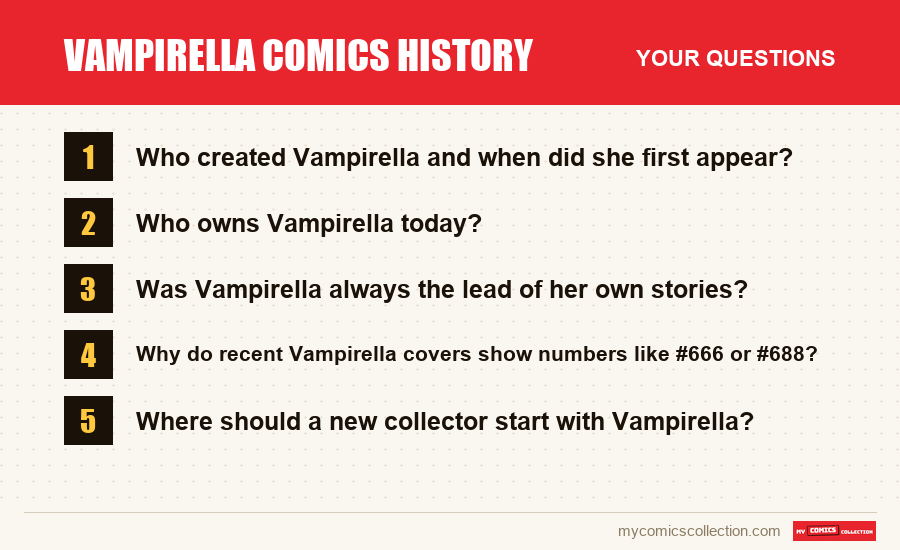
Forrest J Ackerman is credited with creating Vampirella, and Trina Robbins designed her costume and hairstyle. She debuted in Warren Publishing's Vampirella #1, dated September 1969, with a Frank Frazetta cover and first stories drawn by Tom Sutton.
Today the rights sit with Dynamite Entertainment, whose purchase from Harris is dated to March 2010. Harris had bought the assets of Warren Publishing at auction in August 1983, so the rights moved from Warren to Harris to Dynamite over four decades.
No. In the earliest issues she was a horror host who introduced stories starring other characters, until issue #8 in November 1970. Archie Goodwin then developed her into a lead with her own story, and José González became the main artist from issue #12.
Dynamite restarts the series often, so it prints a legacy number to place each issue in the character's overall run. Volume 6 opened at #666 in February 2024, volume 7 carried legacy number #676, and volume 8, from April 2026, begins at #688.
Pick one layer and read it in order. For modern comics, Christopher Priest's run from July 2019 is a self-contained starting point. For history, the Warren magazines come from 1969 to 1983. The Harris era begins with the 1991 miniseries Morning in America, by Kurt Busiek.
Found a Warren magazine or a Harris comic in a box? Describe it and see where it fits among the three eras of Vampirella.
Estimate my comic