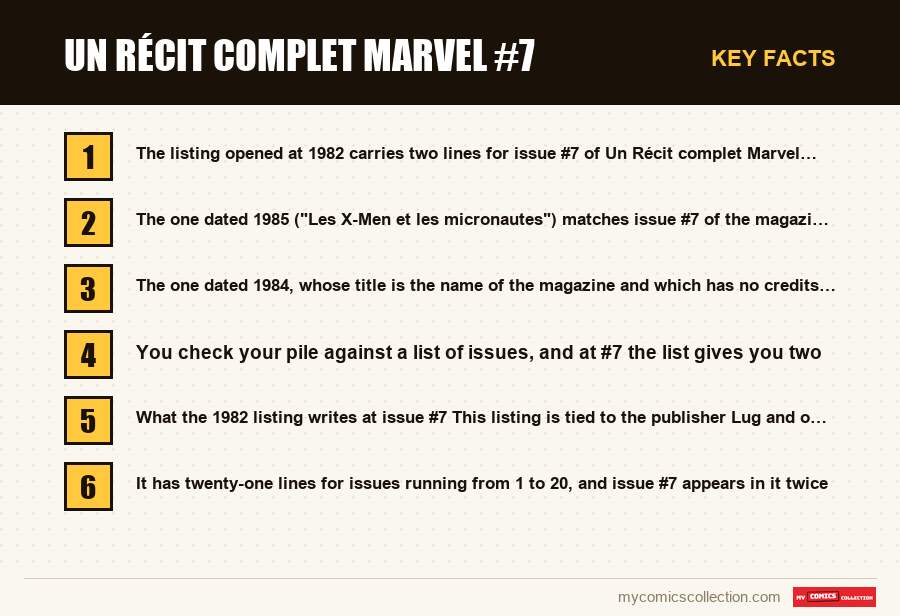
The listing opened at 1982 carries two lines for issue #7 of Un Récit complet Marvel, and they are not identical. The one dated 1985 ("Les X-Men et les micronautes") matches issue #7 of the magazine's other listing, opened at 1984, by year and by three names. The one dated 1984, whose title is the name of the magazine and which has no credits at all, has no counterpart anywhere. Sources disagree on the rest.
You check your pile against a list of issues, and at #7 the list gives you two. Before searching for a second booklet or striking a line at random, you need to know which ones are attested elsewhere, and which rest on a single entry.
As always on this guide, only verified information (creators, issue numbers, dates) is stated as fact. The analysis is ours, with no reproduction of panels or protected dialogue.
What the 1982 listing writes at issue #7
This listing is tied to the publisher Lug and opened at the year 1982. It has twenty-one lines for issues running from 1 to 20, and issue #7 appears in it twice.
The first line carries the date 1984, the title "Un Récit complet Marvel" and no name. The second carries the date 1985, the title "Les X-Men et les micronautes" and three names: Bill Mantlo, Christopher Claremont and Butch Guice.
The three comparable fields differ: the year, the title, the credits. A strict duplicate entry would be the same information copied twice, field for field. That is not the case: to the question of identical copying, the answer is no. What remains is the useful question, namely whether each line describes an object found elsewhere.
What the other listing says, at the same row
The magazine has a second listing, opened at 1984, which has twenty lines for twenty distinct rows, from 1 to 20, with no duplicate line at all. At row 7 it gives only one line: "Double jeu," dated August 1985, with Chris Claremont and Bill Mantlo on script and Butch Guice and Jean Frisano on art.
This second listing is richer, because it separates writing from art and sometimes gives a month where the first gives only a year. It has no 1984 line at row 7, and none of its twenty lines uses the name of the magazine as its title.
The 1985 line: matched, with a title that diverges
The second line of the 1982 listing lines up with "Double jeu": same row, same year, and three out of three names in common, Claremont, Mantlo and Guice. The 1982 listing mixes the names into a single field, without roles, which explains why there is no separate artist. Only Jean Frisano is missing.
The title, however, diverges: "Les X-Men et les micronautes" on one side, "Double jeu" on the other. This is not unique to this pair of listings: at issue 3, "Le Tournoi des champions" faces a long and different title, with Mantlo in common. A title divergence between two listings is therefore not, on its own, proof of two objects. It can also be a sign of two ways of naming the same booklet, without the listing saying which one is printed on the object. Sources disagree, and only the copy settles it.
To go further on the character side, the X-Men hub gathers the reference points.
The 1984 line: with no counterpart anywhere
This line has neither a story title nor credits: it attests that a description existed for an issue 7, without giving its contents. It is the only one of the twenty-one lines to carry the name of the magazine as its title, and the only one with no name at all.
It matches nothing: not at row 7 of the other listing, dated August 1985, nor at another row, since its title appears nowhere there. Its 1984 date falls outside the sequence, like the 1984 line of issue 14: without these two lines, the years do not go backward from one number to the next.
Three readings remain open: a provisional entry made before the contents were known, a date error, or a distinct booklet that only this listing would have seen. The listing cannot choose among them, and one would need a copy dated 1984 bearing the number 7 to retain the third.
Do you collect this series?
Track what you own, what you are missing and what your collection is worth. 7-day trial.
Start my trial →
The neighbors: three before, three after
Before 7, the 1982 listing gives "La Vision et la sorcière rouge," "Œil de faucon" and "Le Faucon" at issues 4, 5 and 6. After it, it gives "Le Valet de cœur," "Hercule l'Olympien" and "Tornade et Illyana" at issues 8, 9 and 10. Each of these six issues has only one line there.
The other listing confirms the titles of issues 4, 5, 6 and 8, apart from capitalization.
It diverges at issues 9 and 10: 9 is "Hercule l'Olympien II" there, and 10 is "Magie." At 10, the name carried by the 1982 listing is "Chris Claremond," a spelling variant of "Claremont": an exact-name search would miss that line.
For a Storm storyline, the Storm hub provides entry points.
The move from 1984 to 1985 happens between issues 4 and 5.
The move from 1985 to 1986 happens between issues 8 and 9. A 1985 issue at number 7 therefore occupies the expected place, which the 1984 line does not.
Three other rows with two lines, and what they teach
Rows 2, 14 and 19 also carry two lines. In all three cases, one of the lines is the 1982 listing's version of the issue of the same row in the other listing: "Hercule l'Olympien" at 2, "Les Vengeurs de la côte Ouest" at 14, "Méphisto" at 19.
The other line, for its part, points elsewhere. The "Prince des mers" carried by 14 is the title the other listing places at row 11. "Diablo," at 19, is the one it places at row 17. The "Serval" at 2 repeats the title of issue 1 in the same listing.
The lesson is precise: at these three rows, the extra line is probably a story from another issue, filed in the wrong place. Issue 7 is the only one of the four where the extra line matches no known title. It would be wrong to file it with the others without saying so.
Rows 11, 13 and 17, absent from the 1982 listing
The 1982 listing has no line for rows 11, 13 and 17: three absences, not two.
The other listing, for its part, carries all three: "Le Prince des Mers" at 11, "Le châtiment" at 13, "Diablo" at 17. The numbers are therefore not holes in the magazine: they are holes in one listing.
That does not mean these rows exist physically, since both listings are descriptions. But the absence no longer counts as evidence of non-publication. In a list of gaps, record these three numbers as "present in one listing, absent from the other," not as "non-existent."
Same caution for the total: the 1982 listing has twenty-one lines, seventeen distinct rows, and a span from 1 to 20. The other listing has twenty lines for twenty rows. Write down in your list which unit you are counting.
On the copy, and in your list
Note the printed number, then any date in the legal notices. An "August 1985" corresponds to the matched line. A 1984 year at issue 7 would be a case to document, with a photograph of the cover and of the notices page. Then note the title of the main story and the printed names, with their spelling.
In a spreadsheet or in the app, a single entry is enough for issue 7 as long as you hold one copy. Add a note: "two lines in one listing, only the 1985 one cross-checked." If a second copy from another year turns up, enter it as a distinct entry at the same row.
No value is given here: it depends on condition and on the copy, which only a hands-on examination can assess.
Frequently asked questions
Not in the sense of a copy: they differ by year, title and credits. One, the 1985 line, matches the magazine's other listing; the other, the 1984 line, has no counterpart anywhere. The listing alone does not settle whether it is a provisional entry, an error or a distinct booklet.
Compare the printed year and title. The 1985 line gives "Les X-Men et les micronautes" with three names, and the other listing dates the August 1985 issue under the title "Double jeu." The 1984 line carries only the name of the magazine: a 1984 copy would need to be documented.
Nothing says so. The 1982 listing has no line for them, as with 17, but the other listing describes all three, with a title and credits. The absence from one listing is therefore not non-publication: record these rows as "to be verified" rather than as non-existent.
The data neither establish nor exclude it. The two listings largely overlap by row, title and names, which suggests a single sequence described twice, with sometimes different dates. To decide, one needs copies and their legal notices.
The listing gives one title per issue, not the table of contents. "Les X-Men et les micronautes" names the announced story, and the other listing gives a different title. Neither says whether it is the first French publication. Read the copy's table of contents before asserting anything.