
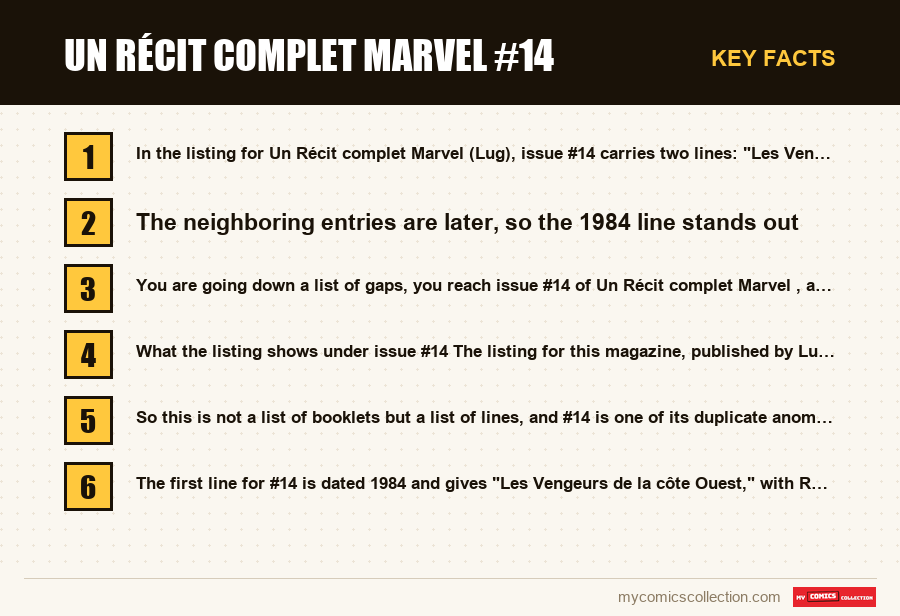
In the listing for Un Récit complet Marvel (Lug), issue #14 carries two lines: "Les Vengeurs de la côte Ouest," dated 1984, and "Le Prince des mers," dated 1986. The neighboring entries are later, so the 1984 line stands out. A second listing of the same magazine finds both titles again, with a rank or a date that changes: the duplicate looks like noisy data entry rather than two booklets. Sources disagree; the copy settles it.
You are going down a list of gaps, you reach issue #14 of Un Récit complet Marvel, and the catalog presents two records for a single slot. Should you look for two booklets or one? The honest answer fits in one sentence: the data do not allow a conclusion, and this page explains why, what it nevertheless establishes, and how to avoid getting it wrong when you tick the box.
As always on this guide, only verified information (creators, issue numbers, dates) is stated as fact. The analysis is ours, with no reproduction of panels or protected dialogue.
What the listing shows under issue #14
The listing for this magazine, published by Lug, has 21 lines for 17 distinct issues, numbered 1 to 20. Three numbers are missing within that range, and four appear twice. So this is not a list of booklets but a list of lines, and #14 is one of its duplicate anomalies.
The first line for #14 is dated 1984 and gives "Les Vengeurs de la côte Ouest," with Roger Stern, Bob Hall and Brett Breeding. The second is dated 1986 and gives "Le Prince des mers," with "Jean-Michel de Matteis, Bob Budiansky, Danny Buladani," spelled as in the listing. Two titles, two teams of three names with no name in common, two years apart.
A reading note before going further: the artist column is empty across all 21 lines, and every name sits in the writer column. The listing credits the booklet, not the episode; it would be imprudent to deduce who wrote and who drew.
Two hypotheses, and the trace each should leave
First hypothesis: two distinct booklets really did receive the number 14. If so, any other listing of the magazine should show the same duplicate, and two distinct objects should exist that can be set side by side.
Second hypothesis: the listing is not one more sequence but a noisy entry of the same sequence as another listing of the magazine, with rows and dates poorly transcribed. If so, each of the two lines should reappear in the other listing, at its row or a neighboring row, with a date that fits in.
A third lead, a simple date error, explains only half the problem: it does not account for two titles and two teams under one number. We keep it in reserve for the 1984 line, not for the whole.
What the neighboring dates settle
Thirteen numbers in the listing have only one line, and on those thirteen the date never goes backward: it climbs from 1982 to 1988 in steps. This is the safest chronological thread in the list, and it serves as the yardstick for judging the duplicated lines.
The three single-line numbers before 14 are all dated 1986; the three after it are dated 1987. The 1986 line for 14 therefore slots in without friction between the two groups. The 1984 line, beyond issue 7, is the only one in the listing bearing that year: it belongs to an earlier period of the magazine than its immediate neighbors.
Be careful about what this test does not prove. A date consistent with its neighbors makes the line plausible in that position; it does not prove that the number recorded is the right one. We will see that next.
What the second listing of the same magazine says
The catalog contains another listing of the same Lug magazine, opening in February 1984: 20 rows, from 1 to 20, where each row appears only once. In this second listing, "Le Prince des Mers" occupies row 11 and carries 1986; "Les Vengeurs de la Côte Ouest" occupies row 14 and carries 1987, with Roger Stern on script and Bob Hall on art.
The comparison is instructive because it does not give the same verdict for both lines. For "Les Vengeurs de la côte Ouest," the number matches (14) but the date diverges: 1984 on one side, 1987 on the other, and 1987 is the year of the two issues that follow here. For "Le Prince des mers," the date matches (1986) but the number diverges: 14 on one side, 11 on the other.
Consequence for the two hypotheses. The first is not confirmed: the second listing shows only one line at number 14 and places the other title elsewhere. The second is supported: each of the two lines of 14 has its equivalent, one in the same row with another date, the other in another row with the same date. Neither forces us to imagine an extra booklet.
The rest of the listing points the same way: matching the 21 lines against the 20 of the other listing by title, 10 find the same row and title, 4 find their title under another row, and 7 have no equivalent. The listing therefore reads as a second, noisier entry of the same sequence, not as a second launch.
But the second listing is not an arbiter. Other titles change rows there too: "Firestar" is at 12 here and at 16 there, "Diablo" at 19 here and at 17 there. Two lists that contradict each other do not indicate which one is right.
Do you collect this series?
Track what you own, what you are missing and what your collection is worth. 7-day trial.
Start my trial →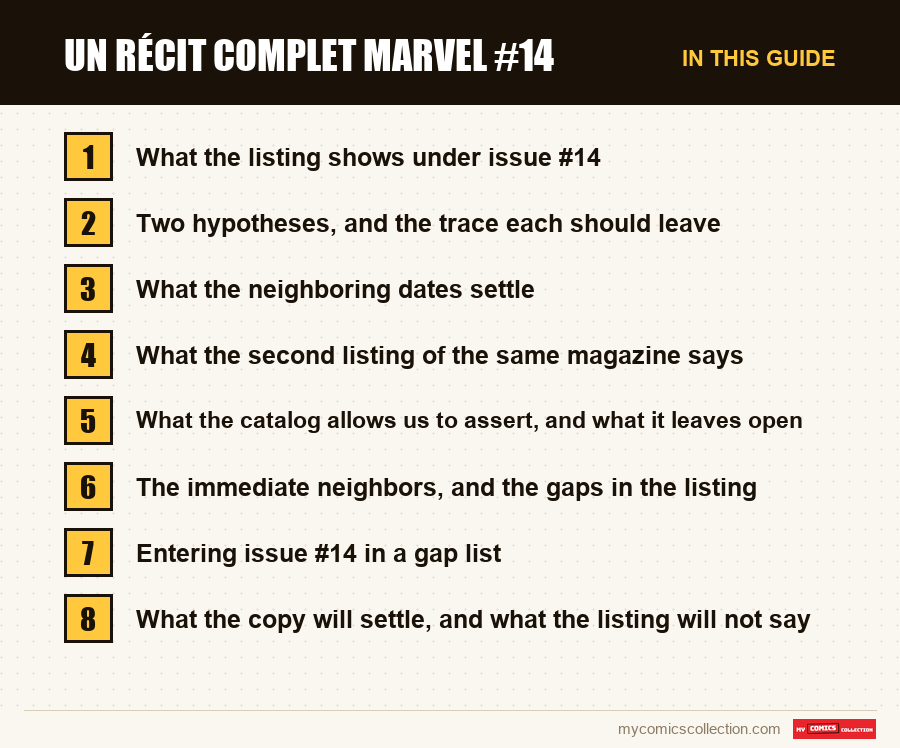
What the catalog allows us to assert, and what it leaves open
What is established: the listing carries two lines under 14, with different titles, creators and dates; the 1984 line is incompatible with the chronology of the rest of the list; each of the two titles appears in a second listing, under two different rows and with one date per title.
What remains open: the number printed on the booklet "Le Prince des mers," 14 or 11, and the actual date of "Les Vengeurs de la côte Ouest." Sources disagree, and nothing in the listing's fields (a title, a date, credits at booklet level) allows a decision without a copy in hand. This page will therefore not assert it, and it leaves you the criterion to do so.
The immediate neighbors, and the gaps in the listing
Before 14, "Firestar" is credited to Tom DeFalco, Steve Leialoha and Mary Wilshire. After it, "La Belle et la bête" is credited to Ann Nocenti and Don Perlin, then "Iceberg" to Jean-Michel de Matteis and Alan Kupperberg. The name of Jean-Michel de Matteis thus returns on the 1986 line of 14 and on its second successor: a neighborhood clue, nothing more.
Numbers 11, 13 and 17 are absent from the listing. "Absent from the listing" does not mean "does not exist": the second listing does have a 11, a 13 and a 17, with titles and dates. For a list of gaps, these three slots should therefore be treated as unknown, not as empty.
If you are looking for the Avengers line, you can match it with the Avengers hub to place the team in your collection; the title alone is enough, since the catalog does not say which American issue the story corresponds to.
Entering issue #14 in a gap list
Do not group the two lines under a single tick. Create two distinct entries, each with its title: "Les Vengeurs de la côte Ouest," date to be confirmed, and "Le Prince des mers," rank to be confirmed (14 or 11). Note the source of the doubt next to them, so you do not lose it at the next check.
If a copy enters your collection, the title printed on the cover decides which entry you tick, and the printed number decides what you record in the rank column. One purchase does not close both entries: buying one teaches you nothing about the other. If you manage your list in the app, keep the same principle: one title, one observed rank, one observed date.
What the copy will settle, and what the listing will not say
On the object, three readings matter: the number as printed on the cover and spine, the story title announced on the cover or title page, and any date or quarter mention in the legal notices, if it carries one. Compare them with the two lines above; the direct reading outweighs the listing, whichever it is.
Do not ask the listing for what it does not carry. It gives only one title per number, no table of contents, no verified French first appearance, no match with an American issue. It does not say what the rest of the booklet contains: the table of contents is read on the copy. For a value, the method goes through condition and the current market, not through a grid.
Frequently asked questions
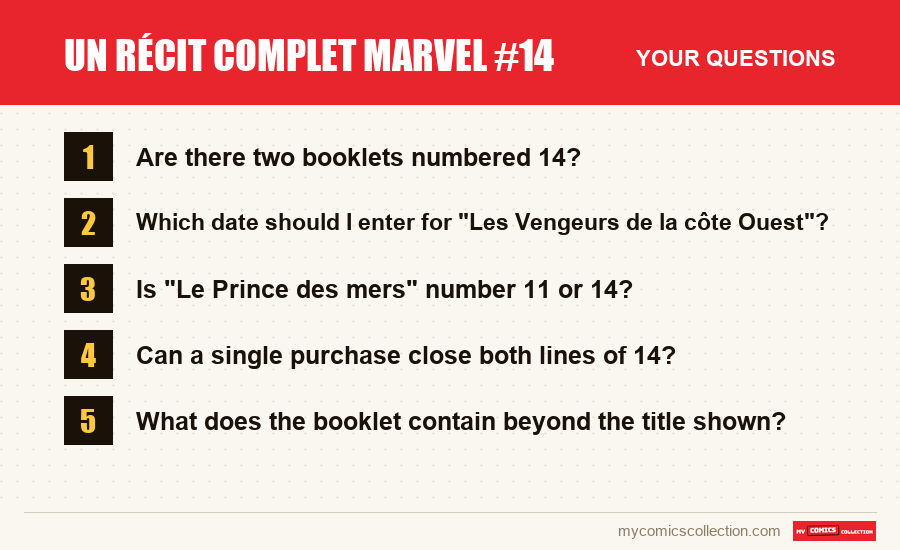
The listing suggests it, but the magazine's second listing does not confirm it: it places "Le Prince des mers" earlier, at row 11, and keeps only one line at row 14. Sources disagree. As long as no copy has been read, it is safer to speak of two lines under one number than of two booklets.
Here, 1984; in the second listing, 1987. The neighbors of 14 are dated 1986 and 1987, which favors 1987, without proving it. Enter both years with a question mark, then correct from the date notice of your copy if it carries one.
The main listing says 14, the second says 11, with the same year in both cases. Row 11 is missing from the main listing, which makes the hypothesis of a shift credible without demonstrating it. Only the number printed on the booklet settles the question.
No, as long as the two titles are distinct. Each title corresponds to a different booklet according to the two listings, and a title printed on the cover gives no right to tick the other. Keep two entries and close them separately, each on the strength of a copy read.
The catalog does not say: it gives a title, a date and credits at booklet level, not a table of contents. The rest is read on the copy. Also avoid deducing an American issue number or a first appearance from it: the data do not allow that match.
To follow this kind of doubt across your purchases, the other guides on the site are gathered in the blog.