
To get into the series by Bendis and Bagley, the most complete option remains the June 2021 Panini Omnibus, with the first thirty-nine issues and the half issue. For a lightweight format, the 2024 “Marvel Poche” collects the first thirteen episodes. Collectors of the first French edition will look for the Panini magazine launched in 2001 or the “Marvel Deluxe” volumes, older and more endearing than practical.
Few series have had their French version change its look as often: newsstand magazine, jacketed albums, tomes of nearly a thousand pages, then pocket books. The result is that the same original adventure exists in several presentations, and the cover title does not always tell you which one you are holding.
As always in this guide, only verified information (creators, issue numbers, dates) is stated as fact; the analysis is our own, with no reproduction of protected pages or dialogue.
The US original in brief
“Ultimate Spider-Man” launched at Marvel in October 2000, spearheading the Ultimate imprint that reinvents the house heroes for a new audience. Brian Michael Bendis writes, with Bill Jemas credited alongside him on the first issues, and Mark Bagley draws. The series restarts Peter Parker's origin from zero: a present-day high schooler, an omnipresent Norman Osborn, a contemporary New York.
The first run goes up to issue 133, which gives the measure of the undertaking for anyone who wants to own everything in French. On top of that come a half issue, annuals and satellite miniseries such as “Ultimate Six”, which the French editions include according to different logics. To place the character in his long history, our history of Spider-Man in comics puts things back in order; here, we limit ourselves to books published in French.
Two particularities weigh on reading in French. First, the series has so many issues that it lends itself to big collections, which publishers have sliced in very different ways. Second, the first arc can be read on its own, whereas what follows leans on characters introduced along the way: the starting point of the book you choose therefore determines what you will understand when you open it.
The French editions, in order of publication
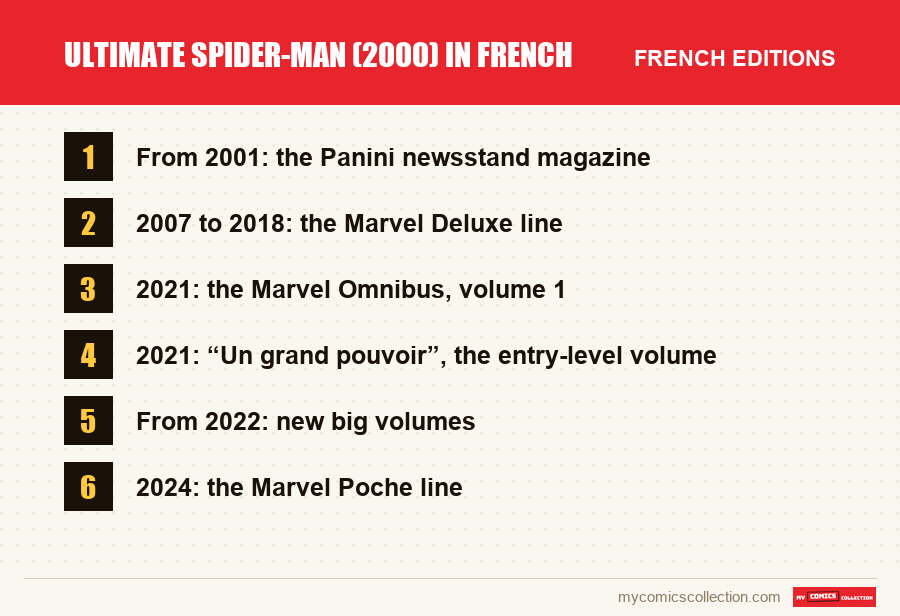
From 2001: the Panini newsstand magazine
The first French encounter with this version of Spider-Man came through a newsstand magazine, published by Panini Comics in its “Marvel France” line starting in 2001. It reprints the American issues in order, in booklets, and a special edition of the first issue, printed in limited numbers, also circulated.
For the collector of French editions, this is the original French edition; it is shelved with the magazines of its era, not with the albums. The total number of issues and the end date are not given here: rely on the issues you hold and on the legal notices of each booklet.
2007 to 2018: the Marvel Deluxe line
In bookstores, Panini publishes the “Marvel Deluxe” line, large-format albums with dust jackets. The first volume came out in April 2007 and gathers the first thirteen episodes, with previously unpublished extras, across three hundred forty-four pages. The second, “Face-à-Face” ("Face to Face"), follows in March 2008 and covers issues 14 to 27. The third, “Verdict”, dated 2009, covers issues 28 to 39: the impostor story, then the first clash with Venom.
The line comprises twelve volumes and ended in 2018. The ninth, “La Saga du clone” ("The Clone Saga"), appeared in 2015 and covers issues 97 to 105. For the intermediate volumes, dates vary according to announcements, which often reflects reprints: always check the legal notice page before concluding that a copy is a first printing.
2021: the Marvel Omnibus, volume 1
On June 9, 2021, Panini launched its “Marvel Omnibus Ultimate Spider-Man” with a first volume, “Pouvoirs et responsabilités” ("Power and Responsibility"), of nearly a thousand pages. It gathers issues 1 to 39 and the half issue, which is what the first three “Marvel Deluxe” volumes spread across three books. The appeal is the unity of reading: the origin saga, the impostor, Venom and their aftermath can be read without changing volumes.
Later printings exist, which brings us back to the question of reprints discussed below. In practice, a volume of this thickness demands care: it is read resting on a surface, not held in one hand on public transport.
2021: “Un grand pouvoir”, the entry-level volume
On July 15, 2021, a softcover volume of two hundred eight pages appeared, announced under the title “Un grand pouvoir” ("With Great Power") or, in the “Best of Marvel” line, under “Pouvoirs et responsabilités”. It is an introductory volume, not a reference edition, and its table of contents deserves a read before purchase. It serves as a test before investing in a big volume.
From 2022: new big volumes
Panini continues from 2022 with massive numbered volumes, among them “Hollywood” and “Ultimatum”. They extend the first Omnibus for readers who want to follow the series further. With no issue range displayed here for these tomes, consult the printed table of contents before any follow-up purchase.
2024: the Marvel Poche line
On April 3, 2024, volume 1 of the series appeared in Panini's “Marvel Poche” line: issues 1 to 13, three hundred forty-four pages, in a 23 by 16 centimeter format. It is the lightest way to discover the series, provided you accept that the collection is built volume after volume and that the run is not yet complete.
US / French edition correspondence
| French edition | Volume or issue | US issues included |
|---|---|---|
| Marvel Deluxe (April 2007) | Volume 1 | #1 to 13 |
| Marvel Deluxe (March 2008) | Volume 2, Face-à-Face | #14 to 27 |
| Marvel Deluxe (2009) | Volume 3, Verdict | #28 to 39 |
| Marvel Deluxe (2015) | Volume 9, La Saga du clone | #97 to 105 |
| Marvel Omnibus (June 2021) | Volume 1 | #1 to 39 and ½ |
| Marvel Poche (April 2024) | Volume 1 | #1 to 13 |
For the intermediate “Marvel Deluxe” volumes, refer to the printed table of contents of each volume rather than to this table, which is limited to established volumes.
Do you collect this series?
Track what you own, what you are missing and what your collection is worth. 7-day trial.
Start my trial →
Which edition to choose for your profile
The reader who wants to read everything cleanly. The Omnibus volumes. They offer the most issues per volume, continuous numbering and a recent presentation. Start with volume 1, then judge whether the rest suits you before continuing.
The reader who travels or is just discovering. The “Marvel Poche”. It does not commit you to a big shelf investment and slips into a bag. Stick to volume 1 to test the tone, and move on to the big volumes afterward if the series hooks you.
The collector of the first French edition. The 2001 Panini magazine, possibly completed by the “Marvel Deluxe” volumes. It is the presentation closest to the era, with its limits: often worn booklets, a collection spread very thin, and little reading value if you already own a collected volume.
The large-format enthusiast. The jacketed “Marvel Deluxe” albums. Their book format, covers and paper appeal to lovers of objects, though the content is no better than that of the Omnibus volumes.
To know which issues deserve to be owned in period printings, also rely on our list of key issues of Ultimate Spider-Man.
Pitfalls and points to watch
The first pitfall is the title. “Pouvoirs et responsabilités” designates the first volume across several formats: the Marvel Deluxe, the Omnibus, the pocket edition and, according to announcements, a 2021 volume of two hundred eight pages. Check the line, the page count and the year before buying or selling, because two books with the same title may not contain the same episodes.
The second concerns reprints. Announcements sometimes give the date of the latest printing rather than that of the first release, and the same volume numbering can reappear years later. For a collector, the printing notice matters as much as the title, since the first edition of a volume is generally more sought after than its later printings.
The third concerns numbering. The same arc can appear in a collection of the Deluxe line, in an Omnibus or in a more recent volume, without the volume number matching: do not look for an episode in a volume without consulting its table of contents. Our comparison of the Omnibus and Absolute formats helps clarify the difference between these presentations.
Finally, a pitfall specific to this series: the half issue and the annuals. They do not appear in every collection, so that a "complete" omnibus of the start of the series may lack an episode that another volume has. Before reselling an older volume because an Omnibus replaces it, check that all of its content is indeed in the new one.
What these editions are worth as a collection
The value of a French edition depends on three things: its scarcity, its condition and its binding. In this line, the most coveted piece is the 2001 magazine, with its issue 1 and even more its limited special printing. The “Marvel Deluxe” volumes follow, with differences between volumes: the first ones, older and often out of print, stand apart from the latest, more recent ones.
The Omnibus volumes and recent big volumes trade like mass-market books: their price depends above all on condition, the presence of the dust jacket, the printing and availability from the publisher. The pocket editions are aimed first at the reader, and let you read without touching fragile copies.
To estimate a copy, compare it to completed sales of the same edition and the same printing, noting the condition, the jacket and any extras. Set aside listings that confuse several editions under one title, and never compare an Omnibus to a Marvel Deluxe of the same name: they are not equivalent. For a newsstand magazine, look at the corners, the spine and any center crease. Our guide collecting French editions: where to start details this method, without citing prices.
One last preservation tip, specific to big volumes: store them flat or well wedged, without tilting them, because the weight of nearly a thousand pages ends up warping the spine of a book shelved at an angle. A jacket protected by a clear sleeve holds its value better than a jacket exposed to light.
Frequently asked questions
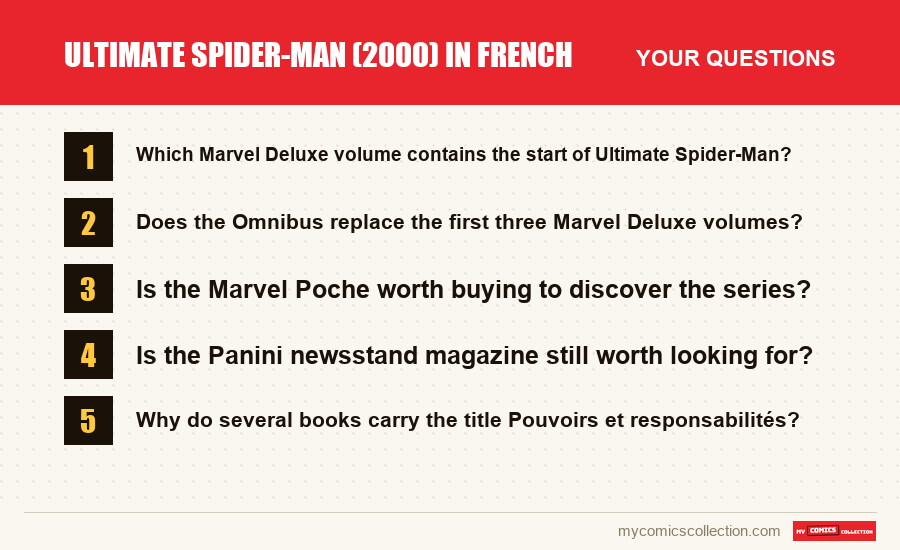
Volume 1 of the “Marvel Deluxe” line, released in April 2007, collects the first thirteen episodes by Bendis and Bagley, with extras. Volume 2, “Face-à-Face”, picks up with issues 14 to 27 in March 2008, then volume 3, “Verdict”, covers issues 28 to 39.
For reading, yes: the Marvel Omnibus volume 1 of June 2021 contains issues 1 to 39 and the half issue, which is the material of the first three Deluxe volumes. For a period collection, no, because the object, the jacket and the extras of 2007 to 2009 differ from those of the Omnibus.
Yes, if you are looking for an entry point: the April 2024 volume 1 gathers issues 1 to 13 in three hundred forty-four pages, in a 23 by 16 centimeter format. For what follows, compare with the Omnibus volumes depending on where you want to pick up the story.
It mostly interests the collector of the first French edition: it is the original French publication, launched in 2001, but it reads less comfortably than a collected volume. Examine the condition of the booklets, the printing notice and the completeness of your run of issues before paying more for a single one.
Because it is the title of the first arc, reused for the first volume of each format: Marvel Deluxe, Omnibus, pocket. The page count and the line distinguish them, as do the issues contained: thirteen episodes in the pocket edition, thirty-nine plus the half issue in the Omnibus.
Have you found an issue of the 2001 Panini magazine or a first-printing Marvel Deluxe? Estimate it before deciding.
Estimate my comic