In short
Typhoid Mary first appears in Daredevil #254, cover dated May 1988. Ann Nocenti wrote the issue and John Romita Jr. penciled it. In it Mary Walker meets Matt Murdock, and the Kingpin hires her as an assassin. The character carries three personalities: the timid Mary, the adventurous Typhoid, and the brutal Bloody Mary. The book sits inside Nocenti's long run on the series and is the issue collectors mean when they search for her debut.
Most Daredevil keys belong to the Frank Miller years, and the book most buyers circle for Typhoid Mary comes from the stretch that followed. Daredevil #254 is the issue where a new kind of antagonist walks into Matt Murdock's life, wearing a face he can trust. This page works through the May 1988 book piece by piece: date, makers, setup, the checks a copy deserves and the roster of later returns.
Before writing, the May 1988 date, the Nocenti and Romita Jr. credits, the three personalities and the five later appearance groups were each checked; the notes on condition, filing and buying order are analysis, and no amounts appear because sales move constantly.
The identity of the issue: cover date, creators and place in the run
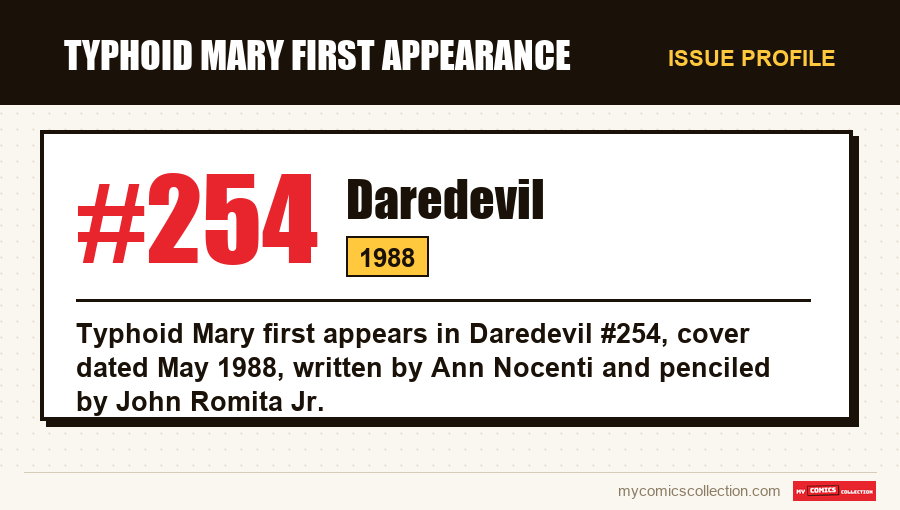
Daredevil #254 carries a May 1988 cover date. The writer is Ann Nocenti and the penciler is John Romita Jr., and the two are named together as the creators of Typhoid Mary. The issue belongs to the first volume of Daredevil, the series that began in 1964, and it lands in the middle of Nocenti's tenure as the regular writer.
That tenure is worth fixing in your notes because it frames every copy on the shelf. Nocenti started on the series with #236, dated November 1986, with Barry Windsor-Smith illustrating. She became the regular writer from #238 and stayed through #291, dated April 1991, skipping only #246 and #258. That gives a run of a little more than four years, and #254 falls roughly in the middle of it.
Romita Jr. is the artist whose name is tied to this book, and his stint is shorter than the writer's. He penciled #250 through #282, from January 1988 to July 1990, and those issues were generally inked by Al Williamson. Because that credit describes the stint as a whole, the safe way to record #254 is to log the writer and penciler as above and read the inker's name off the credits box of the copy you hold, rather than assuming the general pattern holds for every page.
The credits as a set therefore read like this: story by Ann Nocenti, pencils by John Romita Jr., cover date May 1988, first volume, issue #254. Colorist, letterer and story title are not needed to name the book, so copy them from the indicia of your own copy. A listing that gets those five items right is describing the correct issue.
How Typhoid Mary is introduced
The issue establishes two things at once: a woman Matt Murdock can fall for and a killer the Kingpin can use. In the debut, Mary Walker meets Matt Murdock, and Wilson Fisk, the Kingpin, hires her as an assassin. Those are the two relationships the character is built on, and both are visible from the first appearance.
The design of the character is what makes the issue stand apart from a standard villain debut. Mary has three personalities. The first, simply Mary, is timid, quiet and pacifistic. The second, Typhoid, is adventurous, lustful and violent. The third, Bloody Mary, is brutal, sadistic and hostile toward men. The page you are reading is describing a character who changes registers, so the debut is less a fight scene than the setup of a puzzle.
In the early stories, the gentler alter ego, Mary Walker, is the one who dates Daredevil. That detail matters for a reader coming to the issue cold: the romance with Murdock and the assassin work for the Kingpin run side by side. A collector explaining the issue to a newcomer can say it in one sentence: a quiet woman enters Matt's life, and the crime lord quietly employs her as a killer.
The creators and the editorial moment
Nocenti's name is attached to a distinct tone on this series. Her run touched social subjects such as sexism, racism and nuclear proliferation, while Matt Murdock ran a nonprofit urban legal center, and she was known for outspoken political views, including on animal rights. Typhoid Mary is a character who fits that approach, since her central conflict is about identity and about how a person is read by the people around her.
Nocenti also created Blackheart, who debuted in #270, dated September 1989, so #254 is not the only new character of her tenure. It is, though, the one most often searched for by collectors, and the two issues are separated by about a year and a half of the same creative team on the same series. Before her Daredevil work, Nocenti had served as the series editor of Uncanny X-Men for issues #183 to #232 and of The New Mutants for #17 to #66, from 1984 to 1988.
Her connection to the character did not end with the monthly book. In the mid 1990s she wrote a four issue Typhoid Mary miniseries for Marvel, with John Van Fleet, published from 1995 to 1996. A collector who wants the author's own continuation of the idea can use that miniseries as a companion read, and it is a cleaner place to follow the character than hunting for scattered cameos.
On the art side, Romita Jr. penciled this book, which makes it a natural pick for completists of the artist. Those who follow his work can pair the issue with the broader reading advice in the guide to his career, and with the John Romita Jr. author page, which gathers the other books he drew.
Why #254 matters to collectors
A first appearance gains weight from three things: how recognizable the character is, how often the character returns, and how hard the issue is to find in good condition. Typhoid Mary scores unevenly on those, and that unevenness is the honest way to describe the book. She is recognizable among Daredevil readers, and she returns across several decades and several series.
The return pattern is the strongest argument. After her debut she resurfaced in The Spectacular Spider-Man #214, dated July 1994, where she battles Spider-Man when Bloody Mary comes back. She hired Deadpool in Deadpool volume 2 #6 and #7 in June and July 1997, and she tricked him in #13, dated February 1998, while disguised as Siryn. She reappeared in Avengers: The Initiative #4, dated September 2007, as Mutant Zero in disguise, with the storyline continuing in #5 and #20. In X-Men volume 4 #9 and #12 in 2014, she joins the Sisterhood of Mutants.
The second argument is the position within the Daredevil canon. "Born Again", the 1986 storyline by Frank Miller and David Mazzucchelli, is the Kingpin material most Daredevil readers already know. Typhoid Mary arrives a few years later, and her debut is a way to own a piece of the Kingpin's world that is not the Miller material. For a shelf built around the Kingpin's circle, a copy of #254 is the natural bookend to The Amazing Spider-Man #50.
The third argument is the one every buyer has to weigh alone: scarcity at a given grade. For a comic from 1988 the practical question is less whether a copy exists than whether a particular copy is sharp, flat and unrestored. That is why the next sections focus on inspection rather than on rarity claims.
Do you collect this series?
Track what you own, what you are missing and what your collection is worth. 7-day trial.
Start my trial →
Reprints, collected editions and confusions
The first thing to separate is the original issue from any later appearance of the character. Typhoid Mary's name was used for different stories in different years, and a listing that says "Typhoid Mary" without an issue number can be describing any of the books listed above, or the 1995 to 1996 miniseries. The debut is the Daredevil issue with the May 1988 cover date, and nothing else substitutes for it.
What to check before buying a copy
Start with identification. Confirm the number, #254, and the May 1988 cover date on the cover, and confirm both again in the indicia inside. Check that the title is the first volume of Daredevil and not a later series that reuses the name. Look at the credits box for Nocenti and Romita Jr., and read the inker's name there rather than assuming it.
Then examine the spine. A comic of this period is stapled, and the spine is where handling shows first: look for stress lines, color breaks that reveal white paper, and small splits near the staples. The spine tells you how often the book has been opened and how carefully. A tight, flat spine with an unbroken ink surface is the quality to look for.
Examine the corners and edges next. Blunting of the corners, chipping along the edges and small tears at the top of the spine all affect the grade, and a photograph taken at an angle in raking light will reveal creases that a front-on image hides. Ask for photographs of the back cover as well, since a clean front can hide a damaged rear.
Look at the interior pages for tanning, foxing and stains, and compare the page color with the cover. A cover that is brighter than the pages it protects can be a sign of something worth asking about, while an even tone across the book is reassuring. Check that the centerfold is secure and the staples are not rusted, since rust can leave marks that spread.
Restoration is the item to settle before any money changes hands. Color touch, spine repair, tear sealing and cleaning can all change how a book looks without changing the printed number. If the Daredevil book arrives in a plastic case, any restoration is declared by the label, so read that line before the grade number. If a copy is raw, ask the seller directly whether any work has been done, and treat an evasive answer as an answer. On an encapsulated #254, check that the label's issue number agrees with the cover and look up the serial with the grading company itself.
Where to follow the character after #254
The nearest follow-up is the Nocenti era itself. Since she wrote #238 to #291 with Romita Jr. penciling #250 to #282, a reader who wants the debut in context can read forward from #254 with the same team before judging whether the character works for them. Nocenti's run also covers the Blackheart debut in #270, which gives a second reason to keep going.
The Spider-Man crossover and the 1990s Deadpool run come next. The Spectacular Spider-Man #214, dated July 1994, is where Bloody Mary resurfaces against Spider-Man. In volume 2 #6 and #7, dated June and July 1997, the personalities hire Deadpool and Vamp, and in #13, dated February 1998, Typhoid Mary tricks Deadpool by disguising herself as Siryn. These books show a different tone from the Daredevil years, and they extend the character into a very different kind of comic.
Later comes Avengers: The Initiative, where she appears as Mutant Zero in #4, dated September 2007, with the storyline running through #5 and #20, dated February 2009. A collector who enjoys the idea of a character hiding in plain sight will find that run satisfying, since the disguise is the point.
For readers who want the wider Daredevil backdrop, the modern age key issues guide and the Daredevil first appearance guide place #254 within the series as a whole, and the key artists guide explains how the series changed hands over the decades.
Building a Typhoid Mary shelf in a sensible order
A tidy way to approach the character is by role. Begin with the debut, #254, since everything else refers back to it. Add one or two of the Nocenti and Romita Jr. issues that follow so that the debut sits in its own storyline. Then choose a single crossover appearance that matches your other collecting interests, such as the Spider-Man issue or one of the Deadpool books.
Frequently asked questions
Typhoid Mary first appears in Daredevil #254, with a cover date of May 1988. The issue was written by Ann Nocenti and penciled by John Romita Jr. In the story Mary Walker meets Matt Murdock, and the Kingpin hires her as an assassin. Daredevil #254 sits in volume one, the series that began in 1964.
Writer Ann Nocenti and artist John Romita Jr. created her in Daredevil #254. Nocenti wrote the series from #238 to #291, and Romita Jr. penciled #250 to #282. Nocenti later wrote a four issue Typhoid Mary miniseries in 1995 and 1996, with John Van Fleet.
The character has three personalities. Mary is timid, quiet and pacifistic. Typhoid is adventurous, lustful and violent. Bloody Mary is brutal, sadistic and hostile toward men. Her gentler alter ego, Mary Walker, dates Daredevil in the early stories, while the Kingpin employs her as an assassin.
She appears in The Spectacular Spider-Man #214 from July 1994, in Deadpool volume 2 #6, #7 and #13 in 1997 and 1998, in Avengers: The Initiative #4, #5 and #20 between 2007 and 2009, and in X-Men volume 4 #9 and #12 in 2014.
Match the number and May 1988 date on cover and indicia, then examine the spine, corners and pages. Ask about restoration, since color touch and spine repair change a book without changing its number. For a graded copy, read the label type and verify the serial number with the grader.
Holding a copy of Daredevil #254 from May 1988 and unsure of its grade? Run it through a free valuation.
Estimate my comic