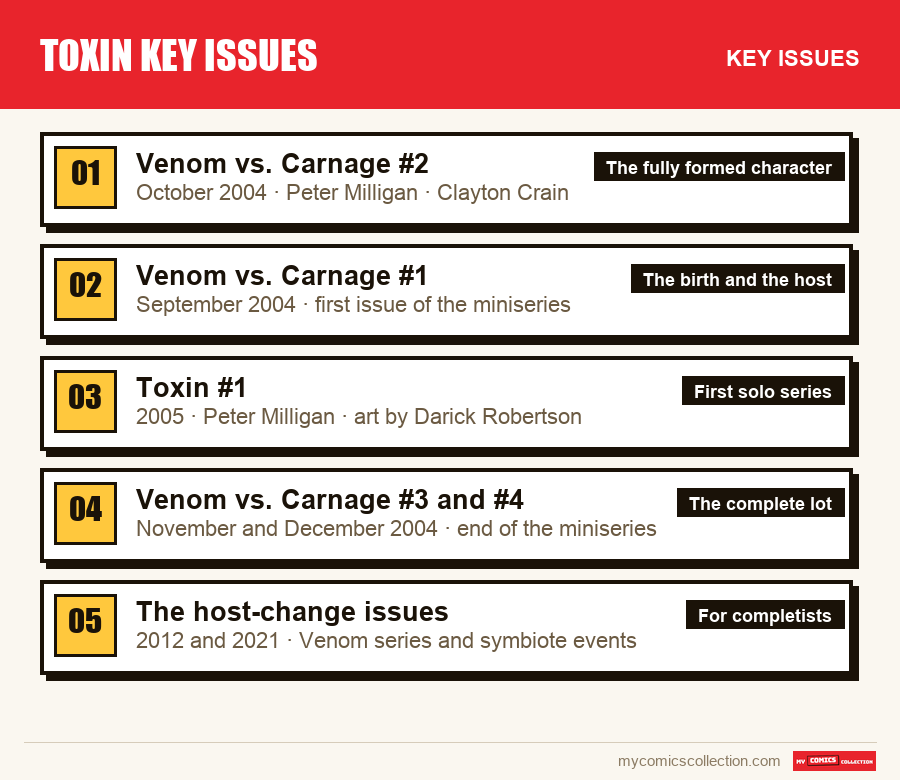
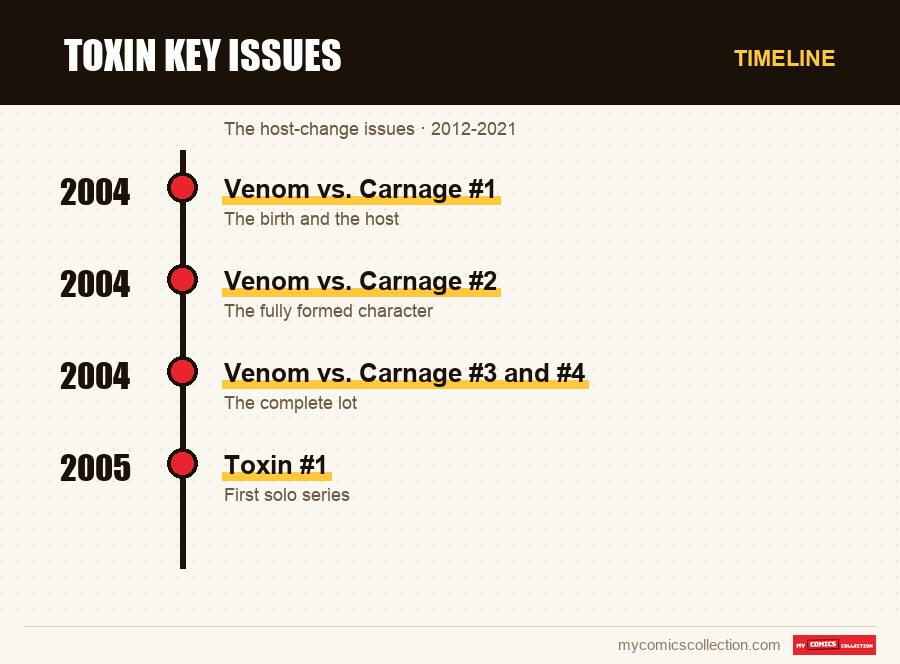
The key issues of Toxin, third-generation symbiote after Venom and Carnage, are concentrated in the Venom vs. Carnage miniseries (four issues, September to December 2004), written by Peter Milligan and drawn by Clayton Crain. Two issues count, and not for the same reason: Venom vs. Carnage #1 introduces the police officer Patrick Mulligan and the symbiote's birth, still reduced to a trace on his neck, while Venom vs. Carnage #2 shows the fully formed character and gives him his name. Next comes the Toxin solo series, six issues released in 2005, then far more discreet host-change issues. All are still found without difficulty on the secondary market, which makes Toxin an affordable collecting ground, provided you accept a thin market and a demand hanging on the screen.
There is a category of characters whose key issues fit on one hand, whose genealogy nobody disputes, and that almost no collector hunts. Toxin is one. Offspring of Carnage, himself offspring of Venom, he forms the third generation of a lineage whose first two members are among the most expensive pieces of the modern market.
This position produces a curious situation. The same family tree that made Amazing Spider-Man #300 and Amazing Spider-Man #361 out of reach of most budgets leaves its third-generation issues within reach. It is not an oversight of the market, nor is it a bargain by definition. It is the mechanical consequence of weak demand, and the whole question is whether this demand can move.
This article says where the issues are, in what order to take them, what the market's thinness implies for whoever buys and whoever resells, and what triggers would raise interest. We give no price: on a character of whom few copies are sold, an isolated amount describes nothing.
What makes Toxin a particular case in the lineage
In the mechanics of this family of characters, each generation is presented as more powerful than the last. Toxin is therefore, in fiction, the strongest of the three. In market logic, he is the least in demand of the three. Both statements are true at once, and that is the whole interest of the file.
The reason is simple: demand does not follow a character's power, it follows their exposure. Toxin had a four-issue miniseries, a six-issue solo series, then an intermittent career.
Second particularity, more favorable: his original host is not a criminal. Patrick Mulligan is a New York police officer, and the 2004 story makes him a character who tries to contain the alien's instincts rather than follow them. This heroic orientation explains why the 2005 solo series could put him against classic adversaries from the catalog without making it a pure horror title.
Third particularity: the artist. Clayton Crain works in digital painting, with a dense, immediately recognizable rendering, which gives the 2004 miniseries a strong visual identity. The covers of the 2005 solo series were entrusted to several different painters, including Esad Ribic, Simon Bisley and Duncan Fegredo.
The issues to aim for, in order of importance
Here is the useful list, ranked by what it really brings and not by age. It is deliberately short: beyond sixth rank, we enter the realm of filler.
Venom vs. Carnage #2
This is the issue where the character truly exists: the symbiote fully bonds with Patrick Mulligan, takes the silhouette we know, and receives the name Toxin, given in the story by Venom himself. If you must buy only one issue of this branch, it is this one: full appearance and explicit naming.
Venom vs. Carnage #1
The opening issue introduces Patrick Mulligan and contains the symbiote's birth, at this stage a mere trace deposited on the officer's neck. It is therefore both the host's first appearance and the organism's very first appearance, but not that of the costumed character. In market vocabulary, we are on the partial-appearance side.
Toxin #1
Six issues, the same writer as in 2004, a very different artist. The series follows Mulligan, now a former police officer, in a New York overwhelmed by a mass criminal breakout, each issue pitting him against an adversary from the catalog with passages of Spider-Man. The first issue of a first solo series is a category apart: it is the document proving the publisher believed in the character.
Venom vs. Carnage #3 and #4
These two issues carry the character's second and third appearances and conclude the story. Their interest is practical more than speculative: they turn two isolated issues into a complete miniseries, which reads and passes on better than a fragment.
The host-change issues
The symbiote passes to Eddie Brock in the second Venom series, in issue 17 released in 2012, after Mulligan's death staged in the same series. Later, after being absorbed in a confrontation tied to the Darkhold, it returns with teenager Bren Waters, introduced in King in Black: Planet of the Symbiotes #3 in 2021 then featured in the one-shot Extreme Carnage: Toxin, released in September 2021 under Steve Orlando's pen.
What "thin market" means concretely
The expression comes up in all discussions of second-tier characters, generally unexplained. It covers four realities, and each changes the way of buying.
Few copies are sold, so the landmarks are blurry. On a major key issue, dozens of transactions each month draw a readable curve. On an issue like those of 2004, weeks can pass between two comparable sales, and two close copies sometimes go at very different levels without that meaning anything. That is why citing an amount here would be misleading.
The gap between asking price and price obtained is wide. An offer with no buyer stays listed a long time, so visible listings over-represent optimistic sellers. You must therefore look at what closed, not what is offered.
Resale is slow. A thin market is comfortable to buy in, since nothing is urgent and nobody outbids. It is uncomfortable to sell in, because finding the next buyer takes time. If your horizon is to resell within the year, it is not the right ground.
High grades are few without being rare. A 2004 comic has not suffered the decades of handling of an older key issue, and a copy near mint is nothing exceptional. On the other hand, few people have judged it useful to have these issues certified, which gives modest graded populations. A low population is not proof of scarcity: it may simply signal nobody spent money on grading. The distinction is developed in our guide to grading applied to symbiote issues.
Demand depends on the screen, and the screen has not decided
On a second-tier character, demand does not come from the readership of single issues, too small, but from mainstream exposure. Toxin's recent history on this ground shows an intermediate scenario nobody anticipates.
The second film devoted to Venom, released in 2021, introduced a character named Patrick Mulligan, played by Stephen Graham, and ended on an emphasized shot hinting at a transformation to come. For anyone who knew the comics, the message was legible, and interest in the 2004 issues logically progressed at that moment. We detail the gaps between this film and the comics in our comparison of the second film and its source.
The third film, released in October 2024, did bring the character back, with the same actor, and a symbiote is indeed associated with him. But this symbiote is never named on screen. The name Toxin only appears in the official subtitles of a trailer. In other words, the character was shown without ever being designated, which is exactly the worst configuration for collecting demand: too much to be ignored, not enough to trigger a mass search. The transmission mechanisms between a theatrical release and prices are described more broadly in our analysis of the effect of adaptations on the market.
Three triggers can still move demand, and it is useful to name them so as not to react to just any rumor.
- An explicit designation on screen. As long as the name is not spoken, the general public has no word to type in a search, and demand does not form. It is the most powerful trigger of the three, and the only immediate one.
- A new regular series devoted to the character. A series announced with an identified creative team always revives interest in the original issues, because it guarantees visibility for several months in shops.
- A structuring role in a symbiote event. Not a filler appearance, but a place that changes the character's situation. It is the slowest and most durable trigger, because it creates new key issues rather than merely warming up the old ones.
Conversely, two signals are worthless: an unconfirmed casting rumor, and a spinoff product.
Where Toxin stands in the symbiote universe in 2026
The state of play is clear, and it must be said frankly because it works against a short-term rise. The 2026 symbiote news has concentrated elsewhere. The Death Spiral arc, published from February to May 2026 across the Amazing Spider-Man and Venom series, rests on a new configuration where Mary Jane Watson wears the Venom symbiote and Eddie Brock has become Carnage, facing an adversary named Torment. Toxin does not appear in it.
This finding has two opposite consequences. On one side, the absence of current publication means the absence of a catalyst: nothing today pushes the 2004 issues upward. On the other, the intensity of editorial activity around symbiotes shows the franchise is far from dormant.
To place Toxin relative to the rest of the family, our overview of the symbiote universe presents the other offshoots, and the list of Carnage key issues gives the immediate point of comparison: it is by putting the two lists side by side that you measure the difficulty gap between the second and third generation.
Method: building the file in four steps
Set the scope before looking at a single listing
Two options stand. The minimal scope is the first two issues of 2004: the birth and the fully formed character. The reasonable scope is the four issues of the miniseries plus the first issue of the 2005 solo series, five issues. Writing this scope before searching avoids the drift that turns a list of five issues into sixty.
Check the issue number, not the listing's mention
Since the first appearance is shared between two issues, descriptions are often approximate: rely on the number printed on the cover and the publication date, never on the presentation text. The 2004 miniseries has also reappeared under a title carrying the mention Spider-Man at the head, and a reprint does not have the original edition's status. Our guide to reprints and misleading copies explains how to tell them apart.
Buy the condition, not the grading
On an accessible 2004 issue, the cost of a certification can represent a significant share of the object's value. Grading only makes sense for a truly near-mint copy, or to address buyers who only buy certified. Otherwise, a fine raw copy, stored flat and out of the light, is the best ratio between spending and pleasure.
Buy outside news periods
It is the only serious advantage a thin market confers. These issues only move when information puts them back in circulation; outside those windows, sellers are few but so are buyers, and negotiation is possible. The week following an announcement is the only moment when a second-tier issue is paid for like a key.
The mistakes that cost dearly on a second-tier character
Confusing accessible and undervalued. A cheap issue is often correctly valued for the demand it meets. It becomes undervalued when an objective element is not yet taken into account by the market, a rare and temporary situation, detailed in our review of the truly undervalued symbiote issues.
Buying in quantity because it is cheap. In a thin market, reselling five copies of the same issue is much harder than reselling one, because buyers are counted one by one. One copy in fine condition is worth more than five average copies.
Transposing the reasoning of previous generations. Applying the trajectory of the first two generations to the third by mere genealogical analogy is the most widespread mistake on this file. Kinship in fiction does not transmit on the market.
Forgetting the adjacent issues. Around a first appearance, the issues before and after tell part of the story and remain very accessible, as we detailed for the previous generation in our study of the issues adjacent to Carnage's keys.
Not keeping a list. The covers of the 2004 miniseries are very homogeneous, in a dark palette and a similar format, and duplicates come quickly. A list you can consult at purchase time solves the problem. To compare the whole family, the Venom hub and our list of Venom key issues give the overview, and Amazing Spider-Man #361 serves as the high landmark for the intermediate generation.
Verdict for the collector
Toxin is a good file for a precise reason: it lets you own an identified, dated first appearance, drawn by a recognizable artist, and build a complete miniseries, without the spending levels the previous two generations impose. It is a complete collecting exercise at reduced scale.
It is not a good investment file, and it would be dishonest to present it otherwise. The absence of a regular series, the absence of a role in the 2026 symbiote news and a character shown on screen without being named make for a situation with no identifiable short-term catalyst. Whoever buys these issues today must do so because they want to read and keep them. If an explicit designation or a new series arrives one day, having bought before will be a good memory. If nothing arrives, you will have five well-drawn issues and a branch of the symbiote lineage understood from end to end, which remains a better return than many costlier bets.