Around the 1992 booklet which introduced this character, the sellers did not offer a single object but a scale of neighboring numbers, each displayed for its position in relation to the central number. The August 29, 2026 announcement report shows the previous issue presented as containing an advance appearance, the next issue presented as a second appearance, a newsstand reissue of that same next issue, a recent collection that reprints the story, and a Spanish edition of the main issue. On the centerfold itself, sellers that day were asking between $9.99 and $2,500.00 for unverified copies, with a mid-range at $135.00, and between $87.00 and $3,500.00 for verified copies, with a mid-range at $300.00. Remember the hierarchy, not the differences: the objects compared are not the same.
A successful character does not concentrate its value on a single booklet. He spreads it. The number which introduces it serves as an anchor point, but around it a small scale of immediately neighboring numbers is formed, and each of these neighbors is put up for sale not for what it contains, but for its position in relation to the central number. The preceding number becomes “the one where we already see it”. The number that follows becomes “the second appearance”. A little further on, there is nothing left to sell: the third issue afterwards has no commercial title, no one has ever managed to make an argument out of it. This scale is short, it stops quickly, but as long as it lasts, it structures an entire portion of the market.
The announcement report from August 29, 2026 documents this scale in a striking manner. At the lower end of the central issue range, where one would expect to find damaged or incomplete copies of the issue itself, one finds mostly items that are not: a recent collection reprinting the story at $9.99, the previous issue offered as containing an advance appearance at $19.99, the next issue sold explicitly as a second appearance at $29.99, the same next issue in a newsstand edition at $39.99, and a Spanish edition of the main issue for $50.00. Five proposals, five different objects, all classified under the same research. What these five lines establish is the existence of the hierarchy and the order in which salespeople present it: nothing more.
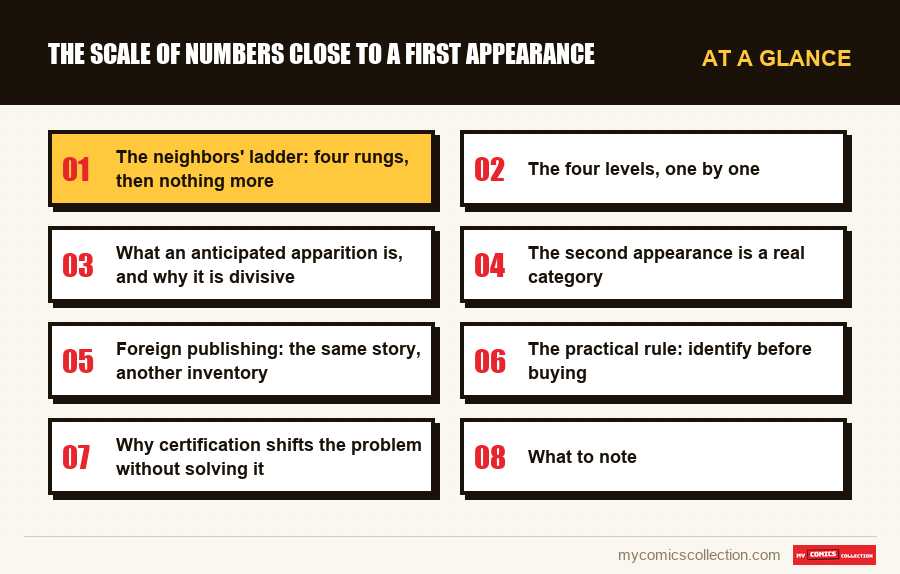
The neighbors' ladder: four rungs, then nothing more
The hierarchy that the ad titles draw is remarkably stable, and it reads in a unique order. At the top, the anticipated appearance: the previous issue, sold on the idea that the character is already present in one way or another. Just below (or just above, depending on the buyer, and that's the whole problem) the first complete appearance, the central fascicle. Then the second appearance, the number immediately following, which exists as a commercial category in its own right. Then nothing more. The fourth rung does not exist: there is no “third apparition” sold as such, and no one is trying to make one. The ladder suddenly falls.
This brutality is what makes the scale interesting. A value that deteriorates slowly over ten issues would be a serial phenomenon; a value which holds over three fascicles and collapses at the fourth is a phenomenon of nomenclature. What carries value is not the physical proximity in the series, it is the existence of an available label. As long as a seller has a word to describe his copy (“preview,” “first,” “second”) he has an argument. As soon as the vocabulary runs out, the booklet becomes an ordinary number again, listed at the lot price.
The four levels, one by one
The anticipated appearance
The previous issue, offered on August 29, 2026 at $19.99. The argument: the character already appears there, in incomplete form. This is the most contested rung of the ladder, because it claims a status that the next booklet also claims.
The first complete appearance
The central issue from 1992. August 29, 2026, 84 unverified listings from $9.99 to $2,500.00, mid-range to $135.00; 103 verified listings from $87.00 to $3,500.00, mid to $300.00. This is the reference level, the one to which all others are compared.
The second appearance
The following issue, posted that day at $29.99 in the current edition and at $39.99 in the newsstand edition. The seller is not hiding anything: the title says “second appearance”. The statement is straightforward, and the buyer knows what he is getting.
The empty rung
Beyond the next number, the scale stops. No commercial title is available, no positional argument holds up. The booklet falls into the commonplace of the series, whatever its state.
We must resist the temptation to read these four boxes as a scale. The order is real; the differences cannot be deduced from this statement. An amount requested is not an established price, and five advertisements for five different objects do not form a curve. The only thing that these titles prove is that the sellers themselves arrange their copies in this order, and that they assume their buyers are capable of reading it.
Methodological reservation. The five proposals noted on August 29, 2026 do not relate to the same subject: a reprint collection, the previous issue, the following issue in two editions, a foreign edition of the main issue. We cannot therefore compare them with each other to establish a numerical scale, nor derive a value relationship between levels.
What they document is the existence of the hierarchy and the order in which sellers present it, not the price differences between it. In the same way, an isolated maximum at the top of a range reflects the hope of a seller, never an actual amount: it is a displayed figure, not a transaction.
What an anticipated apparition is, and why it is divisive
An anticipated appearance is a partial presence. The character is there, but not entirely: a silhouette in the shadows, a box at the end of the booklet which announces the sequel, a figure without the costume, or the costume without the name. The forms vary, and it is precisely because they vary that no common definition is required. One reader will see a full apparition, another a simple teaser, a third a graphic coincidence reconstructed after the fact. None of these three are absolutely wrong; they just don't apply the same standard.
The practical problem is that this elasticity creates two issues that claim the same status. The previous number says “this is where it starts”; the central number says “no, it’s here”. The two statements coexist in the ads, and nothing in the title allows the buyer in a hurry to decide. He orders what he believes to be the decisive number and receives the neighbor, technically as described, commercially something else.
This division has a consequence that we underestimate: it limits anticipated appearance. As long as the debate remains open, the level remains second. An object whose status is debatable cannot dominate an object whose status is not debatable. This is why the anticipated appearance, despite its chronological anteriority, is sold as a complement and not as a substitute: it is added to the central number in the collections constructed, it almost never replaces it.
It is necessary to add a nuance of shape. An early appearance is not a concept invented by sellers. It describes a banal editorial reality: characters are frequently introduced in stages, an introduction here, a development there. What the market does is transform this narrative progression into a pricing category. The progression is authentic; the category is a commercial construction: useful, as long as we know that it is one.
The second appearance is a real category
We often read that the “second appearance” would be a seller’s dressing, a way of promoting any booklet. The August 29, 2026 statement contradicts this reading. The mention is made frankly, in the title, without ambiguity about the rank. The seller does not claim to sell the central number; he announces the following, and he announces it as such. It's not a deception, it's a segment.
This segment has its customers. It brings together those for whom the central number is out of reach or out of interest, those who want narrative continuity rather than the point of origin, and those who build a complete sequel around a character. For all of these, the following number has its own function: it extends the story where the central number opens it. It is a reading object before being a ranking object.
But the category has its ceiling, and it is structural. A second appearance is worth a fraction of a first, always, regardless of the character. The reason is simple: the relative rarity is not the same. The issue that introduces a character was purchased at the time by readers who didn't know what they were buying; the following issue often benefited from a circulation adjusted to the emerging demand, and it was kept by people who were beginning to know. More copies preserved, less tension when purchasing.
The double proposition observed on August 29, 2026 on this same next issue: a current edition at $29.99 and a newsstand edition at $39.99: illustrates a second layer of hierarchy, within the same level. Distribution channels have produced hardware variants of the same issue, and these variants are sold separately. In other words: the scale of neighbors subdivides itself. Each level can in turn be divided into editions, and each fraction seeks its own label.
Foreign publishing: the same story, another inventory
One line in the statement deserves separate treatment. On August 29, 2026, a Spanish edition of the main issue was offered for $50.00. Same story, another country, another language, and an amount requested which has nothing to do with what the copies of the original edition claim in the same statement. This is the only item on the list that contains exactly the story you're looking for without being the item you're looking for.
To a reader, this proposition is perfectly rational. The content is the same. The boards are the same. If the objective is to read the story which introduces the character, the foreign edition responds completely, and often with greater comfort: the foreign editions are frequently later, therefore less tired. The ratio between what we look for and what we pay is excellent.
For an inventory, on the other hand, the object is something else. It does not replace the original number in a collection ordered by first publication: it is a separate entry, with its own publisher, language and date. Treating it as a substitute creates lasting confusion in the listing, and it's the kind of confusion that pays for itself years later when you no longer remember what you actually bought. It's best to grasp it for what it is, a foreign edition of the same story, and leave the original number line open.
There is a third position, minority but coherent: deliberately collecting foreign editions, for their own sake. Redesigned covers, different formats, story divisions that do not always follow the original publication. It is an entire axis of collection, with its own rarities, and it does not compare itself on the scale of its neighbors: it crosses it without intersecting it.
Collecting this series?
Track what you own, what you are missing and what your collection is worth. 7 day trial.
Start my trial →The practical rule: identify before buying
From all of the above comes a single rule, and it is operational. Before purchasing, determine which of the neighboring numbers you are aiming for, and check it in the catalog. Not in the title of the ad: in the catalogue. Because the titles mention the three levels indifferently, often in the same sentence, and an advertisement which mentions the central number can perfectly relate to its neighbor.
Read the number, not the sentence
The title can name all three levels at once. Only the issue number actually put up for sale counts, and it rarely appears at the top of the title.
Check the publication date
The previous issue, the central issue and the following issue do not share the same publication month. The catalog immediately distinguishes them, where the announcement remains vague.
Translate the label
“Anticipatory appearance”, “first appearance”, “second appearance” designate three distinct objects. Any ad that uses two of these terms at the same time requires verification.
Separate reprint and booklet
A collection that reprints the story: like the one offered for $9.99 on August 29, 2026: is not a rung on the ladder. It is access to content, to be stored as such.
Distinguish between editions of the same issue
A level can be subdivided: two distribution circuits, two objects, two amounts requested. The collection sheet must decide which one you hold.
Isolate foreign editions
The identical story does not make the identical object. A foreign language edition is a separate entry, never a replacement for the original line.
This check takes one minute. It consists of comparing the number announced with the corresponding sheet and confirming that the booklet offered is indeed the one you think you are purchasing. It's the only gesture that neutralizes the ambiguity of titles, and it's also the one that we skip most often, precisely when the ad seems interesting and we want to move quickly.
Why certification shifts the problem without solving it
The statement of August 29, 2026 clearly separates the two worlds on the central issue: 84 unverified advertisements, with a mid-range at $135.00, against 103 advertisements of verified copies, mid-range at $300.00. The two populations are comparable in number, and yet they do not tell the same story. On that issue, on that date, there were more verified copies offered than raw copies.
Certification resolves one question and one question only: the condition, certified by a third party, with a readable scale. She says nothing about rank. A verified copy of the next issue remains a copy of the next issue; verification does not promote him one level. However, this is exactly the confusion that sets in for the buyer in a hurry, for whom the presence of a sealed hull becomes a signal of overall value rather than a simple observation of condition.
The consequence is concrete: at the bottom of the ranges, we find verified copies of neighbors presented with the same visual seriousness as a verified copy of the central number. The object is authentic, the certificate is authentic, the level is not the same. Here again, the only solution is to check the catalog number in advance, before letting the packaging make the argument.
One final point about the forks themselves. A spread that goes from $9.99 to $2,500.00 on unverified listings doesn't describe a market: it describes a mix. At one end, objects that are not the fascicle; at the other, isolated hopes of sellers. The middle of the range is more informative than the limits, but it remains a middle of requested amounts, not a transaction price, and it should be read as such.
What to note
The scale is short and reads in a single order. Early appearance, first full appearance, second appearance, then nothing. Three salable levels around the 1992 issue, and a clear drop at the fourth. Remembering this order is enough to decode almost all of the titles that revolve around this number, including those that only mention it in passing.
Two fascicles claim the same status, and this will not be decided. The previous issue and the central issue compete for the original title, because the definition of an anticipated appearance (a silhouette, an ending panel, a presence without the costume or without the name) is not stabilized. Don't wait for arbitrage: decide for yourself which criterion you apply, and buy accordingly.
The second appearance is an actual segment, not a contrivance. On August 29, 2026, the following issue was offered at $29.99 in the current edition and at $39.99 in the newsstand edition, with the mention clearly stated in the title. It is an accepted category, with its own clientele, and which is structurally worth a fraction of the upper echelon.
The five proposals noted do not compare with each other. Reprint collection, previous issue, next issue in two editions, Spanish edition: five separate objects. They establish the existence of a hierarchy and the order in which sellers present it, never the price differences between levels. Any numerical scale built on these five lines would be a reconstruction.
The foreign edition is a great reading buy and a poor inventory substitution. At $50.00 on August 29, 2026, the Spanish edition of the main issue offers access to the full story for a fraction of what the original copies charge in the same issue. It deserves its own line in the collection, with its publisher and its language, without ever closing that of the original issue.
By reading the issue number and its publication date, never the title alone. Advertisement titles readily cite the three levels in the same sentence, which makes them unusable to identify the object. The comparison with the catalog file removes the ambiguity in a few seconds.
The statement of August 29, 2026 does not allow us to decide, since it does not compare identical objects. What we can say is that a contested status does not dominate an uncontested status: as long as two fascicles claim the same origin, the anticipated appearance functions as a complement and not as a replacement.
Because sellers index their ads on the central number, which is the most searched term. A collection of reprints, a neighboring edition or a foreign edition thus find themselves placed next to the booklet that they are not, each with a title that remains literally accurate.
No. Certification certifies a state, it does not modify the rank of the issue in the scale. A verified neighbor remains a neighbor, and the certificate does not change the level, regardless of the quality of their presentation.
No: it deserves its own entry, with its publisher, language and date. The story is the same, the object is not. Confusing the two in a single file produces an ambiguity that becomes impossible to disentangle a few years later.
Follow the three steps separately
Previous issue, central issue, next issue, newsstand editions, foreign editions: five distinct lines that a handwritten list always mixes up. My Comics Collection keeps them separate, with the exact edition and publication date attached to each copy, so you know at all times which of the neighbors you already own.