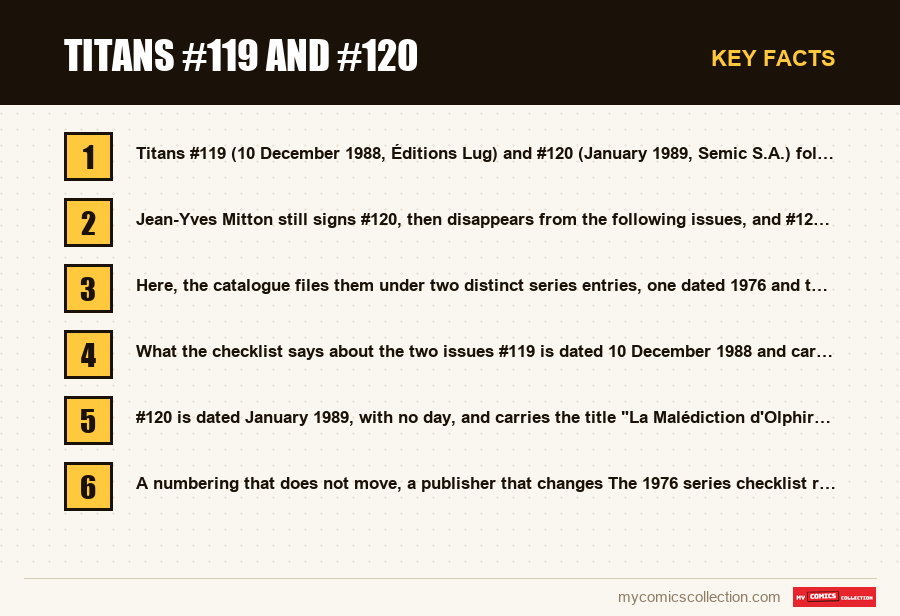
Titans #119 (10 December 1988, Éditions Lug) and #120 (January 1989, Semic S.A.) follow each other with no gap in the numbering: only the publisher changes in the catalogue. The real boundary lies in the credits and in the date. Jean-Yves Mitton still signs #120, then disappears from the following issues, and #120 is the first since #86 whose date gives only the month.
On a list of gaps, two consecutive issues normally form a single move: you look for them together. Here, the catalogue files them under two distinct series entries, one dated 1976 and the other 1989. Knowing what really changes between them, and what does not, avoids two symmetrical mistakes: searching for an issue that does not exist, or believing in a continuity that the object does not confirm.
As always on this guide, only verified information (creators, issue numbers, dates) is stated as fact; the analysis is our own, with no reproduction of artwork or protected dialogue.
What the checklist says about the two issues
#119 is dated 10 December 1988 and carries the story title "Une taupe chez les Vengeurs !" ("A Mole Among the Avengers!"). Its credits, at the level of the issue, pair Jean-Yves Mitton, Chris Claremont and Steve Englehart on writing, then Jean-Yves Mitton, Rick Leonardi and Al Milgrom on art. #120 is dated January 1989, with no day, and carries the title "La Malédiction d'Olphir 3ème partie" ("The Curse of Olphir, Part 3"). Its writers are Chris Claremont, Steve Englehart and Jean-Yves Mitton, its artists Al Milgrom, Sal Buscema and Dave Hunt.
That is all the data asserts. One title per issue, and credits that do not say which name goes with which episode: the real contents of these two issues remain to be read on the copies. The page can therefore answer only one question, that of the relationship between the two objects.
A numbering that does not move, a publisher that changes
The 1976 series checklist runs from #1 to #119 with no missing number, and the 1989 one from #120 to #221, also with no gap. Placed end to end, they make 221 consecutive issues, and that is the only reading that makes sense for a collector: the checklist does not show a "Titans #1" at Semic, and the counter was not reset at the switch.
The split into two entries is therefore a cataloguing decision, backed by the publisher shown: Éditions Lug for one, Semic S.A. for the other. On a shelf, the magazine is a single run. In a spreadsheet, however, you have to decide where to file #120, and the safest choice is to file it with both columns: number 120, and the publisher mention read on the copy.
A word of caution on vocabulary: the checklist does not describe the look of the cover or the spine. Whether the format, the logo or the layout changed between 119 and 120 is not data here; it is what you will observe by placing the two issues side by side, and it is better to note it than to assume it.
The day that disappears from the date
In the Lug checklist, 117 of the 119 issues carry the 10th as their cover day. The two others are #7 (5 March 1977) and #86, dated only March 1986. Between #87 and #119, all 33 issues are dated the 10th. Then #120 arrives with "January 1989" and nothing else: it is the first date without a day in the series since #86.
This detail is less trivial than it seems. #118 and #119 are dated 10 November and 10 December 1988, #121 is dated 10 February 1989: from #36 to #119, the cover months advance one step per issue, and #121 continues that step, so #120 indeed falls in January. But the exact day is not in the catalogue, and I do not deduce it from the neighbouring 10th. Further along the series, dates without a day become frequent: 36 of the 102 issues in the 1989 checklist give only the month, including #188 to #221 without exception. The boundary therefore marks not only a change of publisher name, but also the point where the source stops giving a day.
For your personal record, the consequence is simple: note "January 1989", not "10 January 1989", unless the copy itself prints a day.
Jean-Yves Mitton, the last name across the boundary
This is the most telling element of the pair. Jean-Yves Mitton is credited in the checklist from #26 as an artist, then from #41 as a writer. In total, his name appears in 73 of the first 120 issues, or 61% of them. Across the five issues #115 to #119, he is credited for both writing and art.
As an artist, his last mention is #119, the last Lug issue in the checklist. As a writer, his last mention is #120, the first Semic issue. After that, his name no longer appears: none of the other 101 issues in the 1989 checklist, from #121 to #221, credits him. The publisher boundary thus coincides with the end of a presence that 72 Lug issues had established.
A caution nonetheless: credits are grouped by issue. Mitton's name on #120 says that he takes part somewhere in that issue, not that he wrote the episode titled "La Malédiction d'Olphir". And the checklist says nothing about the reasons for his departure; the sources I know differ on the precise timing, and I do not settle that here.
Do you collect this series?
Track what you own, what you are missing and what your collection is worth. 7-day trial.
Start my trial →
What crosses the boundary, and what stops
The three writing names are the same for #119 and #120, in a different order: Mitton first on the former, Claremont first on the latter. On the art side, Al Milgrom is present on both sides. Dave Hunt, for his part, appears only on #120 in the entire checklist.
#121 then shifts the team: Louise Simonson, credited on writing for that issue, replaces the third name, that of Mitton, while Claremont and Englehart stay. Her name then returns on many issues of the 1989 series. For a collector who sorts by writer, this makes #120 an exact cut-off point: this issue closes one team.
A story already under way: "Part 3"
The title of #120 contains "3ème partie" ("Part 3"). No other issue in the checklist mentions "Olphir" in its title, and the titles of #117, #118 and #119 are respectively "L'ange de la mort" ("The Angel of Death"), "Fantastiques contre X-Men" ("Fantastic Four vs. X-Men") and "Une taupe chez les Vengeurs !". Neither this clue nor the checklist tells us where the first two parts appear.
Still, we must resist the temptation to conclude that the story is cut cleanly by the boundary. Only one title is kept per issue, and the checklist offers a close parallel: "Noces mortelles 2ème partie" is the title of #116, whereas #115 is titled "Méphisto". A first part can therefore hide in a contents list without appearing as a title. The only reliable method is to open #119 and read its contents page: if a first or second part appears there, the story crosses the boundary; if not, you will know sooner where to look.
Recognising each copy on the object
Three checks are enough, all on the issue in hand. First the printed number: 119 or 120, never a counter specific to the publisher. Then the date: a precise day for 119, probably only a month for 120, which is consistent with the catalogue but must be verified on the copy. Finally the publisher mention, which is what actually files the copy under one entry or the other.
Be wary of listings that speak of a "last Lug" or a "first Semic" without a photo of the back and of the page showing the publisher. The catalogue does give these two labels, but it gives them as the publisher of the series, not as a guarantee for the copy being sold on a marketplace. Ask for that page: the printed publisher mention is what decides.
The neighbours, and the place in a list of gaps
Around the boundary, the run is dense. #116 to #119 are dated 10 September, 10 October, 10 November and 10 December 1988, and #121 to #123 are dated 10 February, 10 March and 10 April 1989. In the checklist, #121 is titled "La Panthère Noire" ("The Black Panther"), #122 "Les géants de la tempête" ("The Storm Giants") and #123 "Histoires extraordinaires, 1ère partie : l'homme dans la fourmilière !". These titles say nothing about the full contents; they serve to identify the issue, not to describe it.
To enter the pair in a list of gaps, use one line per issue, with three columns: number, date read on the object, publisher read on the object. The two issues can then be ticked separately, and a missing copy does not erase the other line. If you hold only one of the two, #120 is the easier to confuse with its neighbours, since its date has no day: photograph the cover and the page showing the publisher as soon as you buy it.
For the condition record, look at the spine, the corners, the cover folds, and above all the first and last pages, which you leaf through while looking for the contents page.
Frequently asked questions
No. The Lug series checklist stops at #119, and the Semic series checklist starts at #120 and runs to #221, with no missing or duplicate number. The counter continues, and only the publisher shown differs between the two catalogue entries.
The catalogue gives no day for this issue, whereas #119 is dated 10 December 1988 and #121 10 February 1989. The step is one month per issue, but the exact day is not a data point: record what the copy prints, without deducing it.
In the checklist, his name appears on art up to #119 and on writing up to #120, then on none of the issues from #121 to #221. Since credits are given per issue, we do not know which episode he signs in #120.
The catalogue does not say. #119 carries another title, "Une taupe chez les Vengeurs !", and only one title is kept per issue. A first part can appear in the contents without showing up as a title: the issue has to be opened to settle it.
Nothing in the catalogue requires it: they are two distinct issues, and a story in several parts is not proven between them. Together, they reduce postage and mark the boundary between publishers. Separately, simply note the number, date and publisher read on each one.
In the end, the pair #119 and #120 reads more as a hinge than as a break: same counter, same monthly pace, three shared writers, but a signature that stops, a date that loses its day, and two catalogue entries. You can track this set issue by issue, with the publisher noted on each line, from your own collection.