The narrative sources for this work come from three traditions that were never intended to come together: the daily adventure strip, the folk tale, and the character comedy. None are contemporary comic strips, which explains why the result does not resemble anything that was published around it. These filiations are not homages:these are construction methods borrowed and applied, and we can spot them in specific places.
Identifying these sources sheds light on choices that seem arbitrary when we judge the work according to the codes of the medium.
This article details each filiation, shows what it brings concretely, explains why their combination is rare, and distinguishes these borrowings from decorative references.
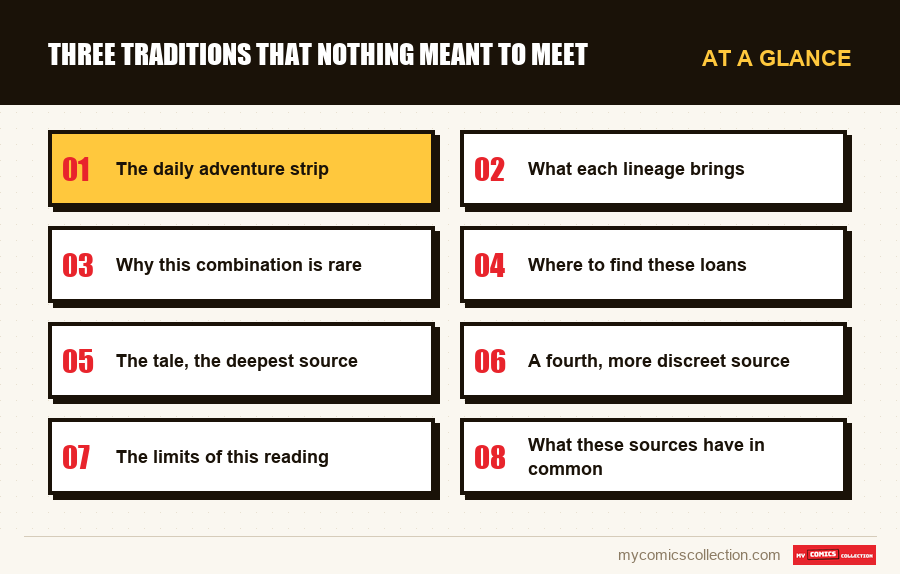
The daily adventure strip
This is the least obvious source and probably the most determining for the overall structure.
The adventure strip appeared in the daily press, three or four boxes per day, with a larger spread on Sundays. He told long-term stories over months, sometimes years.
This form imposes very specific rules. Each delivery must remind us where we are without saying it, end with a reminder, and remain understandable by a reader who missed the day before: all this in three boxes.
These constraints have produced a know-how of relaunch and implicit recall that we find here: the story advances in small units, each closed, without ever resorting to an explicit summary.
They also explain an observable property: we can resume this work after months without being lost, which is rare for a story of this length and which is not a coincidence.
What each lineage brings
The adventure strip: the mechanics
Progression through closed units, regular reminders, implicit reminders. This is what keeps a story of thousands of pages followable.
The most useful and least visible source.
The popular tale: the frame
Forced departure, world bigger than we thought, trials, return. An ancient structure that requires no explanation from the reader.
Character comedy: tone
Fixed temperaments which produce situations by their mere presence, without the story having to construct gags.
Their combination: originality
None of these three sources are rare. It is their simultaneous use, on the same page, that is.
Why this combination is rare
The three traditions belong to environments which did not communicate, and this is enough to explain the singularity of the result.
The press strip was an industrial profession, judged on its regularity and readability by a mass audience. Its practitioners were not those of bookstore comics.
The folk tale was children's literature or scholarly study, two areas that the medium rarely frequented at this period.
Character comedy belonged to animation and the comedy strip, considered minor by the world of author comics.
An author trained in the usual circuit would therefore not have encountered any of these three schools. You need an offset trajectory to have these tools, which explains why the work has no direct equivalent and why it took time to be taken seriously.
A distinction that matters: borrowing is not quoting. A decorative reference reproduces a recognizable motif to signal the informed reader; borrowing a method takes up a work constraint and suffers the consequences.
What we observe here falls entirely into the second case. Nothing invites the reader to recognize a source, and the borrowings are seen in construction choices rather than winks: this is what makes them productive rather than ornamental.
Where to find these loans
Trois endroits précis où chaque filiation devient visible, vérifiables en ouvrant n'importe quel volume.
The end of the sequence. They almost always end with a restart or a holding frame, never with a complete resolution. It’s the mechanics of the daily soap opera applied to a book.
Meetings with ancient figures. They follow the protocol of the story: a creature poses a condition, help is given in exchange for something, and the character leaves without having understood everything.
Meal and rest scenes. They take up a considerable amount of space and almost never advance the plot: this is the register of character comedy, where the trivial is the opportunity to show who people are.
These three markers are visible without particular erudition. Spotting them changes the reading: what seemed like filler becomes a recognizable method.
The tale, the deepest source
Of the three filiations, this one deserves particular development, because it provides not only a structure but a moral position.
The popular tale presupposes a precise relationship between the character and the world: the latter is older, larger and more dangerous than him, and it is never a question of defeating him but of crossing him. A fairytale hero does not reform the universe, he returns home.
This modesty of ambition is found exactly here, and it explains a characteristic that is disconcerting: the protagonists never seek to change anything. They want to get out, and the story falls on them.
A work built on a heroic model would have produced characters with a mission. The story model produces characters with a problem, which is not the same thing and reads very differently.
This is also what authorizes the ending described elsewhere: a return rather than a coronation. This conclusion can only be understood by relating it to its source, where the return is the normal outcome.
A fourth, more discreet source
It is necessary to mention a contribution that is less easily identified but which runs through the entire book.
The story gives considerable space to agricultural work, the seasons, fairs and village exchanges. These passages do not come from any of the three traditions mentioned: they come from an observation of the rural world.
This material provides the ground on which everything else rests. Without it, the valley would be a fantasy setting like any other; with it, it becomes a place where people work, which makes the threat tangible: we concretely understand what would be lost.
This is probably the least discussed contribution and one of the most effective. He explains why the issues of this work appear concrete where the genre usually produces abstraction.
He also explains the rhythm: the seasons pass, the harvests are harvested, and the story takes the time these things take: which contributes to the impression of real duration that few long works manage to give.
Collecting this series?
Track what you own, what you are missing and what your collection is worth. 7 day trial.
Start my trial →The limits of this reading
Reconstructed connections
Identifying a method does not prove intention. These connections describe similarities, not declared sources.
Vast traditions
Each of these three schools covers thousands of very different works. Talking about influence remains a useful approximation.
A risk of over-interpretation
Many choices are also explained by production constraints, without any filiation being necessary.
Sources that are not easily accessible
Adventure strips from the heyday are difficult to consult today, which makes comparison difficult.
What these sources have in common
A line connects them, and it explains why they come together without opposing each other.
The three traditions were designed for a non-specialist audience. The newspaper strip was for everyone, the story for anyone who would listen, the character comedy for a family audience.
None assumes prior knowledge or familiarity with codes. All were refined by the need to be understood by people who had not asked for anything.
This is what makes their combination coherent and this explains the unusual accessibility of the work. It is not accessible by simplification but because each of its tools comes from an accessibility school.
This convergence is probably the most interesting fact in this bibliography. An author who draws on three popular traditions produces a work that is also popular, without having to target an audience.
Which doesn't come from any of these sources
We must also name what the filiations do not explain, otherwise we risk reducing everything to influences.
The duration. None of the three traditions produces stories of several thousand pages led by a single person. It's a clean decision, and it's expensive.
Gradual darkening. Neither the strip, nor the tale, nor the comedy transforms their register along the way. This is the most personal contribution of the work.
The coexistence of two graphic regimes. It raises a problem that these sources did not pose.
These three elements are the ones that cannot be linked to anything, and they are probably the ones that make the work exist. Influences provide tools; they never explain what we do with them.
What to record
On careful reading of the construction methods, the sheet must keep what is not found by search.
The processes you identify, with the page where you noticed them. A restart at the end of the sequence, a story protocol, a trivial scene that characterizes: these markers are scattered and their interest comes from their accumulation. Isolated they prove nothing; united they draw a method.
It is also the only way to verify a reading intuition instead of keeping it in an impression state, which is the difference between a hypothesis and a conviction.
Connections that you consider doubtful, noted as such: on an exercise where over-interpretation lurks, distinguishing what we observe from what we suppose avoids transforming a resemblance into filiation.
These two mentions serve an analytical reading rather than a collection, and it is a use that this type of work particularly rewards.
Frequently asked questions
From three traditions external to contemporary comic strips: the daily adventure strip for the mechanics, the popular tale for the framework, the comedy of characters for the tone. None belonged to the environment where the work appeared, which explains why it does not resemble anything that was published around it.
It is a direct legacy of the daily strip, a form where each delivery had to remind us where we were without saying it and remain understandable for those who had missed the day before. The story advances in small closed units, with implicit reminders and without ever resorting to an explicit summary.
In three places: the end of the sequence, which restarts instead of resolving; encounters with ancient figures, who follow the protocol of the tale; and the scenes of meals and rest, which advance nothing and serve to show who the people are. No scholarship is necessary.
No, and it must be said: identifying a method does not prove an intention. These connections describe similarities, not declared sources, and many choices can also be explained by simple production constraints. This is useful reading, not a demonstration.
Three things, and these are perhaps the most important: the duration, none of these traditions produces thousands of pages carried out by a single person, the progressive darkening, and the cohabitation of two graphic regimes. Influences provide tools, never what we do with them.
Where have you seen this process?
Isolated, these markers prove nothing; united, they draw a method.