The humor of this work relies almost entirely on the discrepancy between what a character wants and what the situation demands. Nobody says anything good about it: the gags are born from people who pursue petty objectives in the middle of considerable events. It's a situation comedy and not a dialogue one, which explains two things:it works in all languages, and it survives when the story gets serious.
Understanding this mechanism sheds light on the main feat of the work: never having to choose between laughter and challenge.
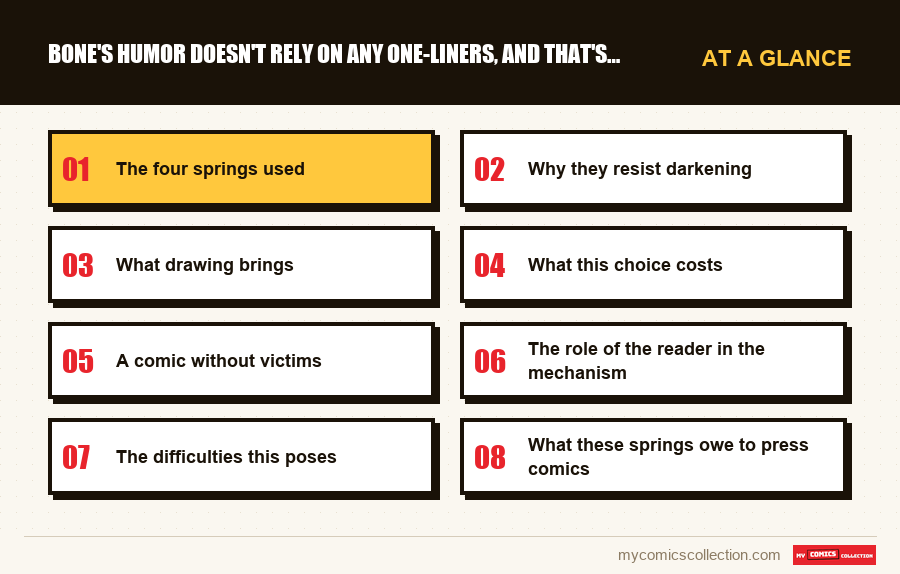
This article describes the springs used, shows why they resist darkening, examines what they owe to drawing, and says what distinguishes them from comic dialogue.
The four springs used
They recur constantly and they are enough to cover most of the comic scenes in the work.
The scale shift. A character preoccupies himself with a trivial interest-a profit, a meal, an annoyance-while a serious situation unfolds around him. The comic is born from the gap, not from the content of its preoccupation.
Maladaptive stubbornness. A figure pursues a plan that everything denies, and continues. The repetition of failure, far from tiring, establishes an expectation that the reader recognizes.
The off-beat comment. Someone says out loud what the situation prohibits from saying, usually out of tact rather than wit.
Mutual incomprehension. Two characters talk about different things while believing they understand each other, each acting accordingly.
None of these four springs depends on a play on words or a formulation. They are all positional: they care about who is where and wants what, and this is what makes them translatable without loss.
Why they resist darkening
They don't deny gravity
A character who complains about what to do during a flight does not minimize the danger: he goes along with it. The reader laughs without ceasing to take the situation seriously.
This is the decisive property and it is rare.
They intensify with the stakes
The more serious the situation, the sharper the shift in scale. The main force therefore strengthens as the story darkens.
They belong to the characters
The comic comes from constant temperaments and not from arranged circumstances. It therefore does not have to be reintroduced: it is there as long as the characters are there.
They change function without changing shape
Late in the story, joking becomes a refusal to give in rather than a character trait. The process is identical, the effect has matured.
What drawing brings
A significant part of these gags does not go through the text, and it is necessary to specify how.
The discrepancy is seen before it is understood. A round, relaxed figure placed in a threatening setting produces the gap in an image, without any response establishing it.
The poses carry the reaction. An attitude of despondency or indignation is readable in silhouette, which allows a comic reaction to be placed in a silent box in the middle of a tense sequence.
The rhythm of the boxes makes the timing. A pose held on two panels without dialogue produces the dead time that the gag needs: a process borrowed from animation and costly in pages.
The result is that the comic remains active even in sequences without text, which are numerous. This is what allows him to get through passages where a dialogue comic should keep quiet.
The contrast with the comic dialogue is worth asking. A work whose gags rely on one-liners must interrupt its humor as soon as the situation no longer allows for joking: talking becomes inappropriate.
A positional comedian doesn't have this problem: he doesn't need anyone to be funny, only a setup. A figure in the wrong place remains comical even when mute, and this is what allows this work to never have to choose.
What this choice costs
We must name the counterparts, because they are real.
Few memorable lines. A work without good words does not produce quotable sentences. It's a distribution handicap: nothing circulates outside the book.
A slow comic. Installing a configuration takes boxes. The gags are spread out, where a line works in one panel.
An effectiveness that depends on the context. A page taken in isolation may not be funny at all, the discrepancy only existing if we know what is happening around it.
These three costs come together: this humor cannot be extracted. He does not cite himself, does not show himself as an example, does not summarize: which partly explains why the work is so poorly recommended in fragments.
A comic without victims
One property distinguishes this humor from most situation comedies, and it explains why it does not age badly.
Many gags are based on putting someone at fault: we laugh at a ridiculous, clumsy or humiliated character. The mechanism is effective and it presupposes a victim, which makes it fragile: the conventions of what can be mocked change quickly.
Here, the target is never a person but a configuration. We don't laugh at someone who is stupid, we laugh at the fact that their concerns are unrelated to what surrounds them, and this concern is often perfectly reasonable in itself.
The character most often in a comic position is the one whose objectives are the most understandable: eat, sleep, not die, go home. It's his circumstances that are unreasonable, not him.
This is what allows this humor to remain effortlessly readable thirty years later, when a significant part of the comedy from the same period today requires an effort to contextualize.
The role of the reader in the mechanism
One last element deserves to be exposed, because it explains why these gags work better in continuous reading.
A scale shift assumes that the reader knows both scales. You have to know what is really happening to perceive that a character's concern is disproportionate.
The reader is therefore always better informed than the comic figure, and it is this advance that produces laughter. It's not the character that's funny: it's the gap between what he knows and what we know.
This mechanic has a direct consequence on reading. A reader who has followed the story has a considerable head start and laughs a lot; a reader who opens at random has no advance and only sees a banal scene.
It also explains why humor mechanically intensifies over the course of the work: as the reader learns more, his lead grows, and the same behavior becomes more and more offbeat without anything having been modified in the writing.
Collecting this series?
Track what you own, what you are missing and what your collection is worth. 7 day trial.
Start my trial →The difficulties this poses
A misleading first volume
At the beginning, the stakes are low and so is the lag. The humor seems flatter than it will be.
Nothing to mention
No reply sums up the work, which undermines it in the oral recommendations.
A rhythm that takes time
Reading quickly while skimming over the silent boxes removes a large part of the comedy.
Invisible gags in the extract
A single page doesn't show the setup that makes the scene funny.
What these springs owe to press comics
An additional connection deserves to be noted, distinct from that of the cartoon.
The four springs described above are those of the daily press strip: a character with a fixed character, a situation, a shift, a fall in a few boxes. It's an extremely constrained school of comedy, where you have to produce an effect in a tiny space and without obligatory continuity.
This format teaches economics: how to set up a two-panel setup, and that skill shows here, where the comedic scenes almost never need preparation.
It also explains the coexistence with the epic. A strip gag is autonomous: it does not depend on what precedes and does not engage what follows. It can therefore be inserted into a long story without interrupting the thread.
It's an unusual combination (the narrative construction of an epic, the comic mechanics of the daily strip) and it probably constitutes the work's clearest structural feature.
The turning point: when laughing becomes an act
A shift occurs in the second half of the work and it constitutes its finest gesture.
At first, a character jokes because it's his character. The reader laughs in a predictable reaction, and it doesn't commit anything.
Later, the same character jokes in circumstances where no one would want to anymore. The gag is identical in form and has changed meaning: he no longer says “this is how he is” but “this is what he refuses to let win”.
This shift is never commented on, and it does not require any change in writing: it is the context which recharges an unchanged process.
This is also why the last volumes move readers who would not have thought they would be moved by a series of gags. Humor becomes a moral trait, and laughter is accompanied by something else.
What to record
On a comic which depends entirely on its context, the file must retain what a rereading does not restore.
The scenes that made you laugh, with what was happening around them at the time. The gag alone is not found and means nothing outside of its configuration: noting the situation at the same time as the page is the only way to reconstruct why it was funny, months later.
This is also what allows you to show a scene to someone without it falling flat, since you then know what context to give it.
The moment when humor started to seem serious to you, if there is one: this shift occurs in a different place for each reader, it is not indicated anywhere, and locating it at home is the best trace we have of what the work has done.
These two mentions relate to the reading log rather than the inventory, and that is what this type of work calls for.
Frequently asked questions
About the gap between what a character wants and what the situation demands. No one makes jokes there: the gags are born from people pursuing petty objectives in the midst of considerable events. They are positional springs, which depend on who is where and wants what.
Because these forces do not deny gravity, they accompany it, and above all because they intensify with the stakes: the more serious the situation, the clearer the shift in scale. The main force therefore strengthens as the story darkens.
Because there is nothing to remember: the comedy is situational and not dialogue. It's a distribution handicap, nothing circulates outside the book, but it's also what makes these gags translatable without loss and active in the silent sequences, of which there are numerous.
No, and this is a source of misunderstanding. At the beginning the stakes are low, so is the shift, and the humor seems flatter than it will be. The main force needs a stake to function, it only gives its measure once the story is established.
The meaning, not the form. A character who joked out of character now jokes where no one would want to: the gag no longer says « voilà comment il est » but « voilà ce qu'il refuse de laisser gagner ». It is the context that recharges an unchanged process.
What was going on around you?
A positional gag means nothing outside of its configuration, and that's what we forget first.