
The distribution of this work is built on an asymmetry: three protagonists from a comic register, thrown into a world populated by characters who do not belong to it. The former hardly change; the second carry the entire evolution of the story. This imbalance is deliberate and it explains how an epic can settle in without ever breaking away from comedy:funny faces remain the fixed point around which the world darkens.
Understanding this distribution illuminates both the construction of the work and what confuses busy readers.
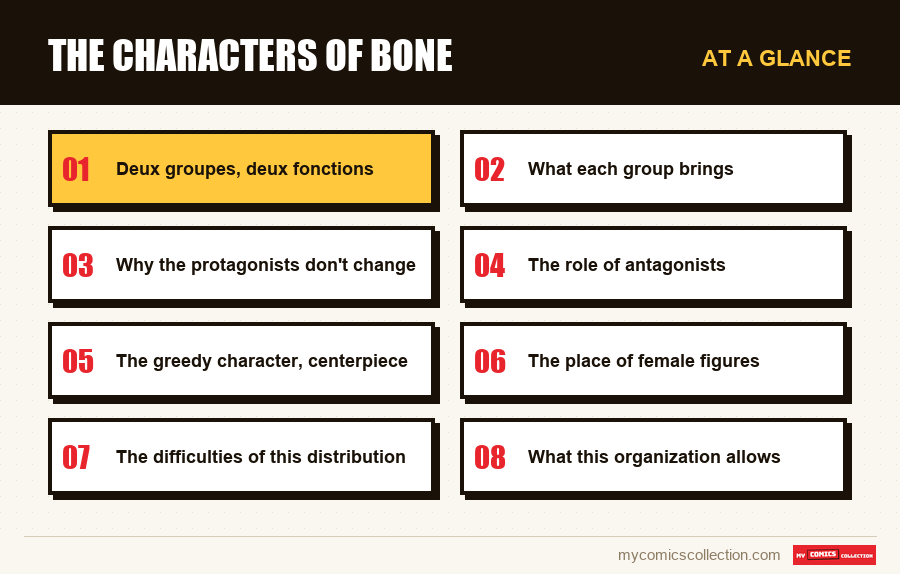
This article describes the two groups, shows how they work together, examines the role of the antagonists, and says what this organization allows.
Deux groupes, deux fonctions
The cast is not divided between good guys and bad guys but between two narrative regimes, and that is the key to everything.
The three protagonists from outside are comedy figures: simple features, characters reduced to a dominant trait, predictable reactions. They belong to a cartoon tradition and behave as such.
The inhabitants of the world where they arrive belong to a completely different regime: personal history, contradictions, secrets, capacity to change. They are characters from a novel.
The story puts these two regimes in permanent contact without ever merging them. The former do not become romantic and the latter do not become comical, and it is precisely this friction that produces the material of the book.
What each group brings
The three from outside
They provide the point of view: knowing nothing about the world they arrive in, they allow the reader to discover it with them without any explanation being necessary.
This is the most useful narrative feature in the entire cast.
Trois tempéraments nettement séparés
One is honest and worried, the other greedy and manipulative, the third carefree. This simple distribution covers all possible reactions to the same situation.
The inhabitants of the valley
They carry ancient history, issues and secrets. The entire epic passes through them, and the story darkens as we learn what they know.
A transmission between generations
The bond between a young woman and her ancestor structures the serious part of the story and provides its emotional driving force.
Why the protagonists don't change
It's a choice that contradicts everything we teach about character building, and it works for a reason.
The common rule is that a protagonist evolves: it is his arc that gives its shape to the story. Here, the three main figures are roughly the same on the last page as on the first.
Their stability is what makes the change in the world perceptible. A reader gauges the growing seriousness of a situation by how it affects characters whose habitual reactions he knows-when someone who is invariably carefree stops joking, that means something.
If these three also evolved, there would no longer be any benchmarks. Everything would move at once, and the gradual darkening would become indiscernible.
This is a rare and effective use: fixed characters serve as measuring instruments rather than subject.
Une nuance nécessaire. To say that they do not change is true of the traits and false of the position: they begin as strangers passing through and end up involved in a history that was not theirs.
This is not an arc of inner transformation but a shift in responsibility: they remain themselves while being obliged to act. The distinction is subtle and it explains why the story nevertheless seems to be going somewhere.
The role of antagonists
They are spread over three levels, and this gradation is the mechanics that sets up the epic.
Les adversaires comiques. Clumsy and talkative creatures, more ridiculous than threatening. They occupy the first volumes and do not involve anything.
The same creatures, seen differently. As the story progresses, they cease to be funny without having changed: it is the way we look at them that changes, which is a remarkable process of economy.
La menace supérieure. A figure who is not fought in the same way, whose means and intentions remain obscure for a long time, and who gives the whole its final stake.
This progression works because it doesn't replace anything: the adversaries at the beginning are those at the end, simply re-evaluated. This is consistent with the general method of the work, where the shift occurs by shifting the gaze rather than by substitution.
The greedy character, centerpiece
One of the three figures deserves a separate look, because it does a job that the other two cannot do.
The self-serving and manipulative protagonist is the only one of the three who actually causes events. His schemes trigger situations, his lies create complications, and a notable part of the intrigue lies in his initiatives.
This is a construction necessity more than a comic choice. A story in which all the protagonists are honest and prudent would not move forward: someone needs to do stupid things, and this role must be played by a character who we accept to do stupid things.
His greed is therefore functional. It provides a driving force for a story in which the other figures would be content to suffer the events, and it does so without the reader having to condemn anyone, since the comic register defuses judgment.
This is also what makes its final evolution perceptible. A character defined by a constant flaw produces a considerable effect the day he acts against this flaw, and the story saves this moment for the place where it counts.
The place of female figures
A notable imbalance structures this distribution and it is worth noting, because it reverses a current distribution.
The three protagonists from outside are masculine and comical. The characters who carry the story, the decisions and the authority are largely female: a young woman whose past constitutes the central issue, and an ancestor who holds knowledge and strength.
The story therefore entrusts seriousness and power to its female figures, and awkwardness to its male figures. This is never commented on, which makes the distribution all the more effective: it is presented as self-evident.
The grandmother is particularly remarkable in that she combines age, physical strength and moral authority: a rare combination, these attributes being usually distributed among different characters.
For a young reader, this organization produces a lasting and discreet effect: it establishes as perfectly natural a relationship that many contemporary stories from this period still presented as a remarkable exception, and it does so without ever drawing attention to it.
Collecting this series?
Track what you own, what you are missing and what your collection is worth. 7 day trial.
Start my trial →The difficulties of this distribution
Three visually close protagonists
The three main figures are similar in construction, which requires some time to adapt at the beginning.
Late secondary characters
Several important figures only appear after hundreds of pages, without anything having announced them.
Links revealed very late
Relationships between characters are only made explicit in the last volumes, which requires remembering the beginning.
An inactive protagonist
The most endearing figure suffers events much more than she causes them, which confuses some readers.
What this organization allows
Three effects that the structure makes possible and that a homogeneous distribution would not obtain.
An accessible story without being simple. A young reader follows the three comic figures, an adult reader follows the inhabitants of the valley. Both read the same book and do not find the same thing in it.
A seriousness without solemnity. The permanent presence of joking characters prevents the story from falling into the serious tone that its subject would call for.
An epic at eye level. The high stakes are constantly reduced to trivial concerns (eating, sleeping, getting home) which makes them concrete.
This last point is probably the main contribution of this distribution. An epic told only by its heroes becomes abstract; told by people who would especially like to return, it remains tangible.
A comparison that enlightens
The device recalls an ancient tradition, and situating it helps to understand why it works so well.
Many classic stories associate a hero and companions of another register: more down to earth, more fearful, more interested. These companions are not there to make people laugh but to keep the story grounded.
The originality here is to have reversed the proportions. The companions are the protagonists and occupy the majority of the pages; the heroic figures are secondary in time of presence, even if the issue passes through them.
This inversion changes the nature of the book. We do not follow a quest accompanied by moments of relaxation: we follow three ordinary people whose lives are invaded by a quest that does not concern them.
This is a point of view rarely adopted and it explains part of the attachment that the work arouses. The reader is not invited to identify with fate but with those who suffer it.
What to record
On a work read in spaced volumes, the record must retain what the memory loses first.
The state of relationships between characters at the end of each volume. Who knows what, who is lying to whom, what information was revealed and to whom: these elements are built over hundreds of pages and nothing summarizes them. A resumption after several months without this trace causes most of the late revelations to be lost.
This is what distinguishes careful rereading from a simple repeat: we know what we knew, so we measure what we learn.
The volume where each secondary character appears for the first time, several important figures emerging late and unannounced: tracing their entry point is otherwise impossible in a work of this length.
These two mentions address the problem specific to stories with delayed revelation, where the effect depends entirely on what the reader has retained.
Frequently asked questions
Because their stability makes the change in the world perceptible: we measure the seriousness of a situation by the way it affects characters whose usual reactions we know. If everything moved at once, the gradual darkening would become indistinguishable. They serve as a measuring instrument rather than a subject.
Visually yes, by construction, which requires time to adapt. Their temperaments, on the other hand, are clearly separated (one honest and worried, the other greedy, the third carefree) and this simple distribution covers all possible reactions to the same situation.
No, and this is the most economical process of the work: the ridiculous creatures of the first volumes cease to be funny without having changed. It is the way we look at them that is changing. The adversaries at the beginning are those at the end, simply re-evaluated.
Because the high stakes are constantly reduced to trivial concerns: eating, sleeping, getting home. An epic told only by its heroes becomes abstract; told by people who would especially like to return, it remains tangible.
The state of relationships at the end of each volume: who knows what, who is lying to whom, what information has been revealed and to whom. These elements are built over hundreds of pages without ever being recapitulated, and a resumption after several months without this trace causes most of the late revelations to be lost.
Who knew what, at the end of the volume?
Nothing sums it up, and that’s what gives the late revelations their weight.