This character is one of the rare ones whose identity is truly transmitted: three successive bearers, none canceling the previous one. This is a practice that the genre often claims and rarely enforces: most successions result in a return of the original holder. Here, the transmission held, and for a specific reason: identity is based on an object and not on a person, which makes the replacement legitimate instead of a spoof.
Understanding this mechanism sheds light on why so many successions fail elsewhere.
This article describes what a transmission requires, why it generally fails, what makes it viable here, and what it produces for a reader.
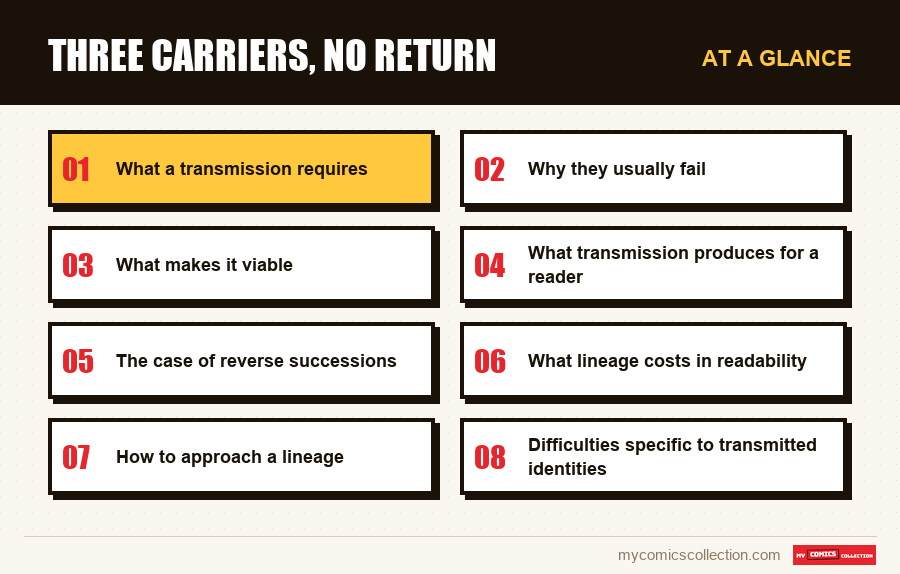
What a transmission requires
Four conditions, and only one is missing for the succession to fail.
An identity separable from the person. If the name refers to someone rather than a function, replacing it produces an imposter. An object, a title or a role is transmitted; a biography no.
A clean exit from the holder. The predecessor must be permanently unavailable. An ambiguous retirement or disappearance suggests a return which permanently delegitimizes the successor.
A successor who does not imitate him. If it uses the same register, it becomes a degraded version. He has to bring something else, even if it means disappointing those who wanted the same series.
Time. A transmission takes years to install. A succession tested over six issues mechanically fails, due to not having given the public time to become attached.
These four conditions are rarely met. This explains the considerable failure rate of successions of this type., much more than a supposed attachment of readers to the original versions.
Why they usually fail
A personal identity
Most figures of the genre are defined by a biography: an origin, a loss, a city. None of this is transmitted.
The successor inherits a suit and no reason to wear it.
A return always possible
The incumbent is rarely definitively removed, and his reappearance is regularly announced as an event: which transforms the successor into an interim.
Commercial pressure
Sales almost always decline after a replacement, and this decline is read as a rejection rather than a normal transition.
Insufficient time
Inheritances are evaluated after a few months, whereas an attachment is built over years.
What makes it viable
All four conditions are met here, and this conjunction is the real subject.
Identity depends on an object. The beetle is the character; he who wears it is a bearer. This formulation, which seems innocuous, alone resolves the problem of legitimacy.
The exits were clear. Each transition was unambiguous, and no predecessor was brought back to take over the role.
Each carrier brings something else. An archaeologist, an inventor, a teenager: three different registers for the same object. None is a degraded version of the previous one.
Time has been left. Each period lasted long enough to establish its carrier, which implies that the publisher accepted modest sales during the transition.
This conjunction is rare. It is not the product of a plan but of a series of circumstances: the first bearer was replaced for editorial reasons, not out of a desire to create a lineage.
We must be careful not to read retrospectively. We readily describe these successions as a device designed from the outset, with a transmissible object designed to last.
There is nothing to confirm this. The archaeological origin of the beetle, decided in the 1960s, made transmission possible: it does not prove that it was predicted. A feature becomes a device when someone uses it, often decades later.
What transmission produces for a reader
Three concrete effects, all favorable and rarely reported.
Three independent series. We can read a carrier without the others. Each period forms an autonomous whole, which makes the character accessible from any end.
Three registers to choose from. Archaeological adventure, team humor, adolescent chronicle: three tones for the same concept, which allows you to choose the one that suits you rather than endure the one that exists.
A distributed value. The market is divided between three segments instead of concentrating on one, which lowers the entry fee for each.
This third effect is purely mechanical and it matters. A single-bearer character focuses all of its value on a handful of numbers; this disperses it, and each segment remains affordable.
The case of reverse successions
One variation is worth distinguishing because it fails for different reasons.
Some estates do not replace a deceased holder but install a second holder in parallel, the first remaining active. Two people then have the same name at the same time.
This configuration is almost always unmanageable. It requires constant justification as to why two are needed, produces constant comparisons, and gives the newcomer the status of a duplicate that no amount of writing can redeem.
The character examined here has never experienced this situation: each transmission followed a disappearance, and at no time have two carriers coexisted sustainably in the same role.
It's probably luck more than choice. Coexistence is the natural temptation of a publisher who does not want to give up anyone, and resisting it requires accepting a loss: which only happens when the decision is made for other reasons.
What lineage costs in readability
We must name the setback, because it is real and it affects the distribution of the character.
A single wielder character introduces itself in one sentence. This requires explaining that there were three people, that the object is the same, that its nature has changed, and that the three periods have almost nothing in common.
It's too long for a regular recommendation, and this explains part of its modest notoriety despite quality series. A figure that cannot be summarized circulates poorly.
The adaptations solve the problem by retaining only one carrier, which is the only practicable solution and deprives the concept of what distinguishes it.
There is therefore a permanent trade-off between richness and readability, and this character is resolutely on the side of wealth. It is a defensible choice which has a constant commercial cost, paid for sixty years.
How to approach a lineage
Three practical recommendations for a reader who is discovering this type of character.
Start with the period that appeals to you, not the first. The three blocks being autonomous, the chronological order adds nothing and requires crossing very dated story conventions.
Don't look for overall consistency. It does not exist and has never existed: explanations of the object contradict each other over time, and that is the price of its longevity.
Treat each carrier as a separate character. They share a suit and nothing else. Expecting continuity of character produces guaranteed disappointment.
This approach transforms a daunting set into three short, independent series. This is the most economical and fair way to approach a transmitted identity, and it applies to all characters constructed in this way.
Collecting this series?
Track what you own, what you are missing and what your collection is worth. 7 day trial.
Start my trial →Difficulties specific to transmitted identities
Homonymous titles
Three bearers, several series with the same name, numberings that start again: the title alone designates nothing.
Very distant periods
Sixty years separate the first from the last, with story conventions unrelated to each other.
A variable object nature
The scarab changes its explanation depending on the time, which makes any overall presentation approximate.
No overall story
Nothing tells the story of the lineage from one end to the other; you have to reconstruct it yourself from three blocks.
Transmission as protection
A side effect of this device is worth noting, because it is verified in the readings.
When one wearer dies and another takes over the suit, the demise becomes much more difficult to undo. Bringing back the predecessor would create a duplicate and remove the reason for the new one.
Succession therefore protects the death it follows, a mechanism that we don't encounter when a disappearance leaves a void, and this is probably what explains why none of this character's transitions were undone.
This is a case where two decisions reinforce each other: death gives legitimacy to the successor, and the successor makes death irreversible. Taken separately, neither would have held up.
For a reader wondering if a disappearance will last, the practical rule is simple and reliable: see if anyone has taken the place. A replacement installed makes it expensive to return; a void makes it free.
What this case teaches about inheritance
The lesson goes far beyond this character and is worth stating.
The failure of successions is usually attributed to the conservatism of readers, who are supposed to refuse to have their figures touched. This case suggests a different, simpler explanation: most inheritances fail because the conditions are not met.
A personal identity is not transmitted, a predecessor who can return delegitimizes his successor, an imitation disappoints, and six months is not enough. These four obstacles are structural and have nothing to do with the public.
When they are raised, as here, the transmission works without anyone particularly complaining.
This is a useful observation when reading replacement announcements. It is enough to check the four conditions to predict whether an inheritance will hold, and the answer is most often known before the first number.
What to record
On an identity carried by three people, the sheet must anchor the generation before everything else.
The bearer concerned, noted before the title and number. Three series share this name, with their own numbering and different bearers: a number placed under the single title becomes indistinguishable, and prices range from one to four hundred dollars depending on the generation.
This is also what allows us to know what we are completing, a question that arises as soon as we have numbers from two periods.
The nature attributed to the beetle in the numbers you own: magical, technological, extraterrestrial depending on the era. This variable changes the reading and no source summarizes it: noting it avoids believing in an inconsistency where there is simply a revision.
These two mentions deal with the difficulty specific to transmitted identities, where the same name covers objects and explanations which do not overlap.
Frequently asked questions
Because the four conditions were met: the identity is linked to an object and not to a person, the exits were clear without return from the predecessor, each bearer brings a different register instead of imitating, and each period lasted long enough to establish its bearer.
Not out of reader conservatism, but because the conditions are lacking. A personal identity is not transmitted, a predecessor who can return permanently delegitimizes his successor, an imitation disappoints, and six months of evaluation are not enough to build an attachment.
There is nothing to confirm this. The archaeological origin of the beetle, decided in the 1960s, made transmission possible: it does not prove that it was planned. A feature becomes a device when someone uses it, often decades later.
Three independent series readable separately, three registers to choose from: archaeological adventure, team humor, adolescent chronicle:, and a value distributed between three segments instead of being concentrated, which lowers the entry ticket for each.
By checking the four conditions: is the identity separable from the person, is the predecessor definitively removed, does the successor bring something else, and are we giving him time. The answer is most often known even before the first number.
Which carrier, what nature of the beetle?
The same name covers three generations and three explanations which do not overlap.