The Blue Beetle scarab has changed its nature three times in sixty years, and each revision retroactively rewrites everything that came before. Egyptian mystical relic in the 1930s, then an object that a second bearer failed to activate and replaced by machines, in 2006 it became a alien technology deposited by a conquering civilization on the planets it intends to annex. This is not a continuity detail: it is what distinguishes the three versions of the character.
Few objects in American comics have undergone such a complete reinterpretation while remaining immediately recognizable on a cover. The form has hardly changed in sixty years; everything else has changed at least twice.
This article traces these three states, explains what each revision narratively allows, and shows why this story matters in identifying what we read, and what we own.
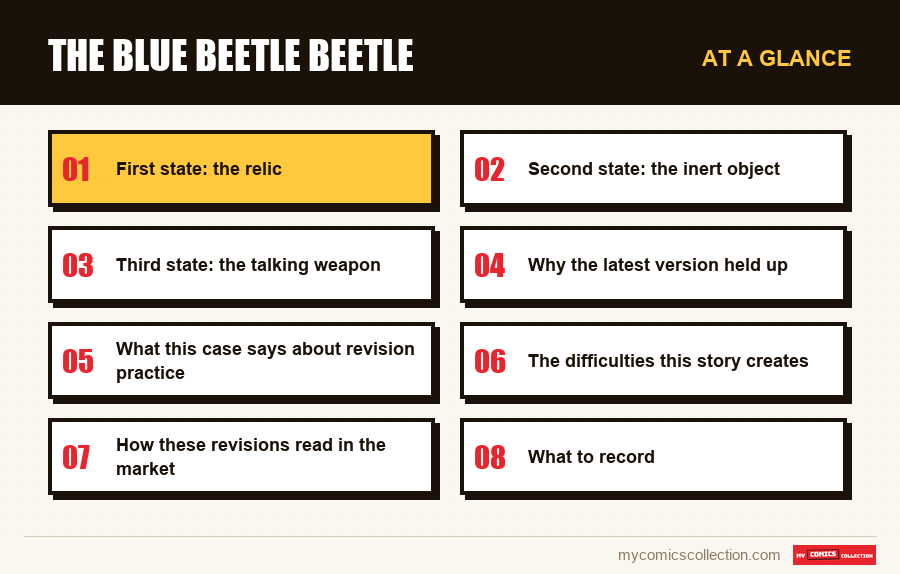
First state: the relic
Originally, the object belonged to the most classic register of the 1930s adventure: an archaeological find brought back from a tomb, charged with a power that science cannot explain.
This device fulfilled a specific function at that time. It justifies superhuman abilities in an ordinary character without having to invent anything: antiquity and exoticism serve as an explanation, and no one asks for more.
He also bears the faults of his time, and it is better to name them than to excuse them. Egypt is not a real place but a setting for mysteries, interchangeable with any distant country. At no point does the story question what it means to take an object from a grave to use it, nor what those to whom it belongs would think. This is the most dated register of the three, and by far the one that is least readable today.
Second state: the inert object
The turning point of 1966 is more interesting than it seems, because it consists of making the object a failure.
The second wielder inherits the scarab and is unable to activate it. Nothing happens. He then decides to do without magic and make what he needs: a ship, tools, a compressed air weapon.
This choice has a considerable consequence on the character. He becomes the only one of the three whose abilities are entirely the product of his work, which simultaneously makes him more fragile and more endearing. He did not receive, he built.
The revision also says something of its time. In 1966, the mystical register was no longer popular and the engineer became a legitimate heroic figure. Failing the magic item is a way to change gender without changing character.
What the relic allowed
Powers without explanation, in an exotic adventure setting. Simple, effective, and dated.
What the inert object allows
A powerless hero whose equipment is all crafted. Fragility, ingenuity, and a more down-to-earth register.
What technology allows
A grafted object that has its own intentions, talks with its bearer and pushes him to kill. The conflict becomes internal.
What the three have in common
Nothing at all, except the external shape of the object. This is precisely what makes this character so difficult to honestly summarize in a single sentence.
Third state: the talking weapon
The 2006 revision is the most radical, and it's the one that gave the character its enduring version.
The object is not a relic but a device made by a civilization which sends it as an advance guard on the worlds it plans to annex. Its mission is to bind itself to an inhabitant, to endow it with considerable power, and to turn it against its own species when the time comes.
Two major narrative consequences arise from this. First, the wearer cannot get rid of it: the beetle attaches itself to his spine, and removing it would kill him. Then he talk to him: an inner voice that comments, advises, and systematically proposes the most lethal solution.
The central conflict of the series is therefore not against an external adversary but against the equipment itself. Each fight asks the same question: how far does the wearer let the object grafted to his back go?
It’s also an elegant retroactive revision. It does not cancel the previous stories: it explains why the first wielder had powers, why the second could not activate the object, and why no one had ever understood what it was for.
What this changes when purchasing. These three states are not nuances of continuity but three different genres: exotic adventure, engineer's story, invasion science fiction.
A reader who buys “Blue Beetle” without knowing what period it is about risks coming across exactly the opposite of what they were looking for. The year of publication is more informative here than the name of the character.
Why the latest version held up
The three interpretations have not had the same posterity, and the reason deserves to be asked.
An object that gives powers without compensation does not produce any story by itself: an external adversary is needed to create conflict. An item that doesn't work doesn't produce more: it just disappears from the plot.
An object that has its own intentions, on the other hand, East the plot. It provides a permanent antagonist, available in every scene, who cannot be defeated or abandoned. It's a story-producing machine, and that's what explains why this version stood out.
It also has the advantage of making the character readable for a new reader in one page. A teenager who discovers that an alien weapon is grafted into his back and that she wants to have him killed: everything is said, and nothing requires knowing sixty years of continuity.
What this case says about revision practice
This journey in three stages illustrates a common editorial practice, and it allows us to judge its success in a specific case.
Retroactively revising the origin of a character is done constantly in this medium, and most often fails. The process generally consists of declaring what has been told false (a dream, a manipulation, an alternative reality) which has the double defect of canceling readings and suggesting that nothing has lasting importance.
The 2006 revision proceeds differently, and that is what saves it. She does not say that the previous stories did not take place: she says that no one understood what was in front of them. Events remain, their interpretation changes.
This type of revision has an advantage that the other does not have: it makes you want to reread old stories knowing what you know now. The silence of the object facing the second bearer, for example, ceases to be an unimportant detail to become an interesting question.
This is a useful criterion for judging any original rewriting: one that invalidates impoverishes what came before, one that reinterprets enriches it.
Collecting this series?
Track what you own, what you are missing and what your collection is worth. 7 day trial.
Start my trial →The difficulties this story creates
Three genres under one name
Archaeological adventure, inventor's story, invasion science fiction: the three periods are not aimed at the same reader, and nothing on the covers warns.
Unreported revisions
A reissue of an ancient story obviously does not mention what the object will become forty years later. The reader who follows the thread encounters contradictory explanations.
Occasional flashbacks
Some later stories reactivate elements from earlier versions, which further confuses the overall reading.
An adaptation that simplifies
The film retains the third version and discards the previous ones, which gives new readers a partial idea of what they will find in the old comics.
How these revisions read in the market
The history of the object has a direct translation into the prices, and it is consistent.
The issues where the object is a relic belong to the oldest and least reprinted period: they are the most expensive in raw copies, despite limited reading interest. Those where he is inert are part of a massive draw team series, and remain among the cheapest of anything related to the character.
Those where it becomes an alien weapon benefit from the effect of a recent adaptation: they ask clearly more than an ordinary booklet of their time, without reaching the levels of old titles.
The lesson is the same as any ancient character: the narrative importance of a revision and the value of the issues which carry it have no mechanical relationship. The most decisive revision of the character is found in abundant and recent fascicles; the least interesting state to read is found in the rarest.
What to record
On an object that changes its nature, an unusual field becomes useful.
The period, more than the title. Knowing that a booklet belongs to the relic version, the inert version or the extraterrestrial version says more than its number. This is the information that allows you to find an accurate reading years later.
Year and publisher. They are enough to deduce the period, and they remove the ambiguity between series which all start again at number one.
The carrier concerned. Three people, three separate markets, and no indication on the cover.
An inventory that includes these three fields answers the only question that matters when faced with a pile of booklets with the same name: what story is this, exactly?
There is an additional reason to inform the period on this specific character. The three states of the object are not sold to the same buyers: anyone looking for the extraterrestrial version discovered in the cinema has no use for a booklet where the scarab is an Egyptian relic, and the opposite is just as true. Correctly describing what you are selling makes the difference between an ad that finds a buyer and one that stays online.
Frequently asked questions
Both, depending on the time of publication. Presented as a mystical relic for decades, it was reinterpreted in 2006 as an extraterrestrial device. This revision does not cancel the previous stories: it claims to explain what no one had understood until then.
Because the object does not activate for him, without the story of the time explaining why. He then makes his own equipment, making him the only one of the three whose abilities are entirely the product of his work, and probably the most endearing for that reason.
It depends on the genre you are looking for, because the three are not aimed at the same reader. For a modern and autonomous story, the extraterrestrial version from 2006. For group comedy, the period where the object is inert. The relic version is of little interest other than historical curiosity.
Because an object with its own intentions produces a story by itself. It provides an antagonist present in every scene, who cannot be defeated or abandoned, where an object that simply grants powers requires an external adversary to create any conflict.
No, and this is one of the strengths of the recent version: a teenager who has an alien weapon grafted into his back, that can be understood in one page without any prerequisites. Knowing past states adds nice depth, but isn't necessary at any point.
The period says more than the number
Three different genres under one name: the year of publication is the most useful information here.