Killing an established character is a decision that pays twice: once by losing an exploitable asset, a second by exposing yourself to a successor canceling it. This screenwriter practiced it on an unusual scale, and the result conditions all the rest of his work:a threat is only credible if a precedent exists. This is also what makes his work vulnerable: each subsequent resurrection retroactively removes tension from already published issues.
This practice is the most expensive of all those examined in this file, and the most fragile.
The sections that follow explain what a death produces narratively, what it costs, how it is made credible, and why it almost never sticks.
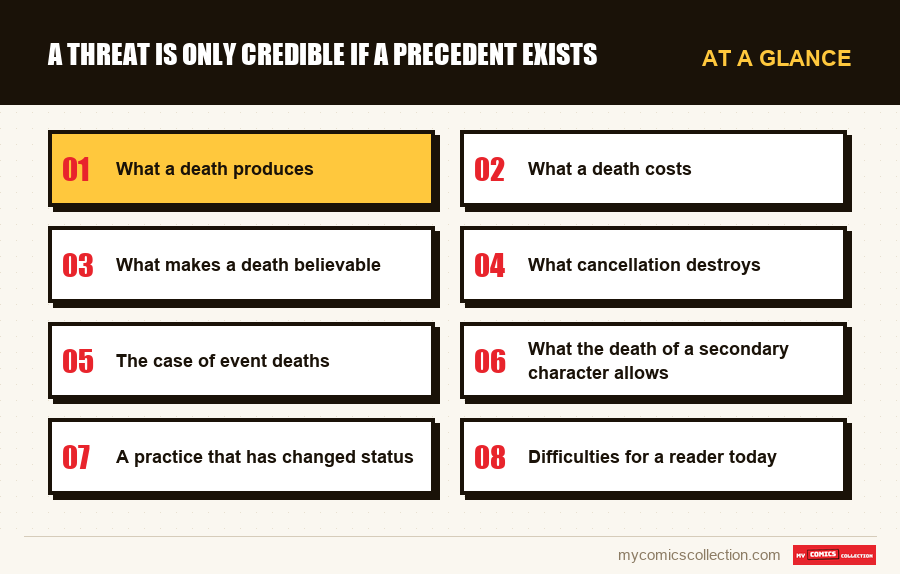
What a death produces
Three effects, only one of which really justifies the cost.
It makes the following threats credible. In a genre where the protagonists are a priori protected, a single precedent is enough to create permanent doubt. This is the main effect and it permeates the entire series.
It produces actionable grief. Survivors react, change, blame themselves for things: narrative material that no other situation provides so directly.
It closes a trajectory. A character who dies has an end, which is rare in a format designed for indefinite renewal and retrospectively gives shape to his journey.
The first effect is by far the most valuable and the only one that benefits the whole. The other two are local; this one transforms all the scenes of danger that will follow, including those written by others.
What a death costs
Un actif supprimé
An established character represents sales, future appearances, spin-off operations. Making him die removes all of that in one go.
This is why publishers resist it.
Colleagues deprived of material
Other shows lose a usable character, and this decision is forced on them without them choosing it.
Un lectorat mécontent
A part of the public reacts badly and makes it known. It is an immediate and noisy cost, when the benefit remains diffuse.
Exposure to cancellation
There is no guarantee that the decision will stand. A successor can undo it, and the work then becomes incoherent.
What makes a death believable
Not all of them work, and the gap is due to identifiable conditions.
It must cost the story. Killing a character you no longer need has no effect: the reader sees the convenience. It’s the embarrassing deaths that create doubt.
It must be irrevocable in its writing. An ambiguous disappearance, an unfound body, careful wording: so many signals that the story creates an exit for itself, and the reader spots them immediately.
It must leave visible consequences. If nothing changes afterwards, the death was only an event and not a fact. It is the following months that validate it.
These three conditions are demanding and they explain the rarity of effective deaths. A death that costs no one anything convinces no one, which is a trivial formulation and rarely applied.
The paradox of this practice deserves to be posed. The more successful a death is, the more narrative value it creates, and the more tempting it becomes, years later, to bring the character back to capitalize on the attachment it produced.
The success of the operation is therefore what puts it in danger. A forgotten death will never be undone; a significant death almost always ends up being so, and it is precisely because it was significant.
Why does it almost never work?
The mechanisms that undo these decisions are structural and have nothing to do with the quality of the initial work.
The authors change. A successor has no reason to feel bound by a decision taken before him, especially if it deprives him of a character that interests him.
Shared universes allow everything. A setting where the supernatural exists always provides a way to bring someone back, and that way will be found if demand warrants it.
Adaptations create pressure. A popular on-screen character must exist in publications, and its absence becomes a business problem.
Time erases the cost. Those who have experienced death leave, and a generation of readers arrives for whom this character is only an available name.
These four forces all work in the same direction and none work in the opposite direction. A held death is an unstable state maintained against constant pressure, and its duration depends on people who did not make the decision.
What cancellation destroys
We must precisely measure what is lost, because it is not just an inconsistency of continuity.
When a character returns, the most valuable effect disappears: the credibility of all future threats collapses at once, and not only in the series concerned.
Worse, the effect is retroactive. The issues published between death and return lose their tension on rereading: we now know that the mourning they describe was temporary.
A reader who discovers these issues after the return can no longer read them as they were written. The work is not only canceled later, it is damaged upstream, which distinguishes this cancellation from all other continuity revisions.
This is the reason why these decisions provoke seemingly disproportionate reactions: it is not a character that we bring back, it is a set of numbers that we devalue.
The case of event deaths
A particular category deserves to be singled out, because its conditions differ completely.
During a large-scale editorial event, several characters die at the same time, in a context where the disappearance is announced as the very issue of the operation. The reader knows there will be losses before opening.
This prior announcement changes everything. It removes the surprise but installs a tension of another order: not "is someone going to die" but "who", a question that lasts throughout the duration of the event.
It also has a considerable practical advantage: event deaths are negotiated in advance with all the teams concerned, which makes them significantly more stable. No one defeats them by surprise since everyone knew about it.
The downside is that they appear more institutional than dramatic. A death decided in a meeting reads differently from a death decided in a story, and the reader perceives this difference without always being able to name it.
What the death of a secondary character allows
There is a less expensive and less discussed route, and it is probably more effective.
Killing a secondary figure (a loved one, a colleague, a minor adversary) does not remove any major assets, deprives anyone of a tool, and does not trigger any public reaction.
Yet the effect on the credibility of threats is almost identical. The reader remembers that a named, popular character, with whom he had spent time, can disappear, and this is enough to create doubt.
This is a practice that we find constantly in the series examined here, and it is much more frequent than the spectacular deaths we are talking about. It goes unnoticed precisely because it costs nothing.
It also has a rare property: these deaths are almost never canceled, due to lack of commercial interest in bringing back someone whose return no one is demanding. Stability here comes from indifference.
Collecting this series?
Track what you own, what you are missing and what your collection is worth. 7 day trial.
Start my trial →A practice that has changed status
A final observation on the evolution of the process since the periods concerned.
What was exceptional has become routine. Character deaths have multiplied to the point of constituting a promotional argument, announced in advance, with the scheduled returns that go with it.
The process has therefore turned around: it no longer produces credibility but distrust. A modern reader greets the news of a death by wondering how long it will last, which is exactly the opposite of the desired effect.
This wear and tear is not attributable to those who established the process, but it changes the way we read their numbers. A reader trained in contemporary skepticism has difficulty believing an ancient death, even when it held.
This is a clear case of impoverishment of a narrative tool through overuse, and there is no way to restore it:once an audience has learned to disbelieve, no amount of writing can make them go back.
Difficulties for a reader today
Knowing what comes next spoils what came before
A reader informed of the return can no longer read the mourning numbers with the tension they carried.
Contradictory continuities
Depending on the periods and series, the same character is dead, alive, or returns in another way.
A lost context
The effect of a death depended on the time it was read. Forty years later, it must be reconstructed.
Divergent screen versions
Adaptations treat these deaths loosely, which further confuses what the reader thinks they know.
How to read these numbers today
Three recommendations to find something of the original effect.
Do not do any research beforehand. Knowing that a character will return takes away the point. If you don't know yet, don't look-this is the only case where ignorance is a real advantage.
Read the following issues, not just the death one. The effect unfolds in the weeks that follow, in the reactions and changes. The death number alone only gives the event.
Take yourself back to the times. These decisions were exceptional at their time, which a reader accustomed to repeated deaths no longer perceives. The subsequent trivialization is the consequence of the success of these first times.
This last remark applies beyond this case. An efficient process is copied until it becomes ineffective, and judging the original in terms of its imitations produces a systematically false assessment.
What to record
On a continuity where the state of the characters varies according to the periods, the sheet must anchor what the reading supposes.
The state of the characters at the end of each block read: who is dead, who still doesn't know it, who has returned. These states condition all the following scenes and they are never recapitulated: a reader who picks up after months reads reactions of mourning without knowing who we are talking about.
This is the most useful note in this entire file on this author, because his signature is precisely to make these statements weigh on what follows.
The date of your reading sessions, next to it: between two blocks separated by six months, what appears to you to be an inconsistency will most often be an oversight, and knowing how much time has passed allows you to tell the difference before accusing the story.
These two mentions transform an experienced continuity into a sustained continuity: something that the original serial format, with monthly delivery, made natural and which a modern reading in spaced blocks no longer allows.
Frequently asked questions
For a single, but considerable, benefit: making all the following threats credible. In a genre where the protagonists are a priori protected, a single precedent establishes a permanent doubt which spreads to the entire series, including the issues subsequently written by others.
That it costs the story, that it is written without escape, and that it leaves visible consequences. A death that bothers no one convinces no one: the reader immediately perceives the convenience, just as he spots a body that cannot be found or a careful wording.
Four forces work in the same direction and none in the opposite direction: authors change and don't feel connected, shared universes always provide a means of feedback, adaptations create commercial pressure, and time erases the cost. It is an unstable state maintained against constant pressure.
Much more than consistency: the credibility of all future threats collapses, and the effect is retroactive. The issues published between death and return lose their tension on rereading, since we now know that the mourning described was temporary. It's not a character that we bring back, it's a set of numbers that we devalue.
By not documenting yourself beforehand, by reading the issues following the death and not just the one where it occurs, and by remembering that these decisions were exceptional in their time. An effective process ends up copied until it becomes ineffective, and judging the original by its imitations distorts everything.
Who is dead, who still doesn't know it?
These states condition all the following scenes and are never summarized.