This work has an end, which is rare, and this end costs less than its middle. As of August 29, 2026, the series which concludes the cycle displays $12.39 median asking out of 143 gross announcements, with numbers at $0.99: compared to $19.99 for the main series. However, it is written and drawn by the author himself, which has not been systematic for years. The market pays for origins, not conclusions.
A thirty-year series which is really coming to an end is an object rare enough to warrant attention.
This article explains what this conclusion represents, what the survey shows, why the ends are not valued, and what this changes for a reader.
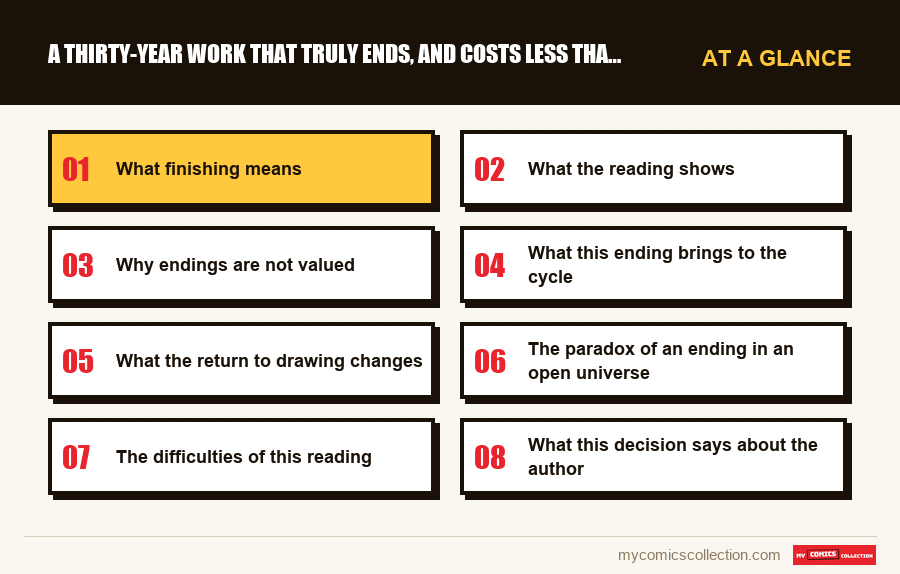
What finishing means
We must measure what this decision implies, because it goes against everything that the format encourages.
A series that works commercially has no reason to stop. It generates regular sales, fuels derivatives, maintains notoriety, and closing it eliminates all of that at once.
The pressure to continue is therefore considerable, and it is exerted all the more as the series belongs to its author: no one can force him to finish, and no one can stop him either. It's entirely his decision, which makes it a textbook case.
Few authors take this step. The usual solution is to slow down, hand off the series to others, or let it die out without a conclusion: all three ways to avoid the question.
What the reading shows
The values below come from fixed price announcements noted on August 29, 2026, raw and certified copies counted separately. They reflect the expectations of sellers.
The conclusion series
143 ads raw, of $0.99 to $600.00 requested, median $12.39. Certified: 2 ads only, at $137.00 and $299.00.
The gross maximum is an isolated value, unrelated to the current market.
The main series, for comparison
124 ads raw to $19.99 of median, and 6 ads certified at $164.97.
The middle of the cycle is therefore much more expensive than its end.
Lowest entries
Numbers to $0.99, $1.49 and $1.80 requested, some described in average condition but others not.
A tiny certified slope
Two announcements compared to six on the main series and ten on the first issue. Certification ignores this part of the cycle.
Why endings are not valued
Three mechanisms combine, and none concerns the quality of the story.
A conclusion is not a first appearance. The entire logic of the collecting market is organized around points of origin: first issue, first appearance, first team. A last number has no equivalent in this grammar.
The publication is recent. These issues were printed around ten years ago, under modern printing and conservation conditions. The supply remains abundant and is not decreasing.
The readership was already established. A conclusion is for those who have followed. It doesn't attract new buyers, so it doesn't create additional demand.
The result is a curious imbalance. The hardest part of the cycle to write is the cheapest to acquire, which is great for a reader and indicative of what the market is measuring.
This imbalance is found everywhere. On almost all long series, the first issues are worth multiples of the last ones, regardless of the respective quality.
This is consistent with the rest of the observations of this campaign: the market values identifiable origin and material rarity, never narrative accomplishment. These are two scales that do not overlap, and confusing them leads to false expectations.
What this ending brings to the cycle
A direct assessment, because that is what justifies reading it.
It answers what the beginning posed. The questions posed thirty years earlier (origin of the character, what is expected of him, whether he will escape it) are answered. Few long works risk this.
It is entirely in the hand of the author. After years where part of the work was entrusted to others, he returned to drawing. The feedback is clear and can be seen from the first board.
She changes register. The pace slows down, the setting becomes smaller, the action becomes rare. It's closer to a contemplative story than an adventure, which confuses some readers.
This last point deserves to be noted without minimizing it. A conclusion that changes register risks disappointing those who expected an outcome from the previous register: and this is the criticism that this ending receives most often.
What the return to drawing changes
A production detail deserves to be developed, because it conditions the effect of this conclusion.
For years, an increasing amount of the universe was drawn by others, with the author focusing on the overall writing and direction. It was a production necessity in an expanding universe.
Resuming the drawing for the conclusion is therefore not a neutral gesture. This means that this part had to be done by him and no one else, a decision that costs time and slows down everything else.
The effect can be read in the pages. The line is freer than in the previous stories, the compositions more stripped down, the silences longer: as if the obligation to maintain a serial rhythm had relaxed at the same time as the story approached its end.
This is also what explains part of the change of register criticized above. An author who draws a conclusion himself no longer has to provide material to a collaborator, and can afford pages where almost nothing happens.
The paradox of an ending in an open universe
An apparent contradiction is worth examining, as it bothers many readers.
How can a work be concluded while other titles in the same universe continue to appear? The feeling of ending seems canceled by this continuation.
The answer lies in what exactly ends. What ends is the journey of a character, not the existence of a world: and these two things have no reason to have the same duration.
It is even consistent with what the work has been telling from the beginning: an ancient world, populated by forces that existed before and will exist after, crossed by figures whose lives are brief on this scale.
A conclusion that also stopped the universe would have contradicted this postulate. Letting it continue without its main character is, on reflection, the only ending consistent with thirty years of stories about the smallness of individual trajectories.
Collecting this series?
Track what you own, what you are missing and what your collection is worth. 7 day trial.
Start my trial →The difficulties of this reading
A cumulative understanding
This part assumes everything else. It is illegible for those who have not followed, and nothing summarizes it.
A very slow pace
The change of register surprises and requires a waiting adjustment which is not announced anywhere.
A universe that continues
Other lines continue after this conclusion, which confuses the feeling of the ending.
A late division into collections
These issues have been collected according to logics which do not follow those of the previous volumes.
A practical consequence is worth noting for those who purchase this part. The $0.99 numbers noted correspond to examples described as being in fair condition, but not all are-several listings at the lower end of the range have fair condition markings. On a recent and abundant publication, there is therefore no reason to accept a tired copy: at these price levels, the difference between an average copy and a good copy is counted in cents, and the offer allows you to choose.
Should you read to the end?
The question really arises, because many readers stop before and do not regret it.
If you followed the cycle, yes. It is the culmination of what you have read, and to deprive yourself of it amounts to leaving a work open when it offers closure: something rare enough to benefit from.
If you read in fragments, probably not. This part only has cumulative meaning. Read in isolation, it will seem slow and allusive without compensation.
If you're looking for action, no. The registry has changed and it will not come back. Better to stop on a part that corresponds to what you are looking for.
There is no shame in stopping before the end. A long work allows multiple outputs, and the last one is not necessarily yours.
What this decision says about the author
One last point, which brings together what this campaign has observed about him.
Finishing a profitable series, taking over the design yourself after having delegated it, changing register when the expectation is greatest: three decisions which each go against immediate commercial interest.
They are consistent with the rest. Refuse to explain folklore, use a brief, little-valued form, leave a universe without an orientation device: these are the same arbitrations, taken in favor of the work against its distribution.
Each of these choices can be discussed, and I have discussed several of them in previous articles. What we cannot blame them for is inconsistency: they form a whole.
This is probably what explains the loyalty of a readership that these biases should have discouraged. A work that holds its line ends up being followed for that very reason.
What to record
On this part of the cycle, the decisive field documents your progress rather than your objects.
The point in the cycle where you are, arc by arc, with the date. This conclusion presupposes having read the above, and a reader who picks up after a long interruption must know not only where he left off but what he read years ago and probably forgot.
Without this trace, the end of a thirty-year cycle is illegible: we no longer know what questions were asked, so we do not recognize the answers.
What you still expected from an arc when you stopped it, noted in one sentence: this is what makes it possible to verify, at the end, whether the work responded: a verification impossible to do from memory over such a duration.
These two fields address the only real issue here, which is neither price nor rarity, but the ability to read a conclusion while still having access to what it concludes.
Frequently asked questions
Because a conclusion is not a first appearance, the publication is recent and the offer abundant, and it is aimed at an already established readership without attracting new buyers. The market values identifiable origin and material rarity, never narrative accomplishment.
The main character's cycle is, and that's what matters: the questions asked thirty years earlier are answered. Other universe lines continue in parallel, which blurs the feeling of ending without canceling it.
No, and this is its main limitation. This part is cumulative by construction, it does not recapitulate anything, and read in isolation it will appear slow and allusive without compensation. This is the only segment of the cycle that truly requires all of the above.
This is the most frequent criticism and it is understandable: the pace slows down, the action becomes rare, we move to a contemplative register. A conclusion that changes register disappoints those who expected the outcome of the previous register: a legitimate expectation that this ending does not satisfy.
Not at all. A long work allows for multiple exits, and the last one isn't necessarily yours: especially if you're looking for action, since the register has changed and won't return. Better to stop on a part that suits you.
What else were you expecting from this arc?
Over thirty years of reading, only a written note makes it possible to verify whether the work responded.