This universe has dozens of titles published over three decades, and no object indicates in which order to read them. Regular series, mini-series, special issues and derivative lines coexist with numberings that all start from one. The reflex of following numbers doesn't work here:the relevant unit is arc, not number: and this is what discourages most readers who give up after a few volumes.
Branching is the main barrier to entry into this work, well before its price or register.
This article describes the real structure of the whole, explains why it was formed like this, gives a method of navigation, and indicates what can be ignored without losing anything.
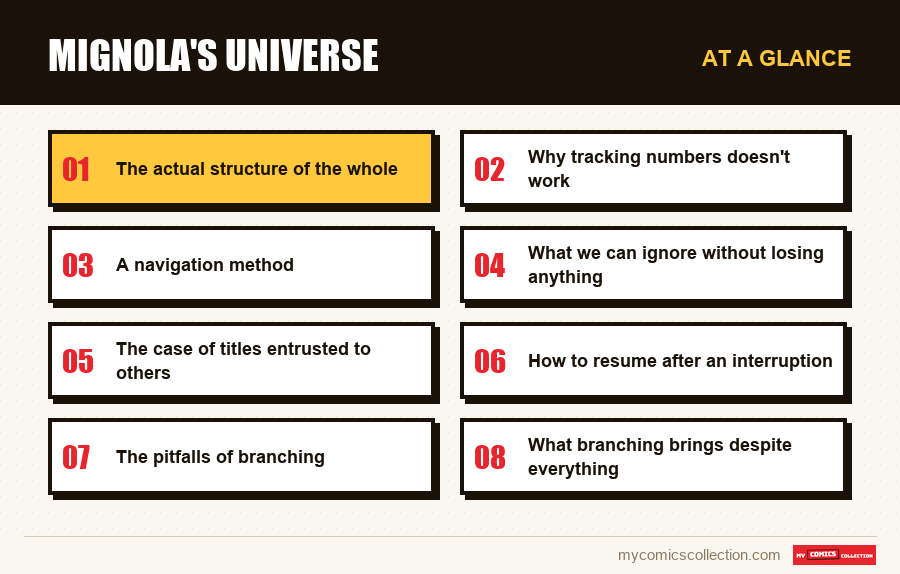
The actual structure of the whole
Four levels coexist, and distinguishing between them solves half the problem.
The central series. It follows the main character, alternates long stories and short stories, and constitutes the core. This is the only really essential part.
The main branch line. It follows the organization to which the character belongs, with its own cast and its own continuity, itself divided into numerous arcs.
Series dedicated to a secondary character. Several figures have obtained their own title, with very variable perimeters and durations.
Occasional publications. Special issues, contributions to collective collections, promotional stories: scattered and often never included in volume.
This structure is nothing exceptional in the medium. What is, is the absence of any orientation device: neither continuous numbering, nor order mention, nor accessible index.
Why was it formed like this?
Growth through opportunities
Each new line was born from an opportunity (an available designer, a character of interest) rather than from an overall plan.
This is the normal mode of development of a universe that lasts.
Mini-series rather than series
Publishing in short arcs allows you to test a character without commitment. Each arc receives its own numbering, hence the multiplication.
A production constraint
Since the author could only draw a fraction of the whole, the extension required entrusting titles to others: therefore separating them.
No set renumbering
At no time did the publisher impose a continuous numbering that would have ordered everything, unlike what other universes have done.
Why tracking numbers doesn't work
This is the natural instinct of any comic book reader, and it completely fails here.
A number three from a 2005 mini-series has no relation to a number three from another 2012 mini-series, even though both are named after the universe and a seller will describe them in a similar way.
The number does not identify anything on the scale of the universe: it identifies a position inside an arc, and the arc is only named in a subtitle that announcements regularly omit.
The practical consequence is immediate. A collection built up by purchasing issues quickly becomes a set of fragments from which one can no longer tell what comes before what.
The remedy is to change units. Think in arcs, a title plus a subtitle, and the number becomes a single row inside, what should have remained.
The subtitle is the most important and most often missing information. An ad that gives the general title and number describes one undetermined item among dozens.
Asking for the subtitle before buying resolves almost all confusion, and it's a question that sellers understand without difficulty in this specific universe, where it is common.
A navigation method
Three principles that are enough to guide you without external documentation.
One arc at a time, from start to finish. Do not mix two current arcs. Each concludes, and completing them one by one avoids confusion entirely.
Follow the publication timeline, not the story timeline. Internal events are deliberately dispersed in time; the order of publication is the only one that guarantees that nothing is discovered too early.
Treat the derived line as a separate work. It has its own continuity and its own rhythm. Reading it in parallel with the trunk doubles the orientation load for no benefit.
These three principles do not require any prior knowledge. They replace the orientation device that the publisher never provided, and they are enough.
What we can ignore without losing anything
This is probably the most useful part of this article, because no one says it.
The series of secondary characters. They develop figures that the trunk has already installed, without the trunk depending on it. Ignoring them creates no holes.
Promotional publications. A few pages produced for one occasion, without consequence on the rest. They are about completeness, not reading.
Much of the line derived. Its arcs follow one another, but we can enter and exit without losing the general thread: the episodic structure allows it.
What remains after these withdrawals is a set of a very reasonable size, comparable to any long-term series. Branching scares more than it costs, provided you know what you can leave behind.
The case of titles entrusted to others
An additional distinction is necessary, and it intersects with the question of navigation.
A significant part of this universe is not designed by its creator, who ensures co-writing and direction. These titles therefore fall under a shared universe regime rather than a work of authorship.
This changes what we can expect from them and therefore the way we classify them. A reader coming for a precise graphic style has no reason to follow these lines; a reader who comes for the universe and its developments will, on the contrary, find them indispensable.
The practical problem is that nothing distinguishes the two regimes from the outside. The name of the creator appears on the covers of all titles, as author, co-author or supervisor, without the function being specified.
This is a scenario already encountered elsewhere in this campaign, and the remedy is the same: check the bear rather than the cover. In a universe of this size, this requires doing so systematically when purchasing, otherwise the information is lost.
How to resume after an interruption
A practical problem arises with long works and it is aggravated here by the branching.
You follow an arc, you stop, several months pass. When you resume, you have to find not only where you left off, but in which of the many titles in progress.
On a single series, the cover of the last issue read is enough to find your place. Here, this information is not enough: you need to know the arc, its rank in the line, and what has been published in the meantime in the parallel titles.
The most economical solution is to never follow more than one line at a time. A reader who finishes the central series before approaching the derivative line only ever has one starting point to find.
This is advice that seems restrictive and saves considerable time. Reading several lines in parallel is possible for those who have been following the universe for a long time; it is discouraging for anyone starting out.
Collecting this series?
Track what you own, what you are missing and what your collection is worth. 7 day trial.
Start my trial →The pitfalls of branching
Interchangeable numbers
The same number denotes dozens of unrelated stories. Without a subtitle, an ad describes nothing.
Arcs started then lost
Buying at random produces the beginnings of arcs without their continuation, difficult to spot afterwards.
Collections with a vague scope
The volumes sometimes bring together several partial arcs, without the summary being visible upon purchase.
An exploded internal timeline
The stories take place in very different eras, which makes the order of the story unusable as a guide.
A final point of reference can help to play down the apparent magnitude. The dozens of titles listed do not represent dozens of independent stories: many are mini-series of a few issues, and several of them actually tell the same overall movement cut into commercial installments. The number of titles therefore measures a publication policy much more than a quantity of material, and the whole can be read in less time than its list suggests.
What branching brings despite everything
It would be unfair to present this structure only as an obstacle, because it produces an effect that is difficult to achieve otherwise.
A universe that we cannot circumnavigate gives the feeling of existing beyond what we read about it. Knowing that things are happening elsewhere, in titles that we don't follow, is exactly the impression that a work of this type seeks to produce.
A perfectly ordered and continuously numbered universe would, on the contrary, give the feeling of a closed whole, the limits of which we know. It's more comfortable and much less evocative.
The ramification is therefore consistent with the rest of the biases: the refusal to explain, the stories without conclusion, the creatures whose rules we ignore. They all produce the same effect: a world bigger than what we see.
The fact remains that this effect has a real practical cost, and that there is no reason to leave readers without guidance. The two findings are compatible.
What to record
In this universe, the decisive field is an order that neither objects nor the market provides.
The couple's title plus subtitle for each arc, with its publication date. It is the only key that uniquely identifies a story in a set where the numbers are repeated by the dozen. The publication date also provides the recommended reading order, which the internal chronology does not provide.
A file built on the number alone makes the whole thing impossible to reconstruct, and it is irreversible: finding out afterwards which arc a number belongs to requires reopening each copy.
The progress of each arc: complete, started, not started: since the main risk of purchasing in batches is to accumulate beginnings without their sequels, a situation that is not detected by looking at a shelf.
These two fields replace the missing orientation device. On a universe of this size, it's the difference between a collection and a stock.
Frequently asked questions
No. The central series is the only essential part; the series of secondary characters develop figures that the trunk has already installed without it depending on it, and the promotional publications have no consequences. What remains after these withdrawals is comparable to any long-term series.
Because a number three from 2005 has no relation to a number three from 2012, both of which are named after the universe. The number identifies a position within an arc, and the arc is only named in a subtitle that announcements often omit. The relevant unit is the arc.
No, the order of publication. The internal events are deliberately scattered over very different times, which makes the story's chronology unusable as a guide, and following the publication ensures that nothing is discovered too early.
The subtitle of the arc, the most important information and most often missing from the announcements. A general title with a number describes one indeterminate object among dozens. The question is common in this universe and sellers understand it without difficulty.
It has a real practical cost and it also produces a desired effect: a universe that we cannot circumnavigate gives the feeling of existing beyond what we read about it. This is consistent with the refusal to explain and the inconclusive narratives: all produce a world larger than what we see.
What arc, and have you completed it?
The risk of buying in batches is accumulating debuts without their sequels: invisible on a shelf.