He is the first author in this series of articles where the heart of the work is expensive and the periphery cheap. At the reading of August 29, 2026, the main series wonders $19.99 median in numbers, when the derived line is at $4.95 and work prior to $5.19. The good strategy with a constrained budget is therefore not to look for cheaper copies from the center, but to enter by the collection for the center and by the numbers for the rest.
Applying here the method that worked with previous authors would lead to spending a lot for little.
This article gives the price distribution, the resulting strategy, what to avoid, and how to keep track of what you really spend.
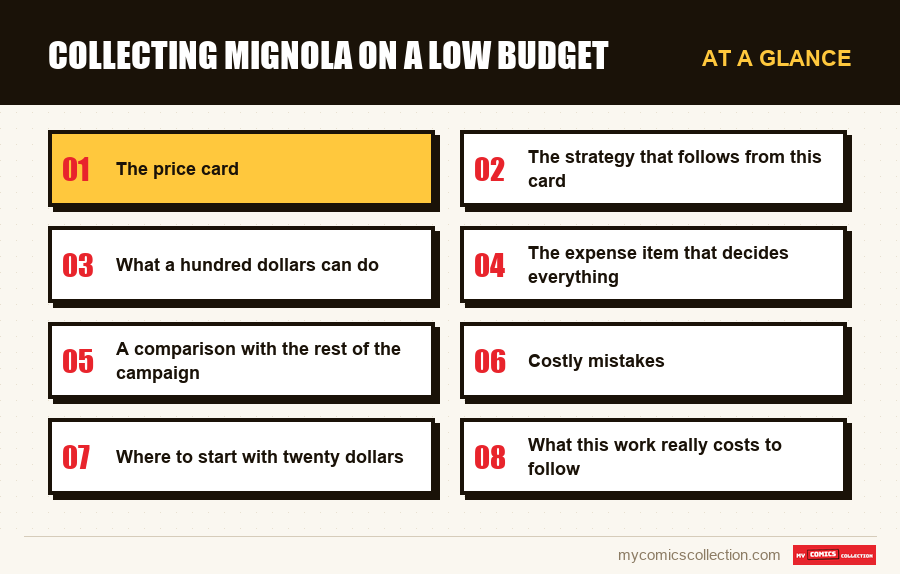
The price card
The values below come from fixed price announcements taken on August 29, 2026, raw and certified copies counted separately. They describe sellers' expectations.
Le centre : cher
Série principale en numéros, 19,99 $median out of 124 ads. First number, 19,98 $en brut et 375,00 $en certifié.
This is the part that the market values, and it cannot be negotiated.
The outskirts: very accessible
Ligne dérivée à 4,95 $of median out of 132 listings, with entries at $1.29. No certified announcement.
The front: even cheaper
Work from the 1980s to 5,19 $of median out of 94 advertisements, without any certified advertisement either.
Collections: the best report
Ligne souple à 26,99 $of median over 199 listings, with volumes between $8.95 and $13. A volume for the price of an issue and a half.
The strategy that follows from this card
It is formulated in one sentence and it is counterintuitive: buy the center in volumes and the periphery in numbers.
For the center, the collection. An $8.95 volume at the bottom of the soft line contains the equivalent of several $19.99 issues. Looking for cheap issues of the main series is a waste of time: they don't exist below a certain level.
For the periphery, the numbers. At $1.29 or $1.62 each, the derivative line can be purchased in packages for the price of a single bound volume. This is where the budget produces the most pages.
For the front, lots of period series. Work from the 1980s is in generic packages where you have to locate it, which takes time but costs little.
This distribution reverses the usual reflex. We spontaneously seek to save on things that are expensive: whereas here, the only leverage is not to buy this part in the most expensive form.
What not to hope for. No cheap copies of the main series are circulating in good condition, and an announcement significantly below the median should arouse suspicion rather than enthusiasm.
On this title, the $1.49 entries correspond to anniversary reprints bearing the same title and number as the original. Always check the year.
What a hundred dollars can do
The order of magnitude deserves to be made concrete, based solely on the prices recorded.
Divided into volumes. One hundred dollars buys several volumes of the soft line in its low range, a substantial set of the main series, read in good conditions.
Divided into periphery numbers. The same amount represents several dozen issues of the derived line, a considerable narrative ensemble.
Divided into main series numbers. Five numbers. Five fragments of stories that are not enough.
The comparison is overwhelming and it makes the decision obvious. The same amount gives access to five issues or several hundred pages, depending only on how we spend it.
The expense item that decides everything
It changes depending on the part of the work concerned, which is unusual.
On the outskirts is the port. At $1.29 per issue, individual shipping multiplies the cost five or six times. Grouping is the only parameter that matters.
On the collections, it is the printing status. An out-of-print volume is asked well above the median of its line, for content identical to an available volume. Checking before you buy changes the price by an important factor.
On the main series, it's the year. Anniversary reprint or original print: two homonymous objects separated by a factor greater than ten.
Three parts, three different vigilances. No single rule covers all of this work, which distinguishes it from the flat bibliographies treated previously.
Why is the outskirts so cheap?
The gap of four times between the center and its periphery is worth returning to, because it determines the entire strategy outlined above.
The collector's market values an identifiable character, a dated first appearance, and demand organized around a specific object. The derived line has none of these three attributes: its protagonist is collective, none of its numbers is a point of origin, and its ramification prevents any goal of readable completeness.
None of these reasons are about what the stories are worth. They describe how a request is formed, not the quality of what is requested.
This is what makes refereeing so reader-friendly. A buyer who seeks to read rather than own directly benefits from a market mechanism that does not concern him.
The downside must be said: these numbers will not resell for better than they were paid for. If your project includes a resale value, this part of the work will not contribute to it.
A comparison with the rest of the campaign
It is useful to situate this work in relation to the bibliographies previously discussed, because the method of purchase changes completely.
For independent authors with flat medians, a few dollars per issue over an entire career, the rule was simple: buy in batches, individually, without worrying about the period. Nothing was expensive enough to justify a strategy.
Here, the gap between segments is a factor of four in numbers, and a factor much greater when comparing certified to raw. A strategy becomes profitable because there is something to optimize, which was not the case until now.
This transition is worth noting to anyone moving from one type of collection to another. The reflexes acquired on cheap series (buying piecemeal, not checking, grabbing what is available) become costly as soon as prices rise.
Conversely, applying maximum caution here to numbers at $1.29 would be a waste of time. The level of vigilance must follow the price level, segment by segment, and not apply uniformly.
Collecting this series?
Track what you own, what you are missing and what your collection is worth. 7 day trial.
Start my trial →Costly mistakes
The reprint taken for the original
Same title, same number, twenty-five years apart. This is the most expensive mistake possible on this work.
The center bought in numbers
Five issues for a hundred dollars, when the same amount in volumes yields several hundred pages.
The sold-out volume paid at a high price
Without having verified that another available volume covers the same content.
The periphery purchased individually
On $1.29 numbers, the postage far exceeds the item. Batch is the only sensible approach.
Where to start with twenty dollars
The question arises often and it has a precise answer here.
Twenty dollars is exactly the price of an issue of the main series, or that of a volume of the soft line plus a few peripheral issues.
Take the volume. It contains a complete story that sets up the character and setting, which is the prerequisite for everything else. An isolated number only gives a fragment and does not allow any judgment.
If the volume convinces you, the next twenty dollars will go to the periphery rather than to central issues: that's where the pages-to-budget ratio is best, and the content is not inferior there.
This progression has an additional advantage: she never commits more than twenty dollars to a work that we do not yet know, which is the right level of risk for a trial.
What this work really costs to follow
A point of frankness, because articles of this type often underestimate the magnitude.
The universe has many parallel lines published over three decades. Following it in its entirety represents an investment out of all proportion to the bibliographies covered previously in this campaign, where the complete work cost just a few dozen dollars.
Here, completion is a several hundred dollar project, even while optimizing each purchase. It is better to know this before you begin than to discover it in the thirtieth volume.
The good news is that there is no requirement for completeness. The work consists of largely self-contained blocks, and stopping after the main series leaves a coherent and complete whole in itself.
This is probably the most useful tip in this article: decide on a perimeter before you start, otherwise the ramifications of the universe will decide for you.
What to record
With a constrained budget on this work, the decisive field concerns what you have already read, not what you own.
Stories already read, regardless of the medium. The same story exists in original number, in several lines of collections and sometimes in a bound edition: a sheet organized by subject will allow you to repurchase content, while a sheet organized by story protects you from it.
This is the specificity of this work compared to the previous ones of this campaign, where the object and the content were largely confused.
The perimeter you have set for yourself, written in black and white: main series only, main series plus periphery, or entirety. In a universe with dozens of lines, this decision is the only protection against an expense that has no natural end.
These two fields address the real risk of this collection, which is not paying too much for a copy but spending without limit on a set that has none.
Questions fréquentes
Not in original issues in good condition: the median is $19.99 and there is no such thing as a cheap deposit. Announcements significantly below this level are for anniversary reprints with the same title and number: always check the year. The only real lever is collection.
Five issues of the main series, or several volumes of the soft line, or several dozen issues of the derivative line. The same amount gives access to five fragments or several hundred pages, depending on how you spend it.
No, and this is what distinguishes this work from flat bibliographies. Three parts, three vigilances: the port on the periphery, the printing status on the collections, the year on the main series. No single rule covers everything.
By a volume of the soft line, not by a number. Twenty dollars is worth exactly one issue of the main series, which only gives a fragment; the same amount in volume yields a complete story setting up character and setting: a prerequisite for everything else.
Several hundred dollars even when optimizing, which is incommensurate with more modest bibliographies. But nothing requires completeness: the work is made up of largely autonomous blocks, and stopping after the main series leaves a coherent whole. Decide on a perimeter before you begin.
Have you already read this story elsewhere?
One sheet per object will make you repurchase content; one sheet per story protects you from this.