The spinoff series that follows the organization rather than the main character is four times cheaper than the parent series, and it has no certified market. As of August 29, 2026, it displays $4.95 median asking on 132 gross ads, compared to $19.99 for the main series, and zero ad certified against six. However, it is the same universe, often co-written by the same author. The difference is that the market buys: a character, not a world.
This gap makes this series one of the best reading deals spotted in this entire campaign.
This article explains what the derived series offers, what the reading shows about the gap, why it exists, and how to approach such a branched line.
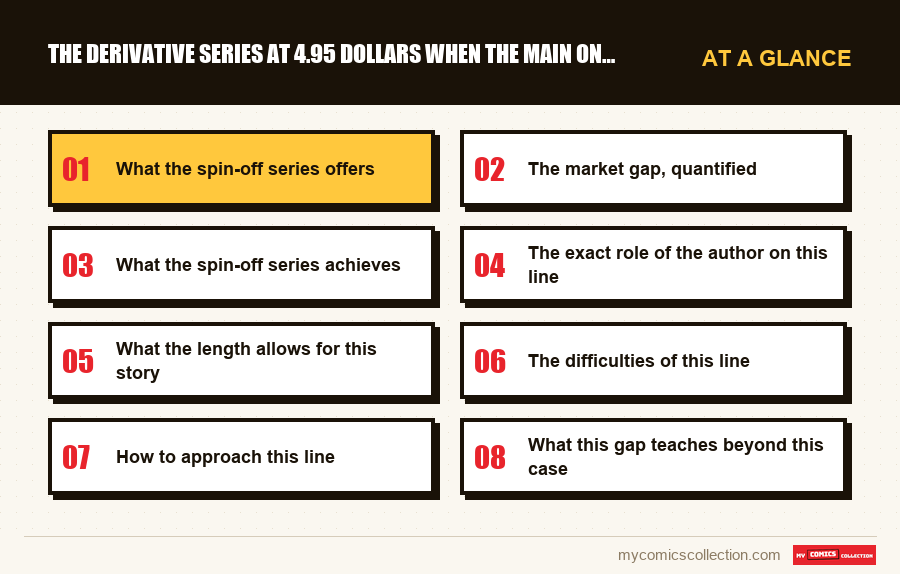
What the spin-off series offers
The shift in subject is more radical than a simple enlargement of the universe.
The main series follows a character: his origins, his choices, his relationship to what is expected of him. It’s a centered narrative, and everything around it exists in relation to it.
The spin-off series follows a organization: an administrative structure responsible for supernatural affairs, with its agents, its procedures and its failures. The protagonist is collective.
This change produces a story of a different nature: less mythological, more operational, with fallible characters who die without the story stopping. It's a fantasy procedural rather than a personal odyssey, and it is not suitable for the same reader.
The market gap, quantified
The data below comes from fixed price announcements from August 29, 2026, raw and certified copies noted separately. These are sellers' expectations.
The spin-off series
Raw : 132 ads, of $1.29 to $1,299.00 requested, median $4.95. Certified: no announcement.
The maximum is an isolated value that describes nothing about the current market.
The main series, for comparison
Raw : 124 ads, median $19.99. Certified: 6 ads, median $164.97.
Comparable offer, price four times higher.
Lowest entries
Numbers to $1.29 and $1.62 requested, in precisely and correctly described conditions. These are regular numbers, not junk.
What the absence of certified means
No certified copy out of 132 advertisements: no one judges the operation profitable, which confirms the absence of organized demand on this line.
Why does this gap exist?
Four causes combine, and none relates to the quality of the stories.
The market buys characters. An identifiable, recognizable, nameable figure concentrates the demand. A collective of agents does not produce the same market attachment, whatever the quality of its treatment.
There is no first appearance that counts. The derivative series is born from an already established universe; none of its numbers constitute the point of origin of anything.
The line is branched. It is available in numerous titles and sub-series, each renumbered. This dispersion prevents the creation of a readable collection objective.
The drawing is not by the same hand. A significant part of these stories is drawn by others, which deprives buyers of the graphic criterion which organizes demand for the parent series.
These four causes reinforce each other, and their cumulative effect is this factor four. None say anything about what the stories are worth.
For a reader, the conclusion is very favorable. Hundreds of issues of a coherent universe, co-written by the author of the parent series, ask for around five dollars, and many for less than two.
This is the best content-price ratio noted in this campaign for a work of this magnitude. We still have to accept the shift in subject, which is real.
What the spin-off series achieves
It is worth being specific, as it is regularly presented as an appendix.
She assumes the consequences. Agents die, operations fail, decisions take their toll. Where the main series necessarily protects its central character, this one has no one to protect.
It sets a duration. Following an organization over years makes it possible to show progressive deterioration (resources running out, a situation getting worse) which the character-centered format makes difficult.
She lets the supporting role breathe. Secondary figures from the parent series become protagonists in their own right, which is precisely the useful function of a spin-off series.
These three successes are due to the same movement. By abandoning the central character, the story gains a freedom that the main series cannot have: and this is what justifies its existence beyond commercial exploitation.
The exact role of the author on this line
Clarification is necessary, because it determines what we can expect.
This line is not drawn by the author of the parent series. He ensures co-writing and overall direction, while the graphic design falls to others, over long periods and with marked styles.
This device is that of a shared universe rather than an author's work. We must therefore immediately give up trying to find the trait that makes the main series unique., and judge these stories on what they are.
The good news is that the selected designers did not try to imitate. They bring their own treatment, often more narrative and less based on the black masses, which is better suited to the procedural register.
A reader who comes for the author's graphic style will therefore be disappointed; a reader who comes for the universe and its developments will find most of the material there. This is a distinction to make before you buy, not after.
What the length allows for this story
One effect deserves to be isolated, because it alone justifies reading this line in order rather than in samples.
An organization followed over years can deteriorate. Its resources are diminishing, its experienced agents are disappearing, its methods are becoming unsuitable for what it is facing, and none of this is making up for it.
This is a movement that character-driven narrative cannot produce as well, because a protagonist must remain capable of acting. An institution can decline without the story stopping, and this possibility is exploited here with remarkable consistency.
The reader who follows the line in order therefore perceives a slope: the first arcs are adjusted, the following ones cost, the last ones are no longer adjusted. This is what gives the whole thing a scope that its one-dollar numbers do not suggest.
Read in fragments, on the other hand, this slope is invisible, and we only see a succession of interchangeable supernatural operations. This is the main risk of buying in scattered lots.
Collecting this series?
Track what you own, what you are missing and what your collection is worth. 7 day trial.
Start my trial →The difficulties of this line
Une ramification considérable
Numerous titles and subseries follow one another, each renumbered. The reading order is not indicated anywhere on the objects.
Titles in acronyms
The line name is an acronym that ads spell multiple ways, fragmenting searches.
Des personnages nombreux
The protagonist being collective, entering along the way requires an effort of identification that nothing alleviates.
Des recueils hétérogènes
The volumes are grouped according to successive logics, with collection numbering which does not follow one another.
How to approach this line
Three principles, which arise from its structure as much as its prices.
Don't start with her. The shift in subject can only be appreciated if we know the starting point. Read the first long story in the parent series first.
Enter in a full arc, not a single number. The collective story involves following an operation from start to finish; a number taken at random gives an impression of confusion which is not representative.
Buy in batches. At $1.29 or $1.62 per issue, shipping completely dominates the cost, and this line is precisely found in bundles among sellers who liquidate volume.
This approach provides access, for a few dozen dollars, to a considerable narrative set. This is the clearest opportunity identified in this campaign, and it is solely due to the fact that the market values characters rather than worlds.
What this gap teaches beyond this case
The mechanism observed here is reproduced everywhere, and knowing how to spot it has immediate practical value.
In any family of related titles, there is a bearer of demand-a nameable character-and a peripheral group that lives in its shadow. The first concentrates the prices, the second suffers from them.
But quality does not follow this distribution. Spin-off series often enjoy a freedom that the main title doesn't have, precisely because they have less to lose.
For a reader with a limited budget, this is the most profitable rule there is: systematically seek the periphery of universes rather than their center. We pay four times less for content that is not four times less good.
The compensation is real and it must be named: these series cannot be resold, and their value will not change. These are reading purchases, not conservation.
Ce qu'il faut enregistrer
On this line, the decisive field is an order that nothing provides elsewhere.
The position of each arc in the internal timeline, noted apart from the title and number. A line broken up into dozens of renumbered sub-series cannot be put back in order from the objects: neither the covers, nor the numbers, nor the collection titles indicate what comes before what.
Without this note, a collection made up of batches becomes a pile of arcs whose sequence is unknown, and the collective story loses exactly what makes its strength, duration.
The subtitle of the subseries, systematically: it is he who identifies the arc, the number alone being shared by dozens of unrelated stories.
These two fields reconstitute a continuity that the publisher has fragmented over the years. This is the work this line requires, and it is not transferable.
Frequently asked questions
Because the market buys characters, not worlds. The protagonist is collective, no number constitutes a first appearance, the line is branched into dozens of sub-series, and the drawing is not by the same hand. None of these four causes says anything about the quality of the stories.
Technically yes, but the shift in subject can only be appreciated if you know the starting point. Read the first long story from the parent series first: it's what makes you understand what the spinoff series gives up and what it gains in exchange.
It simply confirms that no organized demand exists: out of 132 advertisements, no one considers the operation profitable for numbers with a median of five dollars. This is a market fact, not a judgment, and for a reader, it's actually good news.
Noting the subtitle of the arc rather than just the number, which is shared by dozens of unrelated stories. Enter through a complete arc and not through an isolated number: the collective story involves following an operation from start to finish.
No, and it must be said clearly: these numbers cannot be resold and their value will not change. It's a reading purchase, not a conservation one, but as such, it's the best content-price ratio noted in this entire campaign for a work of this magnitude.
Which arc, and in what order?
Dozens of renumbered subseries, and no object to indicate what comes before what.