In 2004, Cable shared a series with a co-star whose notoriety exploded long after. Today, searching for this series by its common title hardly brings it up: on August 29, 2026, an online ad statement gives 29 uncertified proposals between $2.55 and $275.00 (median $7.76) and 3 certified proposals between $39.99 and $249.99 (median $100.00), but above all: of the five cheapest offers, none does not belong to the searched series. These are booklets from other series from the same publisher and from the same period. With 29 and 3 listings, no median proves anything about price levels; what speaks is the composition of the result. The shared title has ceased to function as a search key, absorbed by the name of the more famous of the two.
There is a category of series that can no longer be found by typing their name. Not because they are rare, nor because the catalog has forgotten them: they appear there, properly numbered, with their dates and their sequence of episodes. They disappear in another, more insidious way: their title, which associates two characters, has been captured by one of the two. When you write it, the engine does not understand that you are looking for a specific object. He understands that you are talking about the most famous character, and he serves you what sells best under that name. The shared series slides into the depths of the result.
The series launched in 2004 around Cable and his partner is the textbook case. When he was born, the balance between the two protagonists was real, and the order of the title even left the advantage to Cable. Two decades later, the relationship has been reversed spectacularly: the second name has become a global brand, adapted to cinema, available in derivative products, while Cable remains a background character for established readers. This asymmetry hasn't just changed the way we talk about the series. It has changed the way we find it: that is to say, in practice, the way we no longer find it.
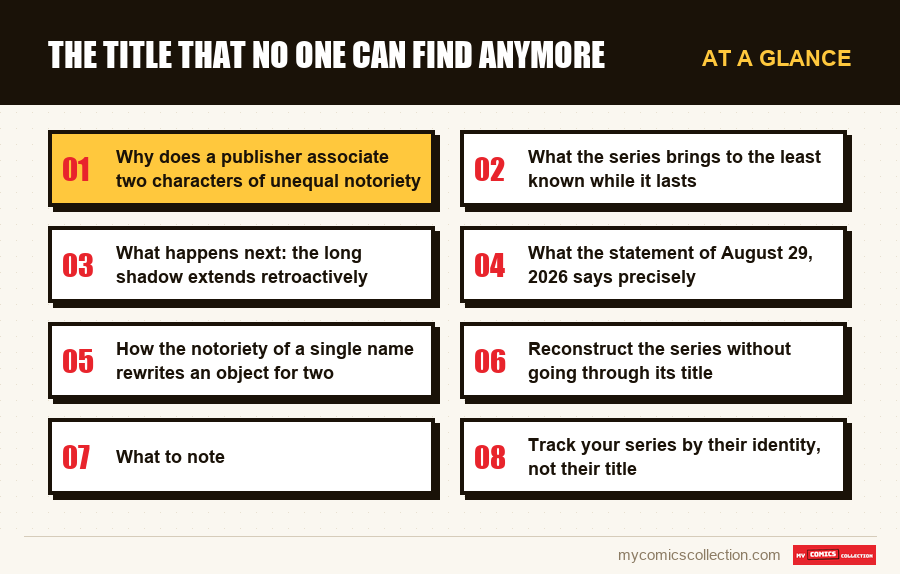
Why does a publisher associate two characters of unequal notoriety
A shared title is never an editorial accident. It's an economic arbitrage, decided before the first page is drawn. A character has a measurable but insufficient readership to carry a monthly series alone; another has a capital of sympathy, a tone, a singularity which have not yet found their vehicle. The publisher puts them together because the sum of two partial audiences creates a viable audience, and because the friction between two opposing registers (here military seriousness on one side, irreverence on the other) produces a narrative mechanism that lasts over time. The common title is not a statement of artistic equality. It is a risk pooling system.
This pooling works all the better as the two names are not at the same level of notoriety at the time of launch. If both characters were equally carriers, each would deserve their own series and the publisher would lose two publishing slots instead of gaining one. Asymmetry is therefore desired from the start: we lean the most fragile against the most solid, or the opposite, depending on what the latest sales statement says. What no editorial committee can anticipate, however, is the direction that the gap will take twenty years later. A supporting character from 2004 can become a franchise; a 2004 mainstay can become a footnote.
What the series brings to the least known while it lasts
Regularity of publication
A character who doesn't have a series to his name lives in scattered appearances, in team titles or spaced out mini-series. The shared title makes him a monthly appointment. For the reader, this changes everything: we can follow a trajectory instead of collecting fragments. For the collector, this creates a sequence of consecutive numbers: that is, a coherent collectible, with a beginning, an end and identifiable holes.
A framework to redefine yourself
A shared series requires writing the character in relationship. It's not a comfort, it's a productive constraint: you have to give it a point of view, reactions, a contrast. Characters who go through a series as a couple often emerge more readable than they entered, because we have had to explain what distinguishes them from their partner page after page.
A gateway for a new readership
The reader who comes for one necessarily reads the other. This is the main calculation of the format. A part of this audience will not stay, but a fraction discovers a character that they would never have bought on their own. It's the only truly free recruitment mechanism available to a publisher: it doesn't cost an additional series, just a name on a cover.
A lasting trace in the catalog
A series exists in the catalog with its numbers, dates and continuity, regardless of what the market will say about it next. It is this trace which still makes it possible today to reconstruct the exact list of numbers: even when the title has ceased to be an usable search key. The catalog still survives in collective memory.
As long as the series appears, the asymmetry of notoriety works in favor of the lesser known. It gives him visibility that he would not have obtained alone, and the common title acts as a signpost: both names are written, both are searched for, both lead back to the same object. It is this panel that will turn around.
Indispensable methodological clarification: all the amounts cited in this article come from a count of announcements carried out on August 29, 2026. These are sums claimed by sellers, never recorded transactions. An ad can stay online for months without finding a buyer.
Out of 29 uncertified proposals and 3 certified proposals, no median supports a conclusion on a price level. A sample of this size does not allow us to say what a number is “worth,” nor to compare two states. What remains legible, on the other hand, is the composition of the result, which objects come up when you type the title, and the narrowness of the offer. It is on these two points, and on them alone, that this article is based.
What happens next: the long shadow extends retroactively
The title ceases to be a query
Writing the full title of the series no longer brings back the series. The engine retains the name that has become famous and serves what is sold under this name, all series combined. The remaining words are treated as noise. The shared title is no longer an address: it is an approximation of a character name.
The period becomes a trap
Objects that date back often belong to the same publishing house and the same range of years. They are therefore plausible at first glance: same format, same era, same logo. Nothing in the thumbnail indicates that we are not in the right series. The confusion is visual before being documentary.
Ad titles become contaminated
Sellers write what attracts. A name that has become famous therefore appears in titles that only concern it incidentally, because it makes people click. The result is not dishonest, it is simply optimized for another objective than yours: to sell, not to identify.
Supply is tightening at both ends
The August 29, 2026 statement includes 29 uncertified proposals and 3 certified proposals. These are very small volumes. A search that returns few relevant objects and many neighboring objects is not corrected by waiting: it is corrected by changing the search key.
The exact number becomes the only reliable entry
When the title no longer discriminates, the complete identity remains: the series as the catalog calls it, plus the precise number. It's less comfortable than a natural language query, but it's the only formulation that mechanically excludes issues from other series.
Public reading is rewritten backwards
The long shadow is not only documentary. What the two characters shared is now told as a step in the trajectory of the most famous. The series is no longer “their” series: it becomes an old chapter in the biography of one, where the other appears in a supporting role.
What the statement of August 29, 2026 says precisely
The count carried out that day distinguished two groups. On one side, 29 advertisements for uncertified copies, the amounts claimed ranging from $2.55 to $275.00, with a median value of $7.76. On the other hand, only 3 listings of certified copies, asking for $39.99 to $249.99, median $100.00. These two sets were counted separately, and they must be read separately: they do not describe the same commercial object nor the same population of sellers.
The actual actionable fact is none of these amounts. It can be summed up in one sentence: among the five cheapest proposals found by the search, none belongs to the series sought. These are booklets from other series from the same publishing house, published in the same period. In other words, the bottom of the result (the one that the eye goes through first, the one that gives the reassuring impression that "it's easy to find") is entirely composed of irrelevant objects. The search does not narrowly miss the series: it attacks the classification by neighbors.
It is necessary to add a reservation which nothing exempts from repeating. Twenty-nine announcements are not many. Three ads is almost nothing. At these numbers, a median is a sorting artifact, not a measure. Removing a single ad would shift the central value arbitrarily, and the gap between the two medians says nothing solid about what certification would achieve. This article therefore asserts no price level, no hierarchy of value between states, and above all no evolution: a count carried out on a single day does not make it possible to say whether the amounts claimed are rising, falling or stagnating. There is no trend here, because there is no time series.
The isolated maximum deserves the same treatment. An ad at $275.00 in a set whose central value is less than eight dollars does not describe a market: it describes the hope of a seller, expressed in a form, without compensation. As long as no one has paid, this figure is an intention. We can see it, we cannot deduce anything from it.
Collecting this series?
Track what you own, what you are missing and what your collection is worth. 7 day trial.
Start my trial →How the notoriety of a single name rewrites an object for two
The mechanism is not mysterious. A merchant search engine ranks by transaction probability, not documentary accuracy. When a name attracts massive demand, any query that contains it is interpreted as a query for that name. The additional words-the other character, the format, the year-weigh less than the dominant signal. They are not ignored in the strict sense, they are diluted. The result is a ranking that answers a question similar to yours, with enough plausibility not to trigger your suspicion.
This dilution is carried out towards the past. That's what makes it special. A character who became famous in 2016 or 2024 changes the way we find a booklet published in 2004, while the booklet has not changed a single millimeter. Its pagination, its number, its place in continuity are identical. What has changed is the word space in which it is indexed. The object has not been decommissioned: it has been wrapped.
For the Cable collector, the practical consequence is direct. Part of the character's bibliography is found under a title which no longer really designates him. Searching for “Cable” returns the series to its name alone; searching for the shared title brings back the other's universe. The 2004 series falls in the blind spot between the two queries. It's not a scarcity problem, it's an addressing problem, and it's solved by changing addresses, not by looking for more. The prior identification of structuring numbers of the character allows you to switch from a query in everyday language to identification by number.
Reconstruct the series without going through its title
The reliable method is to reverse the order of operations. Instead of starting from a request and hoping that the right object comes up, we start from the catalog: we establish the exact list of series numbers, as the series sheet gives it, with its limits and its numbering. This list becomes the reference. It does not depend on any engine, on any formulation, on any fashion.
Only then do we query the market, number by number, with the complete identity. The query becomes long and ugly, it no longer has anything natural, and that's exactly what we want. Wording that doesn't sound like a common phrase is less likely to be reinterpreted. Each number is then searched as a separate object, which immediately eliminates the risk of bringing back a neighboring issue under the pretext that it shares a word with your intention.
Finally, we check what we receive. In a market where the five cheapest offers of a result do not belong to the targeted series, the control step is not an optional precaution: it is the heart of the work. A cover that looks like what you're looking for, published in the same year by the same publisher, in the same format, is precisely the type of object that enters a collection by mistake and never comes out again. The comparison should be based on serial identity and number, not visual impression.
This discipline is valid beyond the present case. Any series whose title associates two names is exposed to the same fate as soon as one of the two takes the ascendancy, and the phenomenon does not warn: it manifests itself the day you search, years after publication. To understand how to identify the character's entry points helps to distinguish what is from Cable's own bibliography and what is from the titles he has shared.
What to note
The shared title is no longer a search key, and it will not become one again. The gap in notoriety between the two characters does not close spontaneously; a further adaptation of the best known would only expand it. So treat the 2004 title as historical information, not a research tool. Your tool is the serial identity as the catalog records it, associated with the exact number.
The bottom of the rankings is the trap, not the top. The statement from August 29, 2026 shows that the five least expensive proposals do not belong to the desired series. These are booklets from other series from the same publisher and from the same period. The natural reflex, sorting by increasing price to “see what’s out there”, therefore confronts you with a completely irrelevant sample, while giving you the impression of having covered the issue.
With 29 and 3 listings, there is no price level to remember. Neither the median of $7.76 on the uncertified side nor that of $100.00 on the verified side supports a conclusion. These values describe a one-day count on a handful of objects, not a market price. They do not authorize any statement about an evolution: this reading is not compared to another, therefore it neither rises nor falls.
The claimed maximum of $275.00 is a short position. It coexists with proposals at $2.55 in the same set. This gap does not indicate a range of value: it indicates that no one, in such a narrow offering, is aligned with anyone. On this type of series, there is no common reference towards which the sellers would converge, and each sets their amount blindly.
The series remains perfectly identifiable in the catalog, even invisible on the market. This is the good news in the file, and it is structural: the erasure occurs in the commercial research layer, not in the documentary layer. The serial sheet, numbering and publication dates are intact. A collection maintained from the catalog rather than from ad results simply does not suffer from this problem.
Because one of the two title characters has become much more famous than the other. Merchant engines classify by transaction probability: they interpret your query as relating to the dominant name and serve what is sold under that name, all series combined. The remaining words of the title weigh too little to discriminate. The series still exists, it is simply no longer addressable by its title.
Neither. These are real booklets, correctly described, but which belong to other series from the same publishing house and from the same period. The problem does not come from the ads: it comes from the fact that the query no longer separates these objects from the one you are looking for. The verification must therefore focus on the serial identity and number, never on the appearance of the cover.
They are valid as a description of a count, not as an estimate. Out of 29 uncertified listings and 3 verified listings, removing a single item would move the central value arbitrarily. These are also amounts claimed by sellers, not recorded transactions. No conclusions about a price, a gap between states or a trend can be drawn from this.
The statement does not allow us to decide. Three certified listings is too few to compare anything to the non-certified set. What we can say, on the other hand, is that certification removes the ambiguity of identification: the booklet is named unequivocally. On a series whose title no longer discriminates, this documentary precision has its own usefulness, independently of any question of value.
Starting from the catalog rather than the market. You first establish the complete list of numbers in the series from its file, then you search for each number separately with its complete identity. The query becomes long and unnatural, which is precisely the desired effect: a wording that does not resemble a common phrase is less likely to be reinterpreted by the engine.
Track your series by their identity, not their title
My Comics Collection identifies each issue by its series and exact number in the catalog. Holes in your collection remain visible even when a shared title stops working as a search key.