To read the Thing on his own, without following the whole history of the Fantastic Four, four steps are enough. A foundation in the team series: Fantastic Four #1 (dated November 1961), #8 (1962, first appearance of Alicia Masters) and #51 (June 1966, "This Man... This Monster!"). Then his two series of the 1970s and 1980s: Marvel Two-in-One, 100 issues from January 1974 to June 1983, where Ben Grimm teams up each month with another hero, and The Thing, 36 issues from July 1983 to June 1986, launched by John Byrne. Next, the modern miniseries: Dan Slott (2005-2006), Walter Mosley (2021-2022) and Clobberin' Time by Steve Skroce (2023). To finish, his wedding to Alicia in Fantastic Four #5 of the 2018 series. Ebon Moss-Bachrach takes the role again in Avengers: Doomsday, on December 18, 2026.
Ben Grimm is a case apart in the Marvel universe. He belongs to a team whose emotional heart he often is, but he also had, for more than twelve years, his own monthly series. Those who discover the character through cinema often want to read him alone, and do not know where to enter six decades of Fantastic Four. That is the question this article answers.
The chosen thread is deliberately narrow: the stories where Ben is the main character, or those that defined who he is. The team's big sagas, and the rivalry with Doom, have their own guides on this site. Here, we follow a man of stone, a former test pilot, born on Yancy Street, and what he did when he was not just "the big guy of the Four."
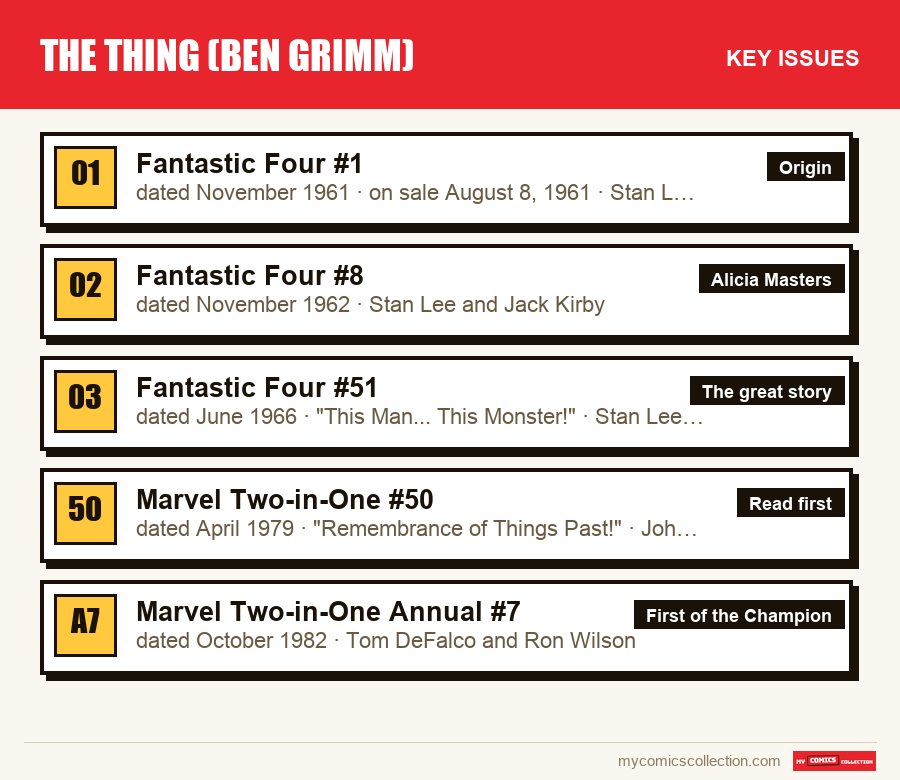
Step 1: the foundation, in Fantastic Four
You cannot understand the Thing without three issues of the team series. No need to read the first fifty: these are enough to grasp what the character carries.
Fantastic Four #1
Ben Grimm pilots Reed Richards' rocket; the cosmic rays transform him. Unlike his three companions, he cannot return to human form at will, and that is the whole character: a hero who lives his transformation as a loss. Our article on the first appearance of the Fantastic Four details this issue, and the hub Fantastic Four #1 gives its collecting landmarks.
Fantastic Four #8
"Prisoners of the Puppet Master!" introduces the Puppet Master and his stepdaughter, Alicia Masters, a blind sculptor. For decades, Alicia will be the person who sees Ben as he is, literally and figuratively. Without this issue, a good part of the character's solo stories loses its meaning.
Fantastic Four #51
A scientist jealous of Reed Richards steals the Thing's appearance to infiltrate the team. What he discovers by living in this body changes his intentions. The issue is often cited among the most beautiful of the whole series, and it speaks of Ben while barely showing him: it is the best possible summary of what it means to be the Thing.
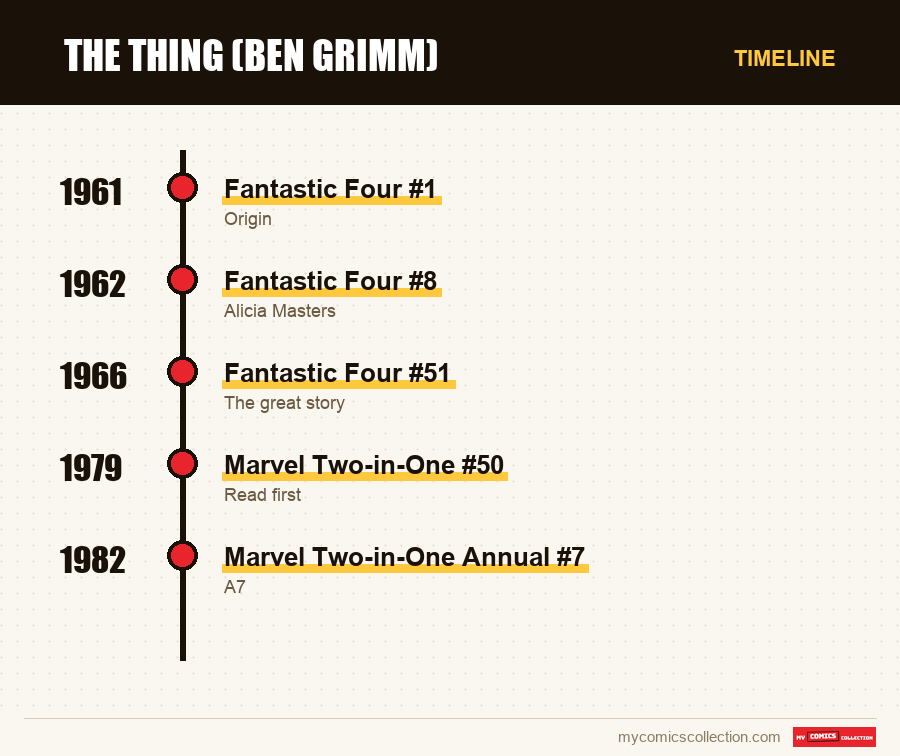
Step 2: Marvel Two-in-One, the Thing meets the Marvel universe
Before getting his series, the Thing is tested solo in Marvel Feature. #11, dated September 1973, by Len Wein and Jim Starlin, pits him against Hulk. The trial's success leads to Marvel Two-in-One, whose #1 is dated January 1974: Steve Gerber and Gil Kane pair Ben with Man-Thing against the Molecule Man.
The principle is simple: each issue, or nearly, brings together the Thing and another character. It is the ideal series for anyone who likes Ben Grimm, because it shows him in very different registers depending on the guest, from humor to drama. It lasts one hundred issues, until June 1983, plus seven annuals.
Marvel Two-in-One #50
Written and drawn by John Byrne, this issue sends the Thing into the past, where he finds himself facing an older version of himself. It is one of the series' best-loved issues, and the best entry door for anyone wanting to read only one.
Marvel Two-in-One Annual #7
"And They Shall Call Him... Champion!" introduces the Champion of the Universe, an Elder of the Universe who organizes a boxing tournament against the strongest of Earth. Ben, a stubborn fighter more than a powerful one, finds a role made to measure there. It is the main first appearance tied to the series.
The last issue, #100, dated June 1983, is again signed John Byrne on script, with Ron Wilson on art. It closes the series and prepares the next.
Step 3: The Thing, the series in his name
The following month, in July 1983, The Thing #1 appears. John Byrne writes the first episode, "Lifelines," drawn by Ron Wilson, which revisits Ben's childhood on Yancy Street, his pilot years and his relationship to Reed. It is the issue to read to understand where the character comes from, beyond the cosmic rays.
The series lasts 36 issues, until June 1986, the last written by Mike Carlin and drawn by Paul Neary. It accompanies a singular period: after the first Secret Wars, Ben chooses for a time not to return, and She-Hulk replaces him on the team. The solo series therefore follows a character literally separated from his family, which gives it a more melancholy tone than Marvel Two-in-One.
For a reader, the recommended order is simple: Byrne's #1 first, then the series in order if the tone pleases you. The mid-series episodes are uneven, and there is no shame in skipping a few issues to head toward the end.
Step 4: the modern miniseries
After 1986, the Thing has no lasting monthly series, but three modern miniseries put him back at the center, each with a very strong creator voice.
The Thing by Dan Slott (2005-2006)
Eight issues, drawn by Andrea DiVito, whose #1 is dated January 2006. Ben, now rich, discovers New York high society, with the light tone and love of continuity detail that characterize Slott. It is the most accessible read for a newcomer. Our portrait of Dan Slott places this series in his career.
The Thing by Walter Mosley (2021-2022)
Six issues, drawn by Tom Reilly, whose #1 is dated January 2022. Crime novelist Walter Mosley writes a Ben Grimm trying to live a love story outside the team. A more adult read, and a curiosity: a big name of American crime literature writing the Thing.
Clobberin' Time by Steve Skroce (2023)
A miniseries written and drawn by Steve Skroce, whose #1 is dated May 2023. The title takes up the character's battle cry. It is the most spectacular of the three, conceived first for the pleasure of the art.
Step 5: the wedding, at last
It took nearly sixty years. In the Fantastic Four series relaunched in 2018 by Dan Slott, Ben asks Alicia to marry him, and the couple moves the date up after a fight against the Griever. The wedding takes place in Fantastic Four #5, dated February 2019 and drawn by Aaron Kuder, in a small gathering, a few days after the team's return to Earth. For readers who have followed the couple since 1962, it is a culmination, and an issue to place right after Fantastic Four #8 in a Ben-centered reading.
An earlier episode is also worth knowing: during the 2015 Secret Wars, on Doom's Battleworld, Ben agrees to become the Shield, the wall protecting the world from its dangers. It is a striking image of the character, a man of stone turned into a rampart, even if the episode fits in a few panels.
The Thing at the movies, and in Doomsday
Ebon Moss-Bachrach plays Ben Grimm in The Fantastic Four: First Steps (2025), and Marvel Studios announced him on March 26, 2025 in the cast of Avengers: Doomsday, alongside Pedro Pascal, Vanessa Kirby and Joseph Quinn. The film comes out on December 18, 2026, with Robert Downey Jr. as Doom. Nothing of the plot is known, and this guide does not speculate on Ben's role.
For readers the film will bring to comics, the recommendation remains that of this article: the three foundation issues, Marvel Two-in-One #50, Byrne's #1, then a modern miniseries according to taste. The team's rivalry with Doom, which the film will put in the foreground, is covered separately in our guide to the Fantastic Four key issues facing Doomsday.
Collecting the Thing: where to start
The two series of the 1970s and 1980s lend themselves well to a complete collection: their common issues are abundant, and you can gather them gradually. Start with the issues flagged above, then fill the gaps. Fantastic Four #1 and #51 are in another category: they are old, highly sought-after issues, and you can perfectly well read them in collected form without owning the original. For the whole team series, our Fantastic Four reading guide gives the complete order, and the Fantastic Four hub gathers the other pages.