The foil cover of this character's first solo issue is the worst conservation support a 1990s booklet could have. It scratches when rubbed, flakes on folds, and makes the condition almost impossible to judge in a photograph: the reflections hide the defects as much as they reveal them. As of August 29, 2026, this number is only the subject of quinze propositions, médiane 9,99 $, et d'aucun exemplaire vérifié. The finish that should mark a precious object is the one that ages the worst.
The subject is purely material, and that's what makes it useful: it's about handling and storage, not speculation.
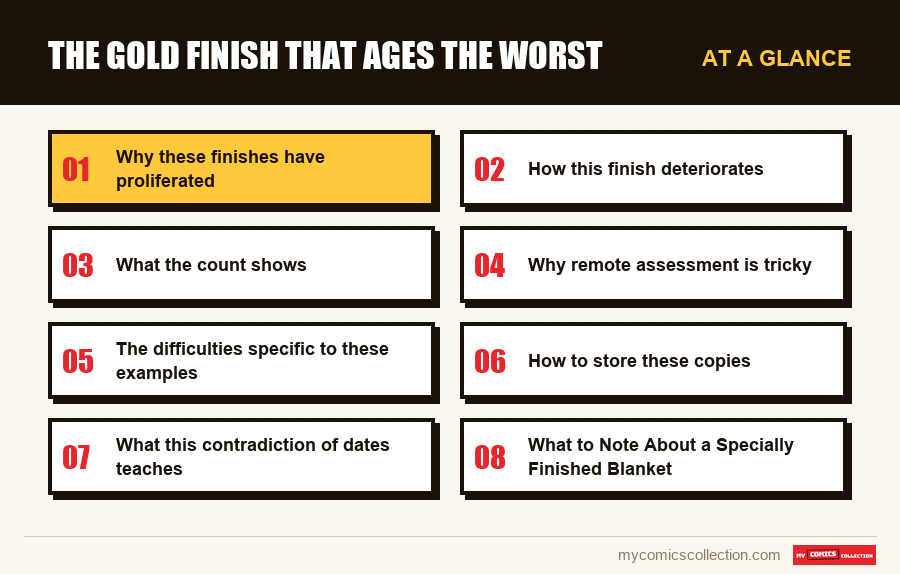
We will see why these finishes have multiplied, how they deteriorate, what the counting shows, why remote evaluation is tricky, and how to arrange these examples differently from the others.
Why these finishes have proliferated
The process is not accidental: it meets three specific commercial objectives, all dating from the early 1990s.
Give an ordinary booklet the appearance of a precious object. A metallized foil costs little to print and radically changes the perception of one product on display among dozens of others. The reader thinks he has a special edition; it holds a regular number with an extra layer.
Justify a higher selling price. Any price increase requires a visible counterpart. A finish fulfills this role better than an extra number of pages, because it can be seen before purchasing.
Stand out physically on the shelves. On a display, an object that reflects light catches the eye. It is a distribution argument before being an editorial argument, and it explains the generalization of the process in a few months.
None of these three reasons are about the drive or the length. These covers were designed for the moment of purchase, not for the next thirty years: and they behave exactly like objects designed to be seen once.
How this finish deteriorates
The wear mechanisms are specific and have no equivalent on conventional printed paper.
La rayure superficielle. The metallized layer is thin and placed on the surface. A light friction (the passage of a finger, the contact of a pocket, the sliding against another booklet) leaves a trace which catches the light and becomes more visible than the defect itself.
Chipping on the edges. Wherever the cover bends, the sheet separates from the backing. The back and corners are the first to be affected, and the chipping progresses with each opening.
Pressure marking. A stack of booklets permanently imprints its weight on a metallized surface, where ordinary paper would lay flat. The mark does not fade.
La réaction à l'humidité. The support and the applied layer do not work in the same way depending on the humidity, which produces micro-detachments and undulations specific to this type of finish.
These four effects accumulate over time and are irreversible. A copy simply read and stored normally therefore bears marks that a classic booklet of the same age would not have., without its owner having done anything in particular.
What the count shows
L'offre disponible
15 propositions seulement, de $3.50 to $35.70 claimed, with a distribution medium at $9.99.
Le segment vérifié
Aucune proposition. No one judges that an audit would be profitable on this number.
What the titles highlight
Several ads cite the metallic finish as the main argument, even before the content of the booklet.
A contradiction on the date
Some titles date this issue from 1993, another from 1992. The sellers do not agree.
These amounts correspond to what was claimed on August 29, 2026, never to successful transactions, the verified copies being kept separate from the others. A measurement taken on a single date shows no price movement in one direction or the other.
Fifteen proposals constitute too small a number for a price level to mean much. What is readable here is the composition: a narrow offer, a very low floor, and the complete absence of a verified segment.
This last absence is the clearest fact. A finish presented at the time as an additional value has not produced, thirty years later, a single copy that anyone has deemed useful to have authenticated.
The paradox deserves to be formulated clearly: the cover which makes a copy more fragile is also the one which makes it more difficult to evaluate, without giving it the slightest additional value.
A collector therefore inherits the worst of three worlds: an object which deteriorates more quickly than another, whose condition is difficult to judge from a distance, and for which no one will pay the difference. This is exactly the opposite of what the finish promised.
Why remote assessment is tricky
This is the most serious practical difficulty, and it deserves to be described precisely.
Reflections create defects that don't exist. A photograph taken under direct lighting reveals light areas that the eye interprets as wear. The copy may be intact.
Reflections hide existing defects. Symmetrically, shooting from a favorable angle hides fine scratches that will only be visible in the hand. Neither error is intentional.
The written descriptions don't make up for it. The state's current vocabulary-the usual conservation notices-was constructed for printed paper, and does not have specific terms for chipping or surface scratching.
The consequence is that you have to ask, systematically. On this type of cover, one additional photograph taken from a different angle is worth more than three lines of description, and a serious seller provides it without difficulty.
The difficulties specific to these examples
Deceptive reflections
The same photograph may suggest a nonexistent defect or conceal actual wear.
A disputed date
The titles contradict each other on the year, which requires a verification of the catalog.
Unsuitable standard storage
Direct contact with a pocket or another booklet is enough to mark the surface.
A gaping state vocabulary
The usual conservation notices do not describe chipping or surface scratching.
A narrow offer
Fifteen proposals leave little choice, and therefore little possibility of comparing states.
No benchmarks checked
Without authenticated copies, there is no state benchmark to compare to.
Collecting this series?
Track what you own, what you are missing and what your collection is worth. 7 day trial.
Start my trial →How to store these copies
The recommendations differ from those of an ordinary booklet on four concrete points.
Store upright, never stacked. This is the most important and most often overlooked rule. A metallized surface retains the mark of prolonged pressure for a long time, whereas ordinary paper recovers.
Interpose a rigid support plate. It prevents sagging, which causes chipping on the folds, and prevents friction against the neighboring fascicle.
Avoid pockets that are too fitted. A tight sheath rubs with each insertion and withdrawal. A slightly wider format limits contact, at the cost of slightly less support.
Limit variations in humidity. This is not specific to this finish, but the effect is more visible there than elsewhere, because the two layers do not react in the same way.
These four precautions cost nothing and can be decided once. They do not protect a value, there is none here, but the appearance of an object whose appearance is the only reason for being, which is consistent with what it is.
What this contradiction of dates teaches
The detail seems anecdotal and is not.
Two bona fide sellers date the same issue from two different years. Both are probably copying what they have in front of them or what they think they know, and nothing in the announcement allows us to decide.
This type of discrepancy is common on booklets whose cover date precedes the actual sale, or whose publication overlaps two calendar years. It does not imply any dishonesty.
It simply reminds us that an ad is not a source. A date read in a title must be confirmed in the catalog before entering an inventory, otherwise the error becomes permanent.
This is true everywhere, and especially here. On a number that is rarely offered, a single erroneous ad can become everyone's apparent source., since there are not enough competing propositions for the contradiction to be obvious.
Should we look for an impeccable copy?
The question arises differently than in an ordinary booklet, and deserves a frank answer.
A copy without any mark is statistically improbable. Thirty years of handling, even careful handling, leave traces on this support. Demanding impeccable quality means waiting a very long time for an item that may not be available.
Added to this is the fact that the offer here is fifteen proposals. On such a narrow population, placing a state requirement eliminates almost all choice, and there is no steady flow to renew possibilities.
The reasonable position is to accept surface marks and reject chipping. The first are inevitable and only affect light; the second removes material and progresses on its own once initiated.
This distinction is the only one that really matters in this type of coverage. A scratch is a condition, chipping is an evolution: and only what evolves deserves to be discarded.
What to Note About a Specially Finished Blanket
These copies require fields that ordinary fascicles do not require.
The exact nature of the finish. Metallic foil, embossing, selective varnish, cutting: these processes do not degrade in the same way and do not require the same precautions. The generic word is not enough.
The condition of the finish, separately from the general condition. A copy can be impeccable as a booklet and damaged as a metallic object. A single note confuses two unrelated pieces of information.
The presence of scratches and their location. Surface, edges, back: this is what degrades, and this is what no photograph will faithfully restore later.
The method of storage chosen. Vertical or horizontal, with or without a plaque: recording it helps explain, years later, why two examples acquired together have aged differently.
The date confirmed in the catalog, not that of the announcement. On this specific number, the sellers contradict themselves; noting the source of the date chosen avoids propagating the error in your own inventory.
Nothing indicates it here. Fifteen proposals as of August 29, 2026, a distribution average around ten dollars, and no verified copy: the finish is cited as an argument in several titles without it corresponding to a high level. It was paid on the original purchase, not on resale.
Because the metallized layer is placed on the surface and behaves differently than the paper that carries it. It scratches when rubbed, flakes where the cover folds, retains the mark of prolonged pressure, and peels off in places depending on humidity. These four effects are irreversible and cumulative.
Difficultly, and that's the real problem. Reflections reveal non-existent defects under direct lighting and hide real ones from a favorable angle. Requesting a second photograph taken differently is better than any written description, the usual condition vocabulary having no term for flaking.
No. Upright rather than stacked, with a rigid backing plate, in a slightly wider than normal pouch to limit friction, and protected from humidity. These precautions do not protect any value, there is none, but the appearance, which is the only reason for this finish.
Check the catalog before entering anything. On this issue, some titles indicate 1993 and another 1992, without anyone's bad faith. An announcement is not a source, and on a booklet so little offered, a single error can become the apparent reference for lack of competing proposals to contradict it.
The condition of the booklet or the condition of the finish?
These are two separate pieces of information, and a single note definitely confuses them.