The best “street-level” comics (these urban heroes who fight at ground level, often without superpowers) are at the top Daredevil , Batman , THE Punisher and Gotham Central. This tier list ranks the “ground floor” stories of the superheroic world according to their quality and realism. Facts (authors, dates) verified, no invented odds.
The “street-level” is the down-to-earth side of comics: no cosmic threats, but organized crime, corruption, urban night. This tier list brings together the stories that best embody this register: tension, human issues, credible violence. Criterion: the success of the “street” tone combined with the quality of writing.
Editorial Ranks, Facts verified. Each entry refers to its file.
Collecting this series?
Track what you own, what you are missing and what your collection is worth. 7 day trial.
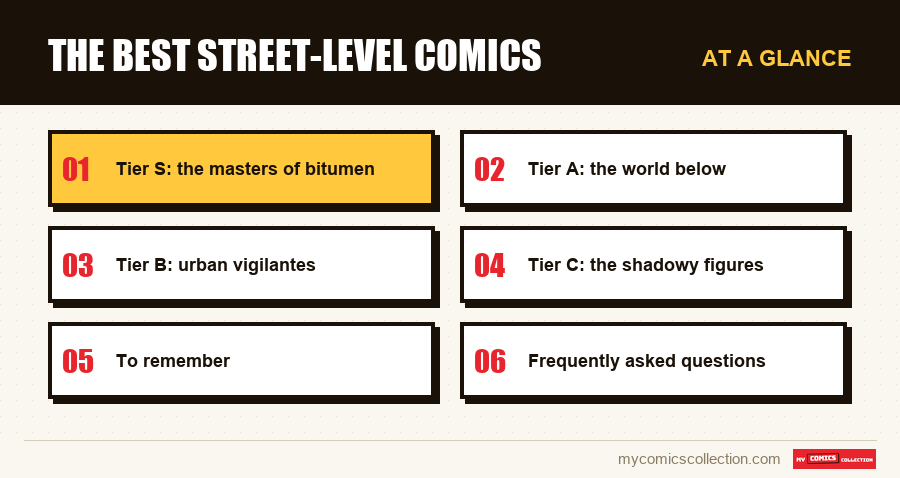
Start my trial →Tier S: the masters of bitumen
Daredevil is the street-level hero par excellence: blind lawyer by day, vigilante by night, served by the runs of Miller, Bendis and Waid. Batman, in its most urban stories, fully belongs to this register. Punisher MAX by Garth Ennis is the most brutal and realistic version. And Gotham Central follows Gotham's capeless cops: a masterpiece of "ground" storytelling.
Tier A: the world below
Alias (Jessica Jones) and Powers by Brian Bendis explore superheroes through the small end of the lens: detectives, cops, those left behind. Sin City pushes urban noir to the extreme, and Elektra: Assassin by Miller and Sienkiewicz is an experimental pinnacle of the genre.
Tier B: urban vigilantes
Le Moon Knight by Jeff Lemire anchors his madness in the streets of New York. Green Arrow: Year One offers a nervous origin, the Nightwing by Tom Taylor rejuvenates the vigilante of Blüdhaven, and Immortal Iron Fist mixes martial arts and the underworld.
Tier C: the shadowy figures
Kingpin embodies the ultimate street-level antagonist. The Question by Denny O'Neil is a cult philosophical thriller, and Daredevil: Born Again remains the absolute reference of the genre: placed here because already mentioned at the top via the character. Three pillars of the world below.
To remember
- Frank Miller and Brian Bendis defined modern street-level comics.
- The genre favors realism: crime, corruption, human issues.
- He bridges the gap with the thriller (Sin City, Gotham Central).
- Each entry refers to a key file or number on the site.
In what order to read street-level comics
A tier list ranks, it does not tell you where to start. For this register, publication order is a good guide, because it shows how the genre builds from one generation of writers to the next. The reference points below take up the stories on the list.
The foundations of the 1980s and 1990s:
- Daredevil: Born Again (Miller, 1986) and Elektra: Assassin (Miller and Sienkiewicz, 1986), two stories where Frank Miller sets the noir tone.
- The Question (O'Neil and Cowan, 1987), a philosophical crime story from DC.
- Sin City (Miller, 1991), which pushes urban noir to the extreme.
The turn of the 2000s:
- Powers (Bendis and Oeming, 2000) and Alias (Bendis, 2001) look at superheroes from the side of detectives and the forgotten.
- Gotham Central (Brubaker and Rucka, 2002) follows Gotham's police officers, capeless.
- Punisher MAX (Ennis, 2004) gives the most brutal version.
- Immortal Iron Fist (Brubaker and Fraction, 2006) and Green Arrow: Year One (Diggle and Jock, 2007) blend the street register with other universes.
Recent relaunches:
- Moon Knight (Lemire, 2016) anchors the character's madness in the streets of New York.
- Nightwing (Taylor, 2021) refreshes the Blüdhaven vigilante.
For a first contact, two entries stand out. The first is Daredevil, through Waid's run or through Born Again, because the series is self-contained and requires no cosmic continuity. The second is Gotham Central, for those who prefer investigation to vigilantes. Once you have read these two starting points, the rest of the list can be taken in the order above without losing anything.
On the collecting side, these stories are mostly complete series or miniseries: they read very well in collected editions, and there is no need to hunt the original issues to enjoy them. The original issue only becomes a question if you collect a specific creator, Miller or Bendis for example, whose influence on the genre is documented in the tier list. In that case, always check the volume, year and edition before buying.
A word on the register itself: street-level is defined by local stakes, such as crime, corruption and the urban night, and by heroes who often lack great powers. It bridges to crime fiction, which explains why Sin City and Gotham Central share a list with Daredevil. If a title puzzles you, simply ask whether it keeps its feet on the street.
Frequently asked questions
It's a superhero story anchored at street level: local issues (crime, corruption), heroes often without great powers. Daredevil, the Punisher and Batman are the most representative figures.
Daredevil is the reference of the genre, in particular the runs of Frank Miller (Born Again) and Brian Bendis. Gotham Central is the most accomplished police version.
Yes: most are grounded, self-contained stories, with no cosmic continuity to know. Waid's Daredevil or Born Again are great entry points.
Do you collect the big urban runs (Daredevil, Punisher, etc.)? Estimate their value for free with our tool based on current eBay listings.