The best kaiju and giant monster comics are, at the top, Godzilla: The Half-Century War by James Stokoe, the Godzilla from Marvel (1977), Kaijumax and Pacific Rim. This tier list ranks stories of colossal creatures according to their quality and inventiveness. Facts (authors, publishers, dates) verified, no invented ratings; each entry refers to a record when it exists.
The kaiju, the giant Japanese creature, has inspired numerous comics, between homage to Godzilla and original monsters. This tier list brings together the stories that best exploit the excess and spectacle of the genre. Criterion: the success of the story of giant monsters.
Editorial Ranks, Facts verified. Each entry refers to a site file when it exists.
Collecting this series?
Track what you own, what you are missing and what your collection is worth. 7 day trial.
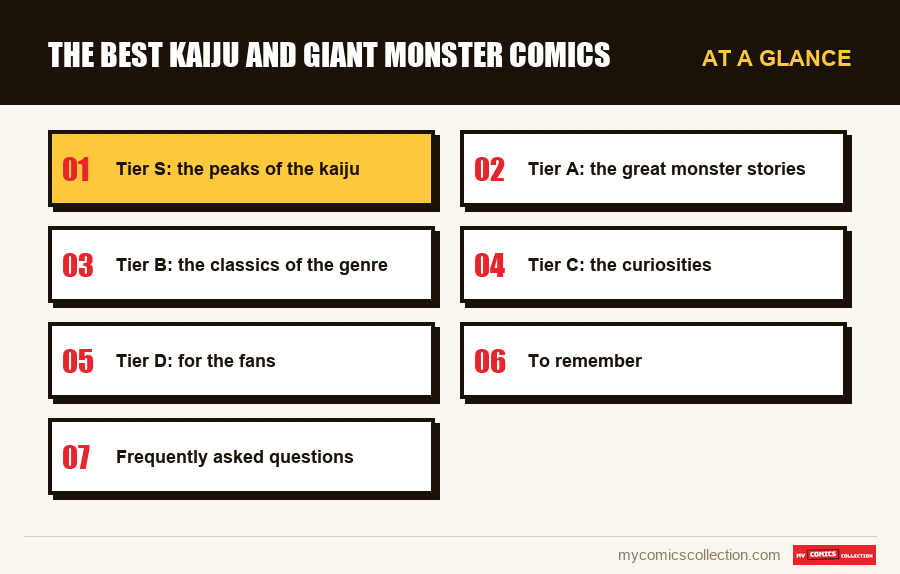
Start my trial →Tier S: the peaks of the kaiju
Godzilla: The Half-Century War by James Stokoe is unanimously hailed as the best Godzilla comic, a graphic masterpiece. THE Godzilla by Marvel (1977) brings together the king of the monsters and the superheroes. Kaijumax imagine a prison for kaiju, and Pacific Rim extends the universe of Jaegers against monsters.
Tier A: the great monster stories
Godzilla: Rulers of Earth , the event Monsters Unleashed from Marvel, The Big Guy and Rusty (Frank Miller & Geof Darrow, robot versus kaiju) and adaptations of King Kong appear at the top.
Tier B: the classics of the genre
End Fang Foom (Marvel's giant dragon), Mars Attacks , Reptisaurus and Konga (Charlton) are giant monster classics.
Tier C: the curiosities
Godzilla: Kingdom of Monsters , Gorgo , Devil Dinosaur by Jack Kirby and Rampage complete the selection.
Tier D: for the fans
Behemoth , Terror of Godzilla (Dark Horse) and Gojira: Rage Across Time close this tier list: more confidential but very real kaiju stories.
To remember
- The Half-Century War is the consensus peak of the Godzilla comic.
- Kaiju in comics oscillates between Japanese homage and American-style monster.
- Giant Marvel Monsters (Fin Fang Foom) are classics of the pre-superhero era.
- Each entry refers to a site file when it exists.
Frequently asked questions
Godzilla: The Half-Century War by James Stokoe is unanimously acclaimed for its exceptional graphic quality and its epic breath.
Yes: in Marvel's Godzilla series (1977), the monster notably confronts SHIELD and crosses the Marvel universe, which makes it a sought-after curiosity.
Yes, like Fin Fang Foom at Marvel or the creatures from Kaijumax. The genre is not limited to adaptations of Godzilla or King Kong.
Do you own an old monster comic (Godzilla Marvel #1…)? Estimate its value for free with our tool based on current eBay listings.
How to approach a kaiju comic: three families to tell apart
A kaiju comic is not always what it seems, and the tier list is best read with a simple grid. There are three families. First, licensed adaptations: Godzilla, King Kong, Pacific Rim. Then original monsters: Fin Fang Foom, the creatures of Kaijumax or Devil Dinosaur. Finally, stories from the pre-superhero era, published in the early 1960s by Charlton or Marvel, when the giant monster ruled the newsstands.
A few useful markers:
- Marvel's Godzilla runs 24 issues. The series Godzilla, King of the Monsters ran from 1977 to 1979. The monster meets SHIELD and the Marvel universe there: that crossover is what makes it a sought-after curiosity.
- Fin Fang Foom was born before Marvel's superheroes. The giant dragon appears in Strange Tales #89 (1961), in the era of monster stories. First appearances are always the best anchor for a collector.
- Devil Dinosaur is by Jack Kirby. This 1978 series mixes a giant dinosaur with a fanciful prehistory, with the young Moon-Boy at his side: a late, very personal Kirby.
- Several Godzillas coexist. There are series at Marvel, Dark Horse and IDW: always check the publisher and the year before buying, since the same title can mean very different works.
For a first read, a simple order works well. Start with Godzilla: The Half-Century War, the consensus peak of the genre, which shows what the kaiju can offer as graphic spectacle. Move on to an original monster story like Kaijumax to see the genre twisted. End with a 1960s classic to understand where all this comes from.
On the collecting side, a piece of common sense: the small monster titles of the early 1960s are fragile paper, originally sold for a few coins. Examine condition carefully, compare several copies, and do not pay a "first appearance" premium without checking that the issue is the right one. For modern stories in collected editions, the value lies mostly in the reading pleasure: a bound volume is often enough.
Whoever is new to the genre need not buy anything rare: a handful of collected editions and one or two 1960s classics are enough to find out which family suits you before investing in original issues. It spares the budget and protects against disappointment with titles you end up not liking.