Start with Rachel Rising if you want to judge Terry Moore quickly, and by Strangers in Paradise if you agree to get involved. The first is a horror story in six volumes, immediately gripping. The second is her major work-nearly ninety issues published over fourteen years-and the greatest graphic novel ever dedicated to a friendship between two women. Rare feature: Moore writes, draws, inks and letters himself, and has been publishing under his own label since the beginning.
This is an almost unique case in American comics: a complete author, in black and white, independent of any publishing house, who maintained this model for more than thirty years.
This article offers three entries depending on what you are looking for, explains what links his series together, and points out the collection particularities specific to an author who publishes himself.
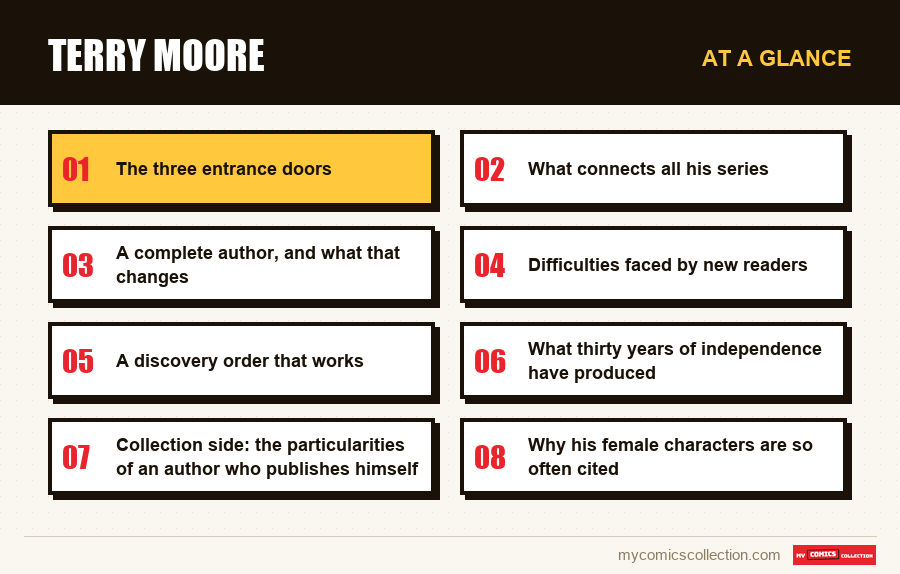
The three entrance doors
Rachel Rising: the fast door
A woman wakes up at the bottom of a shallow grave, with a strangulation mark on her neck, with no memory of what happened. She is investigating her own murder.
Six volumes, a complete horror story, and the most immediately catchy title of his output. The first volume is enough to know if his work suits you.
Strangers in Paradise: the major work
Francine and Katchoo have been friends since high school. One wants an ordinary life, the other has a criminal past that catches up with her. Between them, a feeling that neither of them names.
It's his big book, and the commitment is real: almost ninety chapters. But that's where you have to go if you want to know what he's capable of.
Echo: la porte science-fiction
A photographer finds herself covered in fragments of an experimental suit which fuses with her skin and cannot be removed.
Thirty issues, a suspenseful story, and its most classically structured series: therefore the most reassuring for a hesitant reader.
Motor Girl: the short door
A war veteran runs an automobile junkyard in the middle of the desert, along with a gorilla that no one else sees.
Ten issues, a single volume, and the sweetest story of his production on a subject that is not.
What connects all his series
Under very different genres (drama, horror, science fiction) we find the same constants, and recognizing them helps you choose what comes next.
Female main characters, always. This is not a posture: her stories are built around adult women with pasts, professions and contradictions, in a medium which has long lacked them.
Friendships at the center, not romances. The bond that carries his stories is almost always an old and complicated friendship, rather than a love story. This is what most distinguishes his work.
Humor in the darkest situations. His dialogues are funny even in the midst of horror or mourning. This lightness of surface is what makes subjects bearable that would not otherwise be.
Black and white, without exception. He never published in color. Its inking therefore alone takes on all the work: the volumes, the materials, the light and the expression of the faces.
A complete author, and what that changes
Moore writes, draws, inks and letters all of his books, which he publishes under his own imprint. This configuration has very concrete consequences.
Aucune rupture de style. Neither change of designer, nor change of screenwriter, on series which sometimes span more than a decade. The hand is the same from the first to the last chapter.
Une numérotation stable. No reminder, no double numbering, no imposed editorial event. A number designates a single issue, definitively.
Ends decided by him. Each of his series ends when he has finished telling, and none has been taken up by anyone else.
An availability that depends on a single man. This is the counterpart: the reprints follow his decisions and his means. Some volumes experience longer periods of unavailability than with a traditional publisher.
Difficulties faced by new readers
A very long major work
Nearly ninety chapters for its main series: it's a commitment that few independent stories require, and it is legitimately daunting.
Des éditions multiples
Its main series exists in thin volumes, thick collections and complete editions. The cuts do not match from one presentation to another.
A universe that connected late
His series were independent, then a story explicitly linked them. This creates an optimal reading order where there was none.
A destabilizing mix of tones
The transition from comedy to violent drama is sometimes brutal, within the same chapter. Some readers see this as an inconsistency of tone.
The advice that avoids the main mistake. Don't start with his main series if you're not sure you like his work. Ninety chapters is a commitment that cannot be made blindly.
A short story like horror or science fiction provides exactly the same writing, the same dialogue and the same drawing, for a fraction of the investment. Please there, you will like it elsewhere.
A discovery order that works
As its series have long remained independent, there is no obligatory order. However, here is a route that limits dropouts.
Premier temps. A short and gripping story: its horror in six volumes, or its science fiction series. The goal is to test writing without committing more than one or two volumes.
Deuxième temps. His major work, once convinced. This is where you have to go, but with the certainty of liking its way: otherwise the length becomes a deterrent.
Third time. His short and recent stories, then the title which explicitly links all of his series. The latter only makes sense if we already know the characters it brings together.
Collecting this series?
Track what you own, what you are missing and what your collection is worth. 7 day trial.
Start my trial →What thirty years of independence have produced
The duration of this model deserves attention, because it is exceptional and explains the coherence of the whole.
Many authors start by self-publishing then join a publishing house as soon as success arrives: this is the usual trajectory, and it is understandable: it brings an advance, distribution and visibility that you cannot build alone. Moore did the opposite and never left his own label.
The result is a work of rare continuity. None of his series has been revived, none has changed hands, none has been interrupted by an outside business decision. What he published in 1993 and what he publishes today obey the same rules, which almost never happens on a career of this length.
The downside is less visibility. Without a promotional device, his titles are transmitted by recommendation rather than by presence on the shelves, and his work remains largely less known than its quality would lead one to expect. This is also what keeps prices accessible on most of its production.
Collection side: the particularities of an author who publishes himself
This segment obeys rules that are a little different from those of traditional publishers, and it is better to know them.
Initial print runs are small. An author who finances his own printing orders cautiously. The very first issues of its main series, published in the early 1990s, are therefore rare in comparison to what followed.
Reprints exist and blur the lines. Several of its first issues underwent successive reprints. A copy bearing number one is not necessarily a first printing, and the difference in price is considerable.
Black and white limits variations. There are significantly fewer alternative covers in this segment than among the major publishers, which simplifies identification.
The practical consequence is that a catalog must here bear the draw more than the cover: the opposite of what is true of most recent independent series.
Why his female characters are so often cited
This is the element most regularly mentioned about it, and it is worth clarifying what it covers, otherwise the formula remains vague.
Its protagonists are not female characters in the sense that gender would be their main trait. These are women who have jobs, debts, addictions, criminal pasts, children or not, and whose decisions arise from all of this rather than from their romantic situation.
The most visible consequence is structural: his stories are not organized around a couple but around a friendship. Love stories exist, but they come second and they don't determine the plot. It's a simple move, and yet rare to the point of being noticed for thirty years.
The second consequence is that its characters actually age over the course of the series: they change their minds, reconcile, relapse, make decisions they regret. A story published over fourteen years allows for this in a way that a short format does not.
What to record
Three fields are enough, and the first is specific to this type of author.
The edition, on old fascicles. First print or reprint: this is the information that separates two apparently identical copies, and it is not always clearly shown on the object.
The edition, on the volumes. Thin volumes, thick collections or complete edition: the divisions differ and a volume number does not designate the same content from one presentation to another.
The state, for the stapled booklets from the 1990s. Thirty years of handling leaves traces, and in a market without developed certification, the condition description makes all the resale.
A catalog which records “Strangers in Paradise #1” without specifying the draw will never allow us to know what we really own, nor to estimate anything the day the question arises. This is by far the main source of error on this author, and it is resolved by noting a single piece of information at the time of purchase.
Frequently asked questions
Better to avoid, unless you are certain you like your work. Nearly ninety chapters constitute a considerable commitment, while one of his short stories offers exactly the same writing and drawing for only one or two volumes.
They were independent for a long time, then a late story explicitly brought together the characters of several of them. Each one can always be read alone, but this title of convergence only takes on its meaning if we already know the protagonists it brings together.
None, and it's even the opposite: its inking is remarkably clear, with immediately recognizable faces and cutouts that never give rise to confusion. Black and white here is a long-standing choice, not an imposed budget constraint.
Because an author who finances his own printing prints little at first, then reprints if successful. Two copies bearing the same number can therefore belong to very different editions, with a significant price difference and nothing obvious to distinguish them on the cover.
His major series are, each concluded by itself rather than interrupted. This is one of the advantages of his model: an author who owns his characters decides for himself when he has finished telling the story, and no one picks up the whole thing after him.
The print, not the cover
On an author who publishes himself, two copies of the same issue can be worth ten times each other.