You can stop almost anywhere in Terry Moore's work, and it's a rare property that deserves to be known. Each of his series is a closed story, written to end, and none presupposes the others. A reader can therefore read a single volume, a single series, or three out of five without missing anything. One exception: the title which brings together its characters, which only makes sense after the others, and it is the most visible in bookstores.
The question seems strange. We usually ask where to start, never where to stop. However, it is the one that really arises when faced with a bibliography of one hundred and fifty chapters.
This article gives the legitimate exit points, explains why they exist, and points out the one place where stopping would be a real shame.
Why does this question arise?
On most long works, stopping midway leaves a frustration. An interrupted story is a story that we have not finished, and we keep the feeling of a debt.
This feeling is not irrational: it corresponds to a constructed reality. Most long series are built to make you want to continue, with questions posed and unresolved at the end of each volume. To stop is to give up answers.
This bibliography is constructed differently, and you have to know that to benefit from it. Each series is a complete story written to end, not a segment of a larger whole. They do not respond to each other, do not share characters (with one, late exception) and do not ask any questions whose answers can be found elsewhere.
In other words, stopping after a series is not giving up: it is having read an entire book.
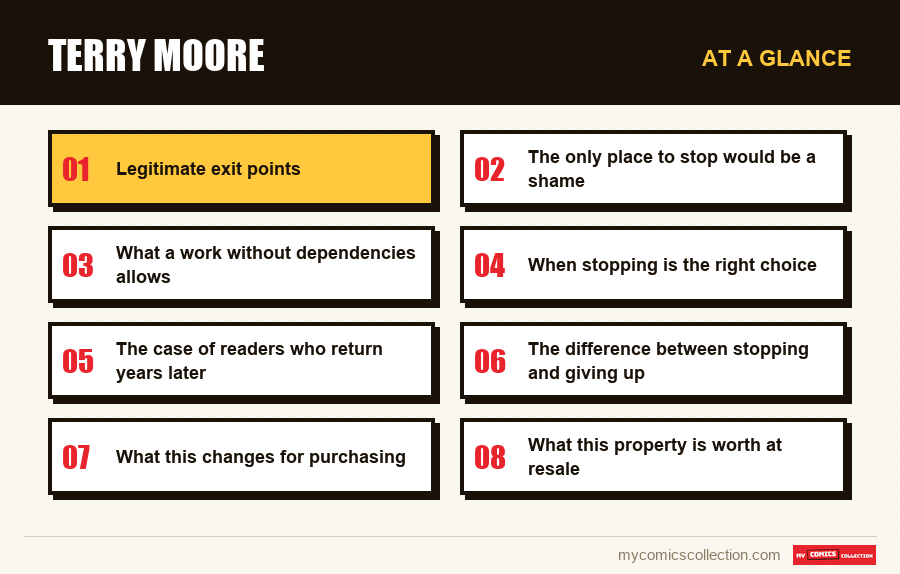
Legitimate exit points
After a single volume
His shortest stories fit into a single volume and tell a complete story, with a beginning and an end.
This is the most economical exit point: an evening of reading, no pending sequels, and a fair idea of what the author is doing.
After a short series
Six volumes are enough to cover several of his titles in full. We leave with a concluded story and nothing hanging.
After two series of opposite registers
This is the most intellectually satisfying exit point: we have seen what belongs to the genre and what belongs to the author, what a single series can never establish.
After the major work
Ninety chapters, a conclusion written as such. Many readers stop there and haven't missed any endings.
The only place to stop would be a shame
There is one exception, and it deserves to be clarified because it flies in the face of everything that has come before.
The title which brings together the characters from its different series is located After them, and it depends entirely on them. He does not present his protagonists: he relies on the fact that we know them, with years of history behind them.
A reader who has read three of his series and stops before this one has not missed any of their endings: they are complete. But one particular thing is missing: seeing characters that we followed separately meet each other. This effect only occurs once, it assumes exactly this preliminary work, and nothing else replaces it.
It is therefore not a narrative obligation but a reward. It is only justified for those who have already made the journey, and it is of no value to those who have not done so, which explains why this title systematically disappoints readers who start there.
The symmetrical error, and the most frequent. The convergence title is the most recent, therefore the most visible in bookstores. Many readers pick it up first, don't understand anything, and conclude that the author is not for them.
It is not a problem of the reader or of the book: it is a problem of order. In this bibliography, the most visible is also the least accessible, and nothing on the cover indicates this.
What a work without dependencies allows
This property, being able to stop anywhere, is not a coincidence. It follows directly from the publishing template, and it's worth making the connection.
An author who owns his characters has no commercial reason to leave a story open. No one asks him to prepare a sequel, to plan a comeback, or to make his title converge towards an editorial event. He finishes when he's done.
Conversely, a series belonging to a publisher has a structural interest in never concluding: a conclusion closes the door, and a closed door no longer sells. This is what produces temporary endings, resurrections and revivals.
The freedom to stop that the reader feels here is therefore the exact counterpart of the author's independence. The two go together, and one does not go without the other.
When stopping is the right choice
If you feel the repetition
The structure varies little from one series to another. Three titles read in a row can produce a weariness that has nothing to do with their individual quality.
If the pace of installation weighs on you
Each of his series takes its time at the beginning. What works once can become painful the third time.
If the translation stops
On a title whose French version is incomplete, stopping at the last published volume is a perfectly defensible choice: provided you know that you are reading a beginning.
If budget is the constraint
Two complete series are better than one major work started. A finished story provides a satisfaction that an interrupted story never gives.
The case of readers who return years later
A frequent situation deserves its treatment, because it is almost always poorly managed: that of the reader who read a series ten years ago and wonders if he can continue elsewhere.
On a work with continuity, the answer is discouraging. You have to reread, or accept not understanding, because the new title presupposes events that you have forgotten. This is what discourages many returns.
Here, the answer is simple: we pick up where we want, without rereading anything. Another series requires no memory of the previous one, and the time elapsed has absolutely no importance. Ten years of interruption cost nothing.
There is even a benefit to spacing. The structure repeating itself from one title to another, reading two of his series years apart avoids the weariness that the sequence produces. A reader who loved a series ten years ago and opens another today is probably in the best possible mood.
The only thing to check before starting again is the one that we systematically forget: had we finished the previous series? Three volumes out of six leave an open story, and reopening it after ten years is much less pleasant than starting a new one.
Collecting this series?
Track what you own, what you are missing and what your collection is worth. 7 day trial.
Start my trial →The difference between stopping and giving up
A distinction is worth making, because it changes the relationship we have with our own library.
Give up, is to leave a story hanging in the middle. We keep volumes that tell nothing in full, an unresolved plot, and a vague feeling of debt. This is what happens when you stop at the third volume of a series of eight.
Stop, it's finishing one story and deciding not to start another. We keep a whole story, and nothing hangs.
In this bibliography, the second option is available in many places, which is rare. You still have to choose your exit points: stopping in the middle of a series remains an abandonment, even here.
The practical rule is contained in one sentence: always finish the current series, only start the next one if you feel like it. Applied systematically, it produces a library that contains only complete stories.
What this changes for purchasing
This freedom has a direct budgetary consequence, and it reverses a common reflex.
On a work with dependencies, you have to decide early: if you want to understand it, you have to plan the whole thing, and the commitment is made before knowing if the beginning pleases. This is what makes some bibliographies intimidating.
Here, each purchase is decided after the previous one. One can acquire a volume, read it, and then decide: without any past decision becoming useless if one stops.
Concretely, this means that it is not necessary jamais acheter l'intégrale d'avance on this author. Not because the budget would be excessive, but because nothing requires it: progressiveness costs nothing and eliminates any risk of ending up with unread volumes.
What this property is worth at resale
A final aspect, purely material, arises from all of the above and is never mentioned.
A complete series sells much better than isolated volumes, because a buyer is looking to read a story and not to fill a gap. This is true everywhere, but it takes on particular importance here: since we can stop properly after each series, we can also resell each series properly.
A reader who decides, after a few years, that this work is no longer for him therefore finds himself with coherent and transferable wholes: not with fragments. This is the exact opposite of what a continuity bibliography produces, the resale of which in pieces is at a significant discount.
This strengthens the argument for progressivity. Buying an entire series before starting another guarantees that at any given time, what you own constitutes one or more complete objects: usable, offerable, resalable. A complete book purchased in advance and read third-party does not offer any of these three possibilities.
What to note for stopping properly
A reader who interrupts a bibliography for months, or even years, needs two pieces of information to resume without difficulty.
What is finished, and what is not. A series read in full and a series started do not require the same replay. Distinguishing the two in your inventory avoids reopening a volume at random to find out where you were.
What we thought about it. On a work whose titles are structurally similar, finding its impression of the time is better than a numerical note. This is what makes it possible to decide, two years later, whether to resume or not, and by what means.
Let's add, for started series, the last chapter read in original issues rather than in volumes. This is the only data that remains accurate if the edition or language is changed in the meantime, which often happens on repeated occasions.
Frequently asked questions
Yes, without missing anything. Each is a complete story written to end, and none poses a question whose answer can be found in another. To stop after one of these is simply to have read an entire book.
No end, since the series it brings together are all concluded. What we miss is of another order: seeing characters meet each other that we have followed separately for years. It is a reward, not a necessity, and it is only good for those who have made the journey.
Often because they started with the wrong title. The most recent is the most visible in bookstores, and it is precisely the one that presupposes all the others. The reader who starts there understands nothing and concludes that the author is not for him: it is a problem of order, not of taste.
Especially not, and nothing requires it. Each purchase is decided after the previous one, without any past decision becoming useless if we stop. Progressiveness costs nothing here and eliminates any risk of ending up with volumes never opened.
Straight from the post template. An author who owns his characters has no commercial reason to leave a story open: no one asks him to prepare a sequel. A publisher's series has a structural interest in never concluding: a closed door no longer sells.
Completed or started: two states which do not call for the same recovery
In a bibliography that we read in episodes, this is the distinction that avoids having to reopen a volume to find out where we were.