Terry Moore's work represents nearly one hundred and fifty chapters: approaching it randomly is expensive, approaching it in a certain order costs almost nothing. The strategy that works is threefold: a single volume to test, two complete short series to confirm, and the major work only last. Asking prices observed on August 28, 2026: its first numbers are all between $8.14 and $9.99, with 61 to 168 listings available: no tension anywhere.
The problem with this bibliography is not its price, which remains modest, but its volume. No one reasonably decides to read one hundred and fifty chapters by an author who they do not yet know if it suits them, and this is precisely what most recommendations suggest they do.
This article proposes an acquisition order that limits risk at each stage, and highlights the three most frequent unnecessary expenses in this segment.
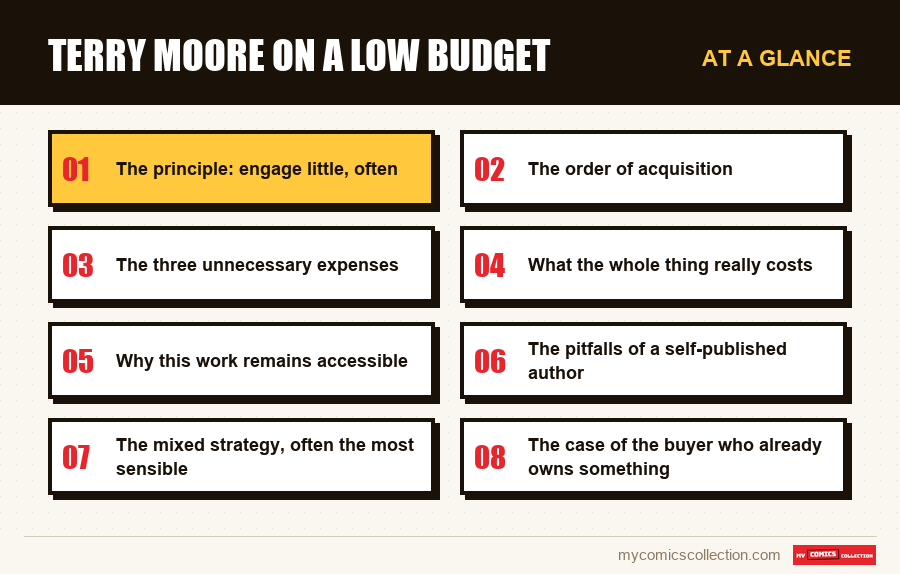
The principle: engage little, often
On a long work, the temptation is to start with the major title. This is the most costly mistake, and not just in money.
His main work requires nearly ninety chapters, with a deliberately slow introduction. A reader who approaches it first therefore commits a substantial budget before knowing whether the author's style suits him, and he judges it on its least representative chapters.
The opposite strategy is to multiply small commitments. His short stories offer exactly the same writing, the same drawing and the same dialogues, for one or two volumes. If it pleases there, it will please elsewhere; If you don't like it, we stop at fifteen dollars.
The order of acquisition
Step 1: a single volume
His shortest story, in a single volume. An evening of reading, no commitments, and a complete story.
This is the cheapest possible test, and it is perfectly representative in its way.
Step 2: a complete short series
Six volumes of horror or science fiction. We check that it holds up over time, and we discover that it completely changes register from one title to another.
Step 3: the second short series
The other register. This is where we distinguish what belongs to the genre from what belongs to the author: impossible with a single title.
Stage 4: the major work
Ninety chapters, approached with the certainty of loving his way. This is the only time when commitment is justified.
A fifth stage exists for avid readers: the title which brings together the characters from all its series. It necessarily comes last, since it does not present its protagonists and relies on the fact that we already know them. Buying it early, because it is the most recent and most visible in bookstores, is the most frequent error in this bibliography, and one of the most discouraging, since it gives the impression of an unreadable author.
The three unnecessary expenses
They keep coming back, and none appear in the displayed price.
The duplicate edition. It is by far the most expensive. Three collections of collections coexist on his main work, with divisions that do not overlap. Buying “the next volume” without checking which chapters it contains regularly produces a partial recovery: a volume that cannot be easily exchanged or resold.
The booklet purchased to read. Bringing together a series by issue costs several times the price of the volumes that bring it together, without adding anything more to the story. The booklets are only of interest for the first issue of a series we care about.
The reprint paid at the price of a first print. On its oldest title, nineteen announcements out of one hundred and twenty-seven explicitly indicated a reprint in the statement. Without asking the seller, we pay one thing for another, and the difference is not visible.
The only gesture that really saves money. Before each volume purchase: “What issues does this volume contain?” » Before each purchase of an old booklet: “first print or reprint? »
These two questions take ten seconds, the seller has the answer in front of them, and they eliminate most of the unnecessary spending in this segment.
What the whole thing really costs
An order of magnitude allows you to make informed decisions, and it is more reassuring than you might imagine.
In second-hand bound volumes, all of his works represent a budget comparable to that of around fifteen novels: spread over as many months as one wishes, since nothing is rare and the prices do not change.
In the booklet, on the other hand, the same set would cost several thousand dollars and would require years of research. The gap between the two approaches is an order of magnitude, for identical content.
That's why the only question that matters before you start is: do you want to read, or do you want to collect? Both answers are legitimate, they simply do not call for the same purchases, and confusing them is the source of all the unpleasant budgetary surprises for this author.
Why this work remains accessible
It is worth understanding where this accessibility comes from, because there is nothing automatic about it and it indicates where the board could move.
Three factors play together. The author has reprinted extensively its most requested titles, which maintains supply at the level of demand: a large publisher reprints the volumes but rarely the fascicles. His work has not been the subject no major adaptation, therefore no influx of external buyers. And black and white has discouraged the market for variants, which is elsewhere the main speculative engine.
These three conditions are stable but not eternal. A screen adaptation of one of his series would be enough to move the first factor, as has been seen with other independent authors: without affecting, however, the abundance of reprints already in circulation.
For a buyer today, the conclusion is simple: there is no reason to hurry, but there is also no guarantee that the situation will be the same in ten years. Patience costs little, waiting indefinitely could cost more.
Collecting this series?
Track what you own, what you are missing and what your collection is worth. 7 day trial.
Start my trial →The pitfalls of a self-published author
Supply disruptions
Reprints depend on the decisions and means of one man. A volume unavailable new can remain unavailable for several months without creating any lasting scarcity.
Unavailability taken for a rarity
This is the error that follows from the previous one. A volume that cannot be found in bookstores can easily be found second-hand, at the same price as before.
A concentrated offer across the Atlantic
The deep market is American. International shipping costs may exceed the price of the copies, which argues for bulk orders.
A partial translation
Not all of its titles have been translated, and those that have been are not necessarily translated to the end. A glance at the French catalog before starting a long series saves the unpleasant surprise of the volume which will never exist.
The mixed strategy, often the most sensible
For anyone who wants to both read and own something, a combination works better than either pure approach.
Read the entirety in bound volumes, and only acquire in booklet the first issues of the two or three series that we really care about. It's a handful of items, less than ten dollars each, and they're the only ones the market is really looking for.
A discreet benefit is added. These few fascicles remain put away once and for all: the story being available in volume, there is no reason to reopen them. They therefore go through the years without taking any additional wear, unlike any copy which is also used for reading.
Finally, it has the merit of producing two clear lists rather than a single confusing one: on one side what can be read, on the other what can be kept, and nothing that appears in both.
The case of the buyer who already owns something
The most common situation is not that of the reader who starts from scratch, but that of someone who already has two or three volumes inherited, given away or purchased at random at a clearance sale. It calls for a different method.
The natural reflex, looking for “the next volume”, is precisely the one that produces duplicates in this work. You must start with an inventory: open each volume owned, note the range of chapters it contains, and establish a list of what is missing in original numbers.
This operation takes half an hour just once, and it completely changes what happens next. We stop looking for volumes to look for chapters, which allows collections to be mixed without risk, and makes it possible to buy an opportunity, as soon as a cheap volume appears.
It also reveals, quite often, that what one possessed did not follow one another. Two volumes purchased separately can perfectly overlap in part, or leave a gap of several chapters in the middle: without anything on their spines suggesting it.
What to save so as not to spend twice
Three fields are enough, and they correspond exactly to the three unnecessary expenses listed above.
The chapter range of each volume. This is what prevents duplicate editions, and nothing else allows it: the volume number varying from one collection to another.
The format owned. Booklet or volume. Without this field, we no longer know if a chapter is already covered elsewhere, and we buy again to read what we already have.
The printing of old fascicles. Statement at time of purchase, on the credits page. It is never reconstituted after the fact without reopening the copy, and it conditions any subsequent estimation.
An inventory that includes these three fields answers the question we ask ourselves when faced with each ad: do I already have this, in another form? Without them, the answer requires physical verification, so, in practice, it is not answered.
Frequently asked questions
By its shortest story, which fits in a single volume and can be read in one evening. It offers exactly the same writing and drawing as his major work, for a fraction of the commitment, and if the tone isn't right, we've settled on fifteen dollars instead of ninety chapters.
The volumes to read, without hesitation: the gap between the two approaches is of an order of magnitude for identical content. The booklets are only justified for the first issues of the series that we really care about, the only objects that the market is looking for in this segment.
Almost never. Reprints depend on the means of a single man, which produces temporary shortages in bookstores without creating the slightest lasting scarcity. The same volume can easily be found second-hand, at the usual price.
Above all not, and there is no reason to do so: prices do not change, the supply is abundant, and the steps are decided one after the other. A spread out acquisition even has a reading advantage, its series being similar enough that it is better to space them out.
By noting, for each volume owned, what original numbers it contains, and asking the same question of the seller before purchasing the next one. Three collections of collections circulate on his main work, with divisions that do not overlap: the rank of the volume provides no information on anything.
Read or collect: the question to decide before buying
Both answers are valid, they just don't call for the same objects: nor the same budget.