On Strangers in Paradise, neither the fascicle number nor the volume number is sufficient to identify what we have in hand. The series was published in three successive waves, each starting from number one, under more than one publisher at first. It was then collected in several collections whose borders do not coincide. The only stable unit throughout is the chapter range indicated on the credits page: everything else is confusing.
It's probably the most difficult title to buy correctly in all of American independent comics, and the difficulty has absolutely nothing to do with its rarity: copies abound.
This article dismantles the problem piece by piece and gives a method that works, whatever edition you come across.
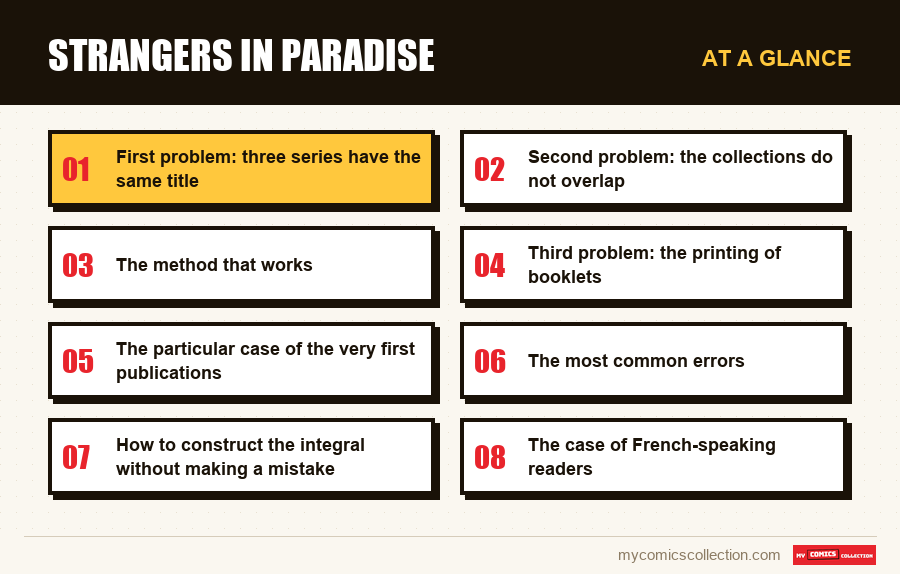
First problem: three series have the same title
The story did not appear in one piece. It went through hiatuses and revivals, and each revival came away with a new number one.
Concretely, a booklet bearing the number 1 can belong to three very distant times from publication, separated by years. Nothing on the cover clearly states this, and the sellers themselves regularly get confused.
Added to this is a change of publisher at the start of the journey: the very first chapters were published under a brand that the author left to found his own. The same story therefore bears two logos depending on the moment.
The only reliable discriminator is the year of publication, which usually appears in the copyright notice. This is the first thing to ask a seller, even before the condition.
Second problem: the collections do not overlap
Original thin volumes
The first collection produced a large number of short volumes, each covering an arc. This is the most common second-hand presentation.
Thick collections
A second collection brings together more chapters per volume. Volume 2 of this collection has nothing to do with volume 2 of the previous one.
Complete editions
There are also presentations aimed at completeness in small volumes. They are the most convenient and least common second-hand.
The result
Three numbering systems coexist on the market, all applied to the same story. “Volume 3” means nothing without its collection.
The method that works
It takes just one step, and it solves both problems at once.
Note the chapter range. Each volume indicates, on its credits page or on the back cover, which original issues it contains. It is the stable unit: it crosses all collections, all publishers and all languages without deforming.
A collection noted in chapter ranges is completed without possible error. We immediately see what is missing, we can mix presentations without creating gaps, and a proposed volume can be evaluated in three seconds.
A collection noted in volume numbers, conversely, becomes unusable as soon as the collection is changed: which inevitably happens with a title published for thirty years.
The question to ask before any volume purchase.“What numbers does this volume contain?” » It takes ten seconds to apply, the seller has the information in front of him, and it eliminates the entire risk of duplication.
A seller who doesn't know how to answer hasn't opened the book. This is information about him as much as about the copy.
Third problem: the printing of booklets
For those who buy by the booklet rather than in volume, an additional difficulty is added, and it costs more than the previous ones.
As he pays for his printing himself, the author has put his first issues back into print whenever demand warrants it. Spread over the duration of publication of the story, this ends up requiring a lot of machine passes.
The report of August 28, 2026 on the American market is eloquent: out of 127 announcements in the first issue, 19 explicitly indicate a reprint: and this figure is a floor, nothing forcing a seller to mention it.
But the indication is printed In the booklet, on the credits side, and nowhere on the cover. No frontal photograph can therefore show it, and this is the only shot that almost all of the advertisements provide. Failing to ask the question, we come away with a reprint nine times out of ten.
The particular case of the very first publications
An additional layer deserves to be noted, because it concerns the most sought-after copies and because it traps even informed buyers.
The very beginnings of the series appeared under a brand that the author did not keep. These chapters were then taken up and republished under its own name, in a different presentation. Two distinct objects therefore contain the same story, with two logos and two dates.
For a collector, this distinction is decisive: it is the original publication which constitutes the rare object, the subsequent republication having benefited from a comfortable print run. But nothing in the content separates them: only the publisher's mark and the year distinguish them.
This is also a case where the ads are honestly wrong. A seller who describes “the first number” is not necessarily lying: he is describing what he has in front of him, without knowing that there are two objects meeting this description. Responsibility for verification rests with the buyer, and it is set by asking for the publisher and the year.
The most common errors
Buy “the next volume”
Without checking the collection, we obtain a volume which partially overlaps the previous one, or which skips chapters without anything indicating it.
Believing to hold “the” number one
Three fascicles bear this figure at different times. Without the year, we don't know which one we have.
Trust the cover photo
A first print and a reprint are visually identical from the front. The difference is inside.
Note the title and volume
This is the most common and useless recording on this title. It does not allow for completion or estimation.
Collecting this series?
Track what you own, what you are missing and what your collection is worth. 7 day trial.
Start my trial →How to construct the integral without making a mistake
A four-step method solves the problem, and it works regardless of which collection you start with.
A. Write down what you already have in chapter ranges, by physically opening each volume. It's tedious once, and it saves you from having to start again.
Two. Create a list of missing chapters, without worrying about collections. What you're looking for are original issues, not volumes.
Three. Buy what covers these chapters, in any presentation. An assumed mix costs significantly less than a homogeneous series that must be hunted down volume by volume, and the story is identical.
Four. Check before each purchase, never after. A volume that partially covers what you already have is difficult to resell and impossible to exchange.
This approach has an unexpected advantage: it makes possible the acquisition by opportunity rather than by plan. One can grab a cheap volume as soon as it appears, without wondering whether it fits in-the only question being whether it adds chapters one does not have.
Why does this situation exist?
It would be tempting to see this as negligence. It is rather the logical consequence of an editorial model.
A traditional publisher plans their collections in advance, with a cohesive collection decided from the start. An author who publishes alone proceeds differently: he collects when he can afford it, in the format that his means allow at that moment.
Likewise, interruptions in publication and resumptions under a new number one reflect an economic reality: an independent series stops and resumes at the rate of what it can finance, whereas a publisher's title continues a continuous numbering without thinking about it.
In other words, the complexity of these editions is the trace of thirty years of independence. This is the price of a model that has also ensured that the story is never interrupted by an external decision or handed over to someone else.
The case of French-speaking readers
An extra layer is added on this side, and it must be said frankly.
The French publishers who published this title made their own groupings, without relying on the original collections. A French volume can therefore cover chapters spread over two American volumes, or the reverse.
This doesn't really add any difficulty to anyone applying the above method: the chapter range remains the same in all languages, and that's precisely the point of this unit. But this prohibits reasoning in volumes as soon as we have volumes from both origins.
An additional point of vigilance: the translation is not necessarily complete. Checking how far it goes before committing avoids discovering in the middle of the story that you will have to switch to the original version: with, at that moment, a connection of chapters to be established between two different systems.
Ce qu'il faut enregistrer
On this title, the current inventory is structurally insufficient, and three fields make it usable.
La plage de chapitres. The decisive field, on volumes as on collections. It is the only one that survives the passage from one collection to another, and the only one that allows you to answer the question “what am I missing?” ".
The year, on the booklets. It places the copy in the right publication wave and removes the ambiguity between three number ones.
The print run, on the booklets again. First or later, noted on the credits page at the time of purchase. This information is never reconstituted after the fact without reopening the copy.
A catalog with these three fields transforms the most confusing title in the segment into a perfectly readable collection. Without them, it remains unmanageable regardless of the care taken elsewhere.
Questions fréquentes
Because the series has had interruptions and then restarts, and each restart has a new numbering. This is an economic reality specific to independent publishing: a series stops and starts again at the rate of what its author can finance, whereas a publisher's title continues without thinking about it.
By asking the seller what original numbers the volume contains, and comparing it to what you already have. The rank of the volume provides no information as long as we do not know which collection it belongs to, and three different collections are circulating simultaneously on this title.
Yes, without any problem, provided you think in sections of chapters rather than volumes. A variegated collection that covers the entire story without gaps is perfectly valid, and often less expensive to put together than a homogeneous series that must be hunted volume by volume.
No, nothing distinguishes them from the front: the covers are strictly identical. What changes can be read inside, on the credits side, therefore outside the scope of the photographs offered in the advertisements. When one ad in seven admits to being a reprint, dispensing with the question amounts to choosing to buy one.
It is regulated with a single reflex, increasing the range of chapters, and it is the counterpart of a model which has guaranteed that the story is never interrupted by an external decision nor taken up by someone else. This is a disadvantage of purchasing in exchange for a work entirely mastered by its author.
The chapter range, not the volume number
It is the only unit that has spanned three collections, two publishers and thirty years without becoming deformed.