Terry Moore's most famous first issue is also the least expensive of his production, and it is the reprint which explains this. Asking prices observed on August 28, 2026 on the American market: Strangers in Paradise #1 wonders $8.48 in raw copy, compared to $9.99 for three of his other series. Of the 127 advertisements noted, 19 explicitly mention a reprint. For an author who finances his own printing, the circulation determines the price much more than seniority or notoriety.
This is a rare configuration: an author who completely controls his reprints produces a market that does not obey the usual rules.
This article gives the complete breakdown on the first five issues, explains why the most sought after is the least expensive, and points out a certification anomaly which deserves to be known before purchasing.
What was counted, and how
Nothing here comes from a bargain: everything comes from a count of the offers visible that day in the United States. These are therefore sellers' claims, systematically higher than the amounts actually collected.
The packages, the completes and the bound albums were put aside. The free copies and those locked in a shell make two distinct columns, because an object that can be opened and a sealed object are not exchanged between the same people.
A third column has been added for this author, and it is this which carries the article: the number of announcements whose title indicates a redraw. This count is a floor, with no seller required to mention it, and many simply ignoring it.
The statement
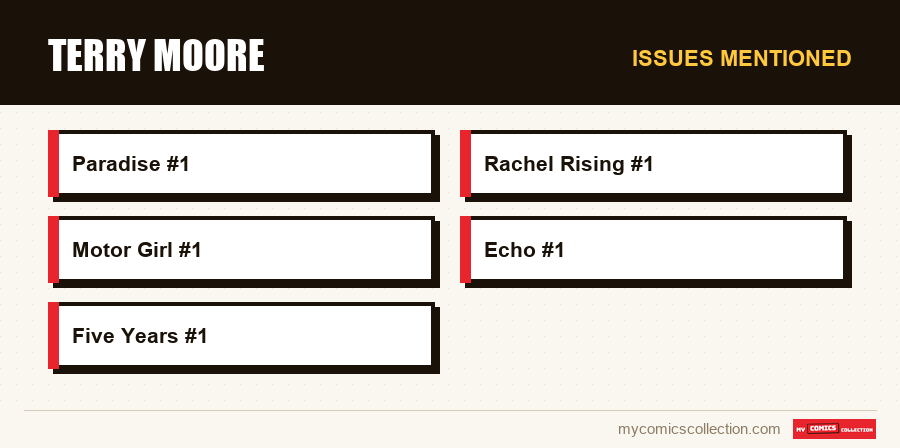
Strangers in Paradise #1: the best known, the least expensive
Raw : $8.48 on 127 listings (0.99-$175).
Certified: $61.99 on 3 listings.
Retractions reported: 19.
The oldest, the most famous, and yet the lowest median in the survey.
Rachel Rising #1: the most abundant supply
Raw : $9.99 on 168 listings ($2.51-$244.95).
Certified: $99 on 7 listings.
Retractions reported: 20.
The largest number of listings in the entire survey, and the second certified market.
Motor Girl #1: the anomaly
Raw : $9.99 on 74 listings ($1.44-$40).
Certified: $189.99 out of 3 ads.
Retractions reported: 5.
The highest certified median of its production, for an ordinary gross price, and on only three announcements.
Echo #1 and Five Years #1: without a certified market
Echo: $9.99 from 133 listings, no verified listings.
Five Years: $8.14 from 61 listings, none either.
Two entire series without the slightest valuation reference for a noted copy.
Why the most famous is the cheapest
The result is surprising, and it has a material explanation that has nothing to do with the quality of the title.
An author who finances his own printing orders little to begin with: he can't afford it any other way. If the series works, he reprints, and he does so as many times as demand warrants. On a title published for fourteen years, this represents several successive waves of reprints.
Thirty years later, the market therefore contains a small number of first printings and a mass of reprints, all with the same number on the cover. The median describes mass, not rarity.
The 19 advertisements which explicitly mention a reprint out of 127 noted are only a floor: nothing obliges a seller to specify this, and many are unaware of it themselves. The actual proportion is necessarily higher.
The practical consequence is direct and costly to ignore: buying this issue at its median is most likely buying a reprint. It's not a bad purchase for anyone who wants to read, it's one for those who think they're acquiring a first print.
The question to ask the seller. The draw notice appears on the credits page interior, never on the cover. It is therefore invisible in a frontal photograph, and this is precisely the photograph that most of the advertisements offer.
An announcement that does not specify the print run on this title statistically describes a reprint. Ask for photo of credits page before purchasing, or consider purchasing a reading copy.
The certification anomaly
One title in the statement behaves in the opposite way to all the others, and it deserves attention rather than dismissing it as an accident.
His shortest story has a certified median of $189.99: the highest of its entire production: for a perfectly ordinary gross price of $9.99. The ratio between the two markets reaches nineteen times.
Two factors combine. First, this title has the narrowest gross supply in the survey: 74 announcements compared to 133 and 168 for the others. Then, and above all, the certified median is based on three announcements.
Three offers do not constitute a deal. They describe the intention of three sellers, only one of whom is very optimistic to move the median. This figure should therefore not be read as a value but as the indication that there are practically no references to promote a graded copy of this title.
This is a common trap with independent authors: a spectacular median calculated on a handful of offers then circulates as an established rating.
What the absence of a certified market implies
No price reference
Two series have no certified announcements. Having a copy graded creates an object that no one knows how to value.
The description replaces the label
Without a shell, resale is entirely based on what the seller writes and photographs. Corners, staples, flatness of the back.
Lower liquidity
A bare copy sells to a reader, not on an organized market. It takes longer, and the price is more negotiable.
The signing is a game changer
This author sells some of his prints in person. A copy signed by someone who did everything himself does not have the status of a screenwriter's dedication.
Collecting this series?
Track what you own, what you are missing and what your collection is worth. 7 day trial.
Start my trial →The case of titles without reprint
One survey title does not display any notice of a reprint, and this is instructive.
This is the most recent of the five. Published recently, it has not yet seen a second printing wave: what is circulating today is what was originally printed. Its median, at $8.14, is however the second lowest in the survey.
This case properly isolates the variable. A title without reprint and cheap shows that the absence of reprinting is not enough to raise a price: we still need a request, and a recent title from a confidential author does not yet have one.
Two simultaneous conditions are therefore necessary for a booklet to gain value in this segment: a limited edition et established notoriety. The most famous title has the second without the first; the most recent has the first without the second. Neither of them goes up.
What this survey teaches about self-publishing
Three lessons emerge, and they are valid beyond this author.
Notoriety does not make rarity. The best-known title is the least expensive because it has been reprinted the most: exactly the opposite of what a large publisher produces, which rarely reprints the issues and concentrates its reprints on the volumes.
Draw replaces coverage as the deciding variable. On modern independent series, you have to identify which of the eight variants you have. Here there are practically none, full black and white has limited the practice, but you have to know what print it is.
Certified markets are tiny or non-existent. Three, seven, three, zero, zero: this is the count of certified announcements on the five titles. None of them have a solid valuation benchmark.
What this changes for a buyer today
This picture, rather discouraging for a speculator, is excellent for a reader, and it is worth stating it clearly.
Five first issues from a unanimously respected author fetch between $8 and $10, with between 61 and 168 listings available on each. No tension, no urgency, no reason to pay above the median or accept a poorly described item.
The most profitable rule in this segment is therefore simple: require a photograph of the credits page. It costs nothing to ask, it settles the issue of reprinting, and a seller who refuses to provide it on a title where nineteen out of one hundred and twenty-seven advertisements mention a reprint tells you something.
For those looking for a first print, the process requires patience rather than budget. The supply is wide, the prices are low, and the only obstacle is information: which is the most comfortable situation a collector can encounter.
What to record
In this segment, one field takes precedence over all the others, and it is almost never filled in.
The draw. First or later. It is the information that separates two visually identical copies and whose values are in no way comparable. It can be read on the credits page, and it is definitely lost if you don't write it down at the time of purchase.
The state, in detail. On thirty-year-old staples and without a certification market, the description makes the resale. Note what a buyer will want to know: corners, staples, spine, paper yellowing.
Signature, if applicable. About an author who produces all of his books alone and sells part of them hand-to-hand, this is information that has its own value.
A catalog which bears “Strangers in Paradise #1” without the print run will never tell if the copy is worth eight dollars or much more. This is the main source of error in this bibliography.
Frequently asked questions
Because it has been reprinted the most. An author who finances his own printing prints little at first and then withdraws as much as demand warrants; over a series published fourteen years, this represents several successive waves. The median therefore describes the mass of reprints, not the first printings.
The mention appears on the inside credits page, never on the cover: it is therefore invisible in the front photographs that most ads offer. You must explicitly ask the seller before buying, otherwise you statistically buy a reprint.
No, not as is: it is based on three listings, which describes the intent of three sellers rather than one market. It only takes one person to be very optimistic to move it. This figure indicates above all that there is practically no reference to value a graded copy of this title.
Two of the five titles noted have no certified announcements for sale, and the other three have three to seven. In such narrow markets, having a copy noted amounts to creating an object that no one knows how to value: the operation has a cost and does not provide a reference.
They do not transpose there. The count was made across the Atlantic, where the supply is by far the deepest for this author; in France the original fascicles circulate in small numbers and cost more, while the translated editions are part of the book trade and follow an unrelated logic.
Two identical copies, two values
The print can be read on the credits page and will be lost if it is not noted upon purchase.