
Strangers in Paradise is Terry Moore's major work: nearly ninety chapters published over fourteen years, written and drawn by him alone. Francine and Katchoo have been friends since high school; one wants an ordinary life, the other has a criminal past that eventually catches up with them both. The story is complete and concluded. It can be read in order, in bound volumes, and its main obstacle is not its length but the fact that it exists in several presentations with incompatible divisions.
It is one of the very rare American graphic novels to have followed the same characters over more than a decade, without the slightest change of author or designer, and without any external editorial decision influencing its course.
This article explains the story, how to approach it without getting stuck along the way, and the point that really costs readers money: distinguishing what you already have from what you think you are buying.
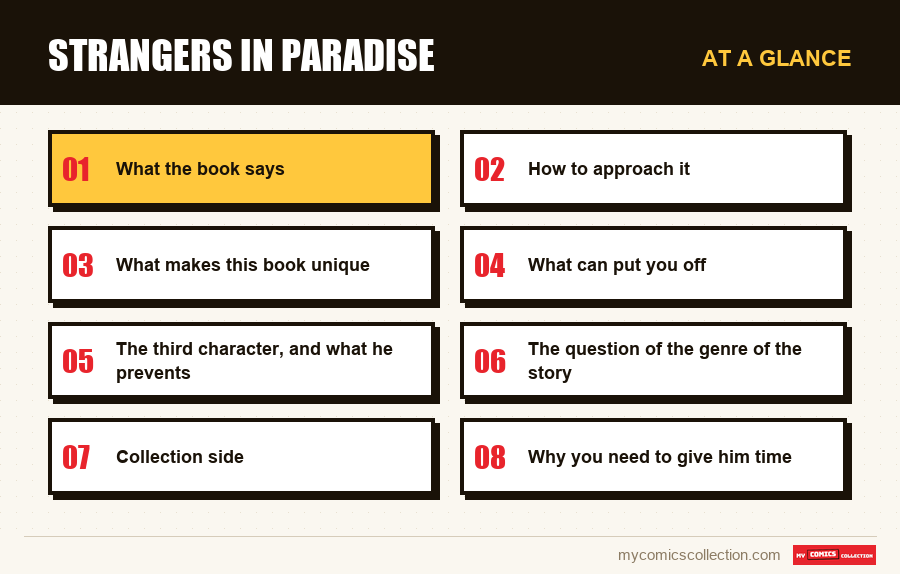
What the book says
Francine Peters leads a seemingly uneventful life: a job, relationships that collapse, parents who have plans for her. His wish would be in one sentence: that this would be enough to make a life.
Katchoo, Katina Choovanski, has been her friend since high school. She is violent, funny, unpredictable, capable of total loyalty and equally brutal brutality, and her past includes episodes that Francine has always preferred not to know in detail. This past ends up returning, accompanied by people who don't ask anyone's permission.
Between them exists something that neither of them names for a very long time. The whole book fits in this gap: what they are to each other, and what they can say about it.
Around them revolves a third character, David, whose presence complicates each situation without ever reducing the affair to a banal love triangle: the story refuses to do so with remarkable consistency, and over several thousand pages.
How to approach it
In order, without exception
The characters evolve over fourteen years of publication. Taking the story in the middle is like meeting people about whom we don't know everything that made them.
In bound volumes
Bringing the series together with the booklet requires dealing with several successive series and distinct numberings. Volumes avoid this problem entirely.
One edition, and only one
Thin volumes, thick collections, complete edition: three presentations with different layouts. Mix two product duplicates and holes.
Without hurrying
The story alternates very dense passages and lighter chapters. Reading it in one go flattens its rhythm, which is based precisely on these breaths.
The only real trap of this title. The series was published in several waves, with numbering that starts again, then collected in collections whose borders do not correspond to those of the thin volumes.
Before any second purchase, open the book to its credits page and note the original numbers which it brings together. Nothing else survives from one presentation to the next, and this is the only information that distinguishes a complementary volume from a redundant volume.
What makes this book unique
Three things set him apart, and they explain his enduring reputation.
A friendship as the main subject. American comics have produced a lot of love stories and a lot of team stories. A long story entirely built on what two friends are to each other remains, thirty years later, a rarity.
An assumed mix of tones. The book moves from situation comedy to violent thriller, sometimes in the same chapter. This is not a hesitation of register: it is what produces an ordinary friendship impacted by a past which is not.
Characters who age. Fourteen years of publication allow the protagonists to change their minds, relapse, reconcile and then start again. Few stories have this length of time, and even fewer use it.
What can put you off
Length
Nearly ninety chapters, it's a commitment that few graphic novels require. It’s better to have tested the author elsewhere before getting started.
Brutal breaks in tone
The transition from a comic scene to a scene of violence can seem incoherent, especially in the first chapters where the device is not yet readable.
Poetic interludes
The book is regularly interrupted for poems and illustrated pages outside the story. Some readers love them, others skip them.
An uneven crime plot
The thriller side of the story is the least convincing for some readers, who come for the characters and support the plot.
The third character, and what he prevents
David occupies a place in this story that the summaries describe poorly, and understanding him avoids the main misinterpretation of the book.
A device with three characters, including two related women and a man in love with one of them, would lead any ordinary story towards the love triangle: a competition, a choice to make, a loser. This book refuses this pattern for several thousand pages.
David is not a rival, nor is he a resigned stooge. There is a third point of view, with its own reasons and its own past, which observes a relationship whose nature it understands better than those who experience it. Its narrative function is to name what the other two cannot say, not to insert themselves between them.
This completely changes the reading. A reader waiting to know "who she ends up with" will be frustrated from start to finish, because the question is not asked in those terms. What the book asks is what two people can be to each other when no available words fit exactly.
The question of the genre of the story
This book is regularly classified in contradictory ways, and that says something about its nature.
It is presented sometimes as a relationship drama, sometimes as a thriller, sometimes as a comedy. These classifications are not bookseller's errors: the story actually does all three, alternately, over fourteen years.
This refusal to settle has an obvious commercial cost, an unclassifiable book is poorly recommended, and it explains why its audience was built up slowly, through transmission rather than through promotion.
But it’s also what gives it its texture. A life does not take place in just one genre, and a story that follows people for fourteen years necessarily ends up crossing several. Readers who give up at the first change in tone miss the very principle of the book.
Collecting this series?
Track what you own, what you are missing and what your collection is worth. 7 day trial.
Start my trial →Collection side
It is its author's most sought-after title, and it presents a difficulty that his other series do not have: you can't trust the number printed on the cover.
The reason lies in the history of the publication. The story did not appear in one piece under a single title: it experienced interruptions, resumptions, and restarts of numbering. A booklet bearing the number one can therefore belong to three very different moments in the series, fifteen years apart.
Added to this is the question of reprints. An author who finances his own printing orders little initially, then withdraws when demand appears. The first issues from the early 1990s therefore exist in several states which are very similar, and whose values are in no way comparable.
Two gestures settle the question. Ask the seller year of publication, which places the booklet in the right wave. And ask for notice of draw, which appears on the inside credits page and never on the cover: therefore invisible in a front photograph.
One advantage compensates for these difficulties: full black and white has largely limited alternative coverage in this segment. Where a modern series requires identifying which of the eight variants one has, the question practically does not arise here.
Why you need to give him time
A criticism comes up among readers who give up early: the first chapters resemble a roommate comedy without stakes. This is correct, and it is deliberate.
The book begins by establishing a normality (meals, housing disputes, work stories) before introducing what will destroy it. Without this installation, the irruption of Katchoo's past would have no weight: we would not measure what it endangers.
This construction requires patience, and it is poorly suited to an era where we judge a story on its first twenty pages. The switch does not occur immediately, and a reader who pauses before will conclude that this is a light book.
The concrete recommendation is therefore to grant it a complete volume before deciding. It is the threshold beyond which we know what we are dealing with, and below which we cannot know it, no matter how carefully we read.
What to record
On this title, three fields resolve most of the difficulties.
The numbers grouped together, for each volume. The rank of the volume is never enough: from one collection to another, it covers chapters that do not correspond. Only the list of original numbers goes through all the editions without being distorted.
The edition, for old fascicles. First printing or reprinting: the difference in value is significant and the information is lost if it is not noted at the time of purchase.
L'état, en détail. On staples over thirty years old, and in a market where certification is little developed, it is the description that makes the resale: corners, staples, spine, yellowing.
Two questions inevitably arise about this title, and an inventory must decide the two: are there any chapters left to find, and what objects are they exactly? A list of volumes remains silent on one as on the other.
Questions fréquentes
Yes, the main story was concluded by its author after fourteen years of publication. He returned to it later with a story set after it, but the original set constitutes a completed whole which can be read without obligatory continuation.
Because the series was published in several successive waves, with numberings starting again, then collected in various ways over the years. The boundaries of thin volumes and those of thick collections do not coincide, hence the importance of checking the chapter range rather than the volume number.
Absolutely, and they constitute the premise of the book rather than a flaw in execution. A story that follows characters over fourteen years necessarily crosses several registers, and the brutal transition from comedy to drama reproduces what a violent past produces in an ordinary life.
This is not necessary for the story, which stands entirely on its own, but it is strongly recommended for another reason: a commitment of ninety chapters is undertaken more calmly when you already know that you like the author's writing and drawing. One of his short stories fulfills this role for one or two volumes.
The notice generally appears on the inside credits page rather than on the cover, which makes verification impossible on a simple front photograph. This is why you must ask the seller for this information before purchasing, and record it immediately afterwards.
Three presentations, divisions that do not overlap
The chapter range is the only stable unit: the volume number is not.