Terry Moore linked his series together after the fact, alone, and without any editor coordinating anything. His four major works-relationship drama, science fiction, horror, and melancholy comedy-were written as stand-alone stories over twenty-five years. Then a title published from 2019 brings together their characters in the same plot. This creates a reading order where there was none, and this is the main difficulty in accessing his work today.
Shared universes are normally built in the other direction: an editor decides on a continuity, then successive authors come and write what is ordered of them. Here, a single man wrote four entirely independent works over twenty-five years, then decided they were one.
This article explains how this convergence works, what it changes to the reading order, and why it constitutes both the best and the worst entry point into his work.
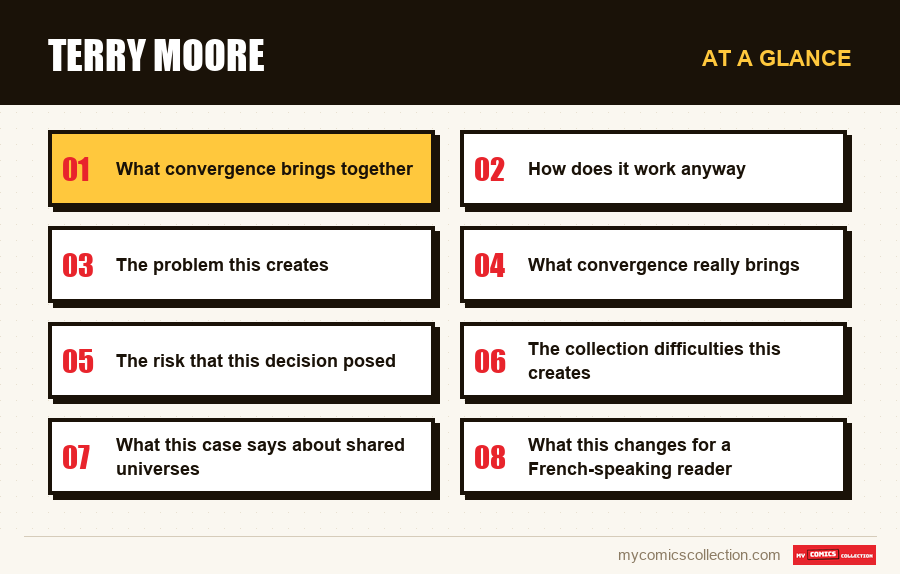
What convergence brings together
Four works written between the beginning of the 1990s and the end of the 2010s, in four registers that have nothing in common.
A relationship drama of nearly ninety chapters about a complicated friendship between two women. A science fiction chase around an alloy that attaches itself to a photographer. A horror story in a small town haunted by a witch hunt. A melancholy comedy about a veteran and an imaginary gorilla.
Nothing in any of these four series announced that they shared a world. They don't quote each other, they don't share secondary characters, and their tones are incompatible. Convergence is not a prepared revelation, it is a decision made after the fact.
How does it work anyway
The same author, therefore the same hand
The drawing, the lettering, the rhythm of the dialogues are identical from one series to another. Bringing the characters together produces no visual discordance.
This is what is missing from most crossovers between series from several authors.
Themes that already corresponded
Old friendships, women who carry a past, damaged families: the four series dealt with the same questions in different genres.
No continuity to respect
As he owns his characters, the author is not accountable to anyone. He did not have to reconcile versions written by others.
A common threat device
The convergence narrative is based on a countdown that concerns everyone. It's the simplest method for bringing unrelated people together, and it works.
The problem this creates
Here is the difficulty, and it is real for anyone discovering this author today.
Before, his series could be read in any order, or not at all. You could love the horror and ignore the relationship drama without missing a thing. This freedom was one of the advantages of a work without continuity.
Since convergence, there has been a title which supposes knowing the other four. His characters arrive with twenty-five years of history behind them, and the story does not present them: it relies on the fact that we know them.
A new reader who starts there would come across an enormous cast of whom he knows nothing, in a plot whose stakes are based on links that he did not see being built. This is the worst possible entry point, and yet it is the most recent title: therefore the most visible in bookstores.
The practical rule. The convergence title is read last, without exception. It only makes sense after the four series it brings together, and it does not itself provide any of the necessary information.
This represents a considerable commitment-nearly one hundred and fifty chapters in total. There is no obligation to do so: the four series remain perfectly readable on their own, and the convergence is a reward for the diligent reader rather than an obligatory passage.
What convergence really brings
An honest question arises: was it worth it?
For a reader who knows all four series, yes, and for a specific reason. Seeing these characters meet produces an effect that few stories achieve: we suddenly realize what each person has been through, because we have read it, and their reactions to each other condense twenty-five years of reading.
Convergence also retrospectively gives coherence to a bibliography that seemed scattered. An author who moves from drama to horror to comedy seems eclectic; the same one, once his series are linked, appears as someone who constructed one thing in four guises.
For a reader who doesn't know the four series, on the other hand, the answer is no, and it's better to say so. The title is not enough in itself, and there is no substitute for prior reading.
The risk that this decision posed
It is worth measuring what the author was putting at stake, because the operation could go very wrong and nothing forced him to do so.
Bringing together series written in incompatible registers requires finding a common tone. But each had its own: the roommate comedy of relationship drama, the dull anguish of horror, the mechanical tension of science fiction. A story that brings them together must either choose one register, and betray the other three, or alternate, at the risk of cacophony.
The more serious danger was retrospective. A failed convergence spoils what precedes: it transforms complete stories into preparations for something else, and gives the impression that their endings were not endings. This is the criticism leveled at most shared universes, where each conclusion becomes provisional.
What avoided this was a simple decision: all four series were finished before convergence, and their conclusions are not reopened. The title that brings them together takes place afterwards, with characters who have experienced what they had to experience. He adds without repeating.
The collection difficulties this creates
A collection that becomes a whole
Owning just one series seemed complete; since convergence, the whole has an end which presupposes the rest. It's a psychological effect, but it encourages purchasing.
One hundred and fifty chapters in total
Putting the whole thing together represents a considerable investment, far greater than reading a single series would suggest.
Heterogeneous editions
The four series did not have the same presentations. Putting together a homogeneous set of volumes is sometimes a headache.
A recent title at the head of the gondola
The most visible in bookstores is the least accessible. Many readers start there and give up.
Collecting this series?
Track what you own, what you are missing and what your collection is worth. 7 day trial.
Start my trial →What this case says about shared universes
This configuration sheds light on the way in which shared universes are usually constructed, and the result is not to the advantage of the current method.
A publisher's universe is decided before being written: continuity exists first, the stories then conform to it. This produces obligatory crossovers, series you have to buy to understand another, and characters written differently depending on who is holding the pen.
Here the order is reversed. The stories existed first, complete and autonomous, and the continuity came later: which means that it can't take anything away from them. None of the four series was amputated or inflected to serve convergence, since they were completed.
This is probably the most honest way to build a shared universe, and it is only possible in a very particular configuration: a single author, owner of the entirety of what he links, over a career long enough to have produced several completed works.
These three conditions explain why the case remains isolated. An author who works for a publisher does not own his characters; an independent author who has only written one series has nothing to link to; and twenty-five years of continuous self-publishing is in itself a rarity. There is no other comparable example in recent American comics, which gives this convergence a documentary value beyond its narrative interest.
What this changes for a French-speaking reader
An additional difficulty arises on this side, and it deserves to be pointed out frankly.
The four series have not suffered the same fate in translation. Some were published in full, others partially, others not at all, and the French publishers were obviously not coordinated, since the author himself had not announced any convergence at the time.
A French-speaking reader who would like to approach the whole in order therefore comes up against a material obstacle: part of the course may not exist in his language. Checking the status of translations before committing avoids discovering halfway through that you will have to switch to the original version.
This is not prohibitive: the four series remaining autonomous, you can perfectly read those which are available and stop there. But this makes the title of convergence, already demanding in English, difficult to access without going through the original fascicles.
What to record
An afterthought linked set poses a specific inventory problem, and an unusual field becomes useful.
The position overall. Standalone series or convergence title: these two statuses are not read at the same time and are not purchased in the same order. Writing it down avoids offering someone, or offering yourself, the only title that cannot be read alone.
The original series of characters. On the subject of convergence, knowing which series each figure comes from allows you to find what needs to be reread first.
Publishing, as in this entire segment. The four series have had different presentations, and creating a homogeneous whole requires knowing what you already have.
The question an inventory needs to answer here is not just “what am I missing?” » but “what am I missing Before to be able to read what I already have? ". This is a rare enough situation to merit a field.
Frequently asked questions
Yes, without reservation. The title Convergence does not present its characters: it relies on the fact that we already know them, with twenty-five years of history behind them. Reading it first means coming across a huge cast about whom we know nothing, in a plot whose stakes are based on connections that we haven't seen being built.
No, and that's the advantage of continuity added after the fact rather than imposed beforehand. All four stories were complete when the convergence arrived: none was cut or twisted to serve it, and each reads exactly as before.
Absolutely not. The four series remain perfectly readable on their own, and the convergence is a reward for the diligent reader rather than an obligatory passage. You can very well like one of them, ignore the other three, and never open the title that brings them together.
Because they were less so than it seems. Under incompatible genres (drama, horror, science fiction, comedy) the four dealt with the same questions: old friendships, women who carry a past, damaged families. Convergence makes visible a coherence that already existed.
Around one hundred and fifty counting the four series and the convergence title, which represents an investment in reading and purchasing much greater than what a single one of these stories suggests. It's better to know this before starting the whole thing rather than discovering it in the third volume.
The only title that cannot be read alone
Noting one's position in the whole avoids starting with the one that presupposes the other four.