What retains Terry Moore's readers is neither the plot nor the drawing: it's the dialogue. His characters speak like people who have known each other for twenty years: with innuendoes, recurring jokes and unfinished sentences that the other still understands. It is this writing which makes difficult subjects bearable, which keeps series of ninety chapters going, and which explains why his stories are reread while their intrigues hold no surprises the second time around.
We readily cite his female characters, more rarely what makes them come alive. However, this is where his know-how lies.
This article breaks down this writing, shows what it allows, what it costs, and why it is the only real criterion for knowing if this author will be right for you.
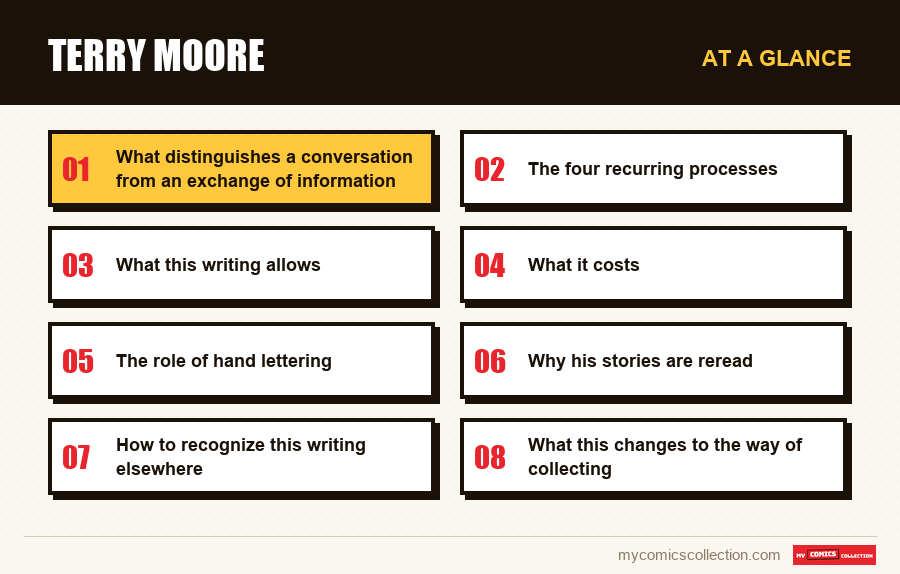
What distinguishes a conversation from an exchange of information
Most comic book dialogue has one function: to convey to the reader what they need to know. The characters explain things they already know, specify first names that they would not need to specify, and recap the situation at regular intervals.
A real conversation does the opposite. She omet everything that the two interlocutors know is based on shared references that no one explains, and it proceeds by allusions, half of which a third party would not understand.
It is this second register that this author practices. His characters cut each other off, respond aside, repeat a joke made three hundred pages earlier without repeating it. The reader doesn't have all the keys, and that's deliberate.
The bet is risky: a reader who doesn't follow picks up. But when it works, it produces a sensation that exhibition never produces: that of witnessing something rather than being told about it.
The four recurring processes
La vanne récurrente
A joke established early returns dozens of chapters later, without preparation. The reader who remembers it laughs; whoever forgot just sees a strange sentence.
It’s a bet on attention, and that’s what rewards rereading the most.
The unfinished sentence
One character interrupts, the other responds anyway. What hasn't been said is inferred from the response, which requires the reader to do the work.
Le décalage de registre
A trivial remark in the middle of a serious scene, or the opposite. This is what keeps the drama from turning into melodrama, and what confuses readers who come looking for a stable tone.
Le silence dessiné
Entire boxes without text, in the middle of a conversation. The rhythm of the dialogue passes through these gaps, which the manual lettering allows to measure as closely as possible.
What this writing allows
Three effects, and they explain construction choices that would otherwise be attributed to chance.
It makes tough subjects bearable. Addiction, mourning, violence, murder: his stories deal with heavy material. The humor of the dialogue provides the breathing space without which reading would become taxing, and it does so without ever minimizing what is happening.
It allows for very long stories. Ninety chapters of pure intrigue would bore anyone. What keeps the reader coming back is the pleasure of hearing these people talk to each other: a pleasure that does not depend on the progression of the story.
It establishes intimacy without describing it. Two people who understand each other half-heartedly show their closeness through the form of their exchange. No sentence needs to say they're close: the way they speak proves it.
What it costs
A slow start
Shared references must first be established. The first chapters therefore spend a lot of time on seemingly pointless exchanges.
Impossible entry along the way
Taking the story in the middle is like listening to two strangers speak to each other in allusions. Nothing is explained, because nothing would have any reason to be.
Penalized split reading
Recurring valves rely on the reader's memory. Spacing the volumes by several months defuses a real part of the text.
Une traduction difficile
Rhythm, innuendo, suspended sentences: this is what resists the least when moving from one language to another, regardless of the care of the translator.
The only test that counts before buying. Open any dialog page and read it. Not the summary, not the first page, not the cover: a conversation taken at random.
If you like the tone, everything else in his bibliography will suit you: it's the constant in his work, much more than the genres or the plots. If you don't like it, none of his titles will change that.
The role of hand lettering
A technical element supports all of the above, and it systematically goes unnoticed.
This author writes his pages himself, by hand. The text is therefore not placed on the drawing after the fact by an external contributor: it is traced at the same time, by the same hand, with the same tool.
This changes specific things. The size of a bubble can vary to the nearest word to allow time. A line can become thinner as a character loses his confidence. A silence occupies the exact space it should occupy, because there is no obligation to respect a typographical grid.
On writing that relies on rhythm rather than the content of sentences, this control of the dosage is decisive. Digital lettering applied afterwards would produce the same words with a different rhythm: therefore, in practice, another text.
Why his stories are reread
This is a rare property, and it arises directly from the processes described above.
A plot cannot be reread: we know the ending, the revelations no longer reveal anything, and the suspense has disappeared. This is why most mechanical stories are read once.
A dialogue never ends. On the second reading, we spot the recurring valves that we had missed, we understand allusions which referred to things that we did not yet know, and we hear differently the lines whose significance we now know.
On his long series, the effect is considerable: an innocuous sentence from the first volume becomes heartbreaking when we know what it announces. These are effects that the author has sown without being able to count on them, and which are only reaped upon rereading.
This justifies a practice that is rarely recommended: resuming the first volume after finishing a series. The time invested is low, and the return unusual.
Collecting this series?
Track what you own, what you are missing and what your collection is worth. 7 day trial.
Start my trial →How to recognize this writing elsewhere
These processes do not belong to him alone, and knowing how to identify them helps to find other readings that provide the same pleasure.
The most reliable sign: the absence of an explanation. Open a book in the middle. If the characters tell you who they are and what is happening, the author is writing to inform you. If they talk among themselves without caring about you, he writes conversations.
The second sign: the length of the scenes without any stakes. An author who agrees to devote six pages to a meal where nothing is decided is betting on the pleasure of company. It is exactly this bet that produces attachment.
The third: laughter in serious moments. A story that remains funny during a funeral understood something about how people actually get through hardship.
What this changes to the way of collecting
A practical consequence follows from all of the above, and it is unusual enough to be noted.
On a work whose value lies in the dialogues rather than the plot, the state of readability takes precedence over the state of conservation. A copy whose text reads poorly-pasty printing, yellowed paper, binding that does not open flat-directly reduces the price of the book.
It's the opposite of an action story, where you can appreciate scenes even on a mediocre reproduction. Here, if the bubbles are difficult to read, the main point is lost.
This suggests a purchasing hierarchy: favoring a readable and inexpensive copy over a better preserved but poorly printed copy. In this segment where prices are low everywhere, arbitrage costs almost nothing, and it determines what we will actually get from the book.
The risk that this bias poses
It is necessary to say what this writing involves, otherwise it would be presented as an unrequited advantage.
An author who refuses to explain accepts losing part of his readership along the way. Some readers do not reconstruct what is not said: not for lack of attention, but because they read differently, waiting for the text to take charge. This is not a fault on their part.
The risk is all the more real as there is no warning. A book that begins with allusive conversations nowhere signals that this work will need to be done, and the reader who drops out usually concludes that the book is poorly written rather than differently written.
This is also what explains the confidential reputation of this work. It does not convert the undecided: those who enter its register stay there for years, those who do not enter stop at the first volume. There are hardly any lukewarm readers.
For a buyer, the consequence is encouraging: the question is resolved quickly and inexpensively. One volume is enough to know, and this volume costs the price of a paperback book.
Ce qu'il faut noter
Two fields are enough, and they are not the ones we usually fill in.
The readability of the text, described in words. Clear or thick bubbles, light or yellowed paper, binding that opens flat or not. This is not a state of conservation in the usual sense: it is an evaluation of what the copy actually allows us to read.
The fact of having reread, or not. On a work where the second reading gives more than the first, knowing that you have only read a volume once is useful information: it signals a pleasure still available, which an ordinary inventory never records.
These two fields answer a question that this bibliography asks more than others: not “what do I own?” » but “what else can I get out of it?” ".
Frequently asked questions
By opening any page of dialogue and reading it: not the summary or the first page, but a random conversation. This is the constant of his work, much more than the genres or the plots: if you like the tone there, you will like it everywhere else in his work.
Because the references shared between characters must first be established for the allusions to then work. The early chapters therefore spend a lot of time on seemingly pointless exchanges, which are in reality the groundwork for everything else.
On writing that relies on rhythm, yes, in a decisive way. The size of a bubble can vary to the nearest word to allow time, a line dwindling as a character loses his confidence. Digital lettering applied afterwards would produce the same words with a different rhythm: therefore another text.
Because a dialogue does not exhaust itself like a plot. On the second reading we spot the missed recurring jokes, we understand allusions which referred to what we did not yet know, and an innocuous sentence from the first volume becomes heartbreaking when we know what it announces.
She renders the story faithfully, but it is precisely this register that is least resistant to the transition from one language to another: the rhythm, the innuendoes and the sentences left hanging require considerable work, and the result varies. This is the case where the original version brings the most.
Readability takes precedence over conservation
On a work whose value lies in the dialogues, a poorly printed copy undermines what we came for.