
What we always quote about Terry Moore, “he writes women well”, actually covers a structural decision, not a quality of writing. His stories are not organized around a couple but around a friendship, which changes everything: the decisions of its protagonists arise from their profession, their debts and their past, never from their romantic situation. The movement is simple and yet rare enough to still be noticed thirty years later.
The formula has been repeated so often, and for so long, that it has ended up meaning nothing at all. It deserves to be taken apart to see what's underneath.
This article explains what this compliment actually means, what it changes when you read it, and why the process remains difficult to imitate.
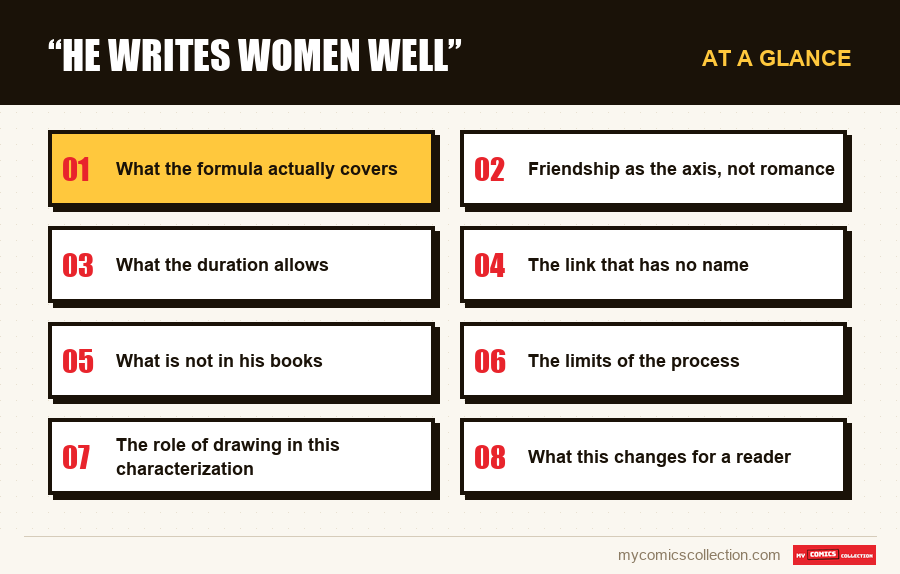
What the formula actually covers
To say of an author that he writes women well suggests a psychological aptitude, a particular sensitivity. That's not what it's about, and reducing it to that makes it inimitable for the wrong reasons.
What he does is structural. Its protagonists have a job that we see practiced, a financial situation that weighs on their choices, a family that expects things from them, and a past that produces consequences. These elements occupy the space that most stories reserve for the question of love.
The consequence is immediate: when a character makes a decision, it results from a bundle of concrete constraints rather than from a feeling. It's a way of writing any character, and there's nothing specifically feminine about it: it's just less often applied to women.
Friendship as the axis, not romance
A link that precedes the story
His duos have known each other since high school, sometimes since childhood. The book does not recount their meeting: it begins years later, with everything that has accumulated.
This immediately gives a depth that a budding romance takes hundreds of pages to build.
A bond you can't leave
A love story can end neatly. A twenty-year friendship, no: we can get angry, avoid each other, lie to each other, but the other remains in your story.
A link with no vocabulary available
What her characters are to each other has no precise name. The entire book fits into this gap, and it refuses to fill it.
A bond that supports comedy
Two friends who know each other too well produce funny dialogues that a budding couple doesn't allow. This is what makes his books light despite their subjects.
What the duration allows
One point is one of format as much as intention, and it is rarely emphasized.
A series published for fourteen years allows trajectories that the short format prohibits. Her characters change their minds, make decisions they regret, relapse, reconcile and then start again: because there is room for that.
Most stories have to condense an evolution into a few chapters, which produces clear, readable changes: someone decides something and sticks to it. Duration allows for inconstancy, which is more like how people behave.
This is also what makes his characters difficult to summarize. Asking “who is Katchoo?” » has no short answer, because it has been several things successively without any of them canceling out the previous ones.
The link that has no name
This is the point where his process goes furthest, and the one which best explains the loyalty of his readers.
What its two main protagonists are to each other doesn't fit into any available category. This is not friendship in the ordinary sense: the word is too weak for what they owe each other. It's also not exactly a love story, although the book never excludes that reading.
An ordinary story decides. He turns the relationship on one side, puts a word on it, and the reader knows where he is. He refuses for thousands of pages, not out of vanity but because this is the subject: two people who cannot name what they are experiencing, and who still have to decide how to behave.
This refusal has a cost. Readers waiting for an answer have been asking for it for fourteen years, and some feel cheated. But it produces a rare thing: a relationship that cannot be summed up by anyone, which is precisely the situation of most of the bonds that matter in life.
What is not in his books
A useful way to understand a process is to look at what it excludes. Four absences are noticeable.
No character-function. None of her female figures exist to motivate, reward, or punish any male character. It is an absence so banal to state and so infrequent to notice that it is worth noting.
No compensatory supernatural skill. Its protagonists are not made interesting by exceptional talent. They are waitresses, photographers, mechanics.
No resolution by the couple. None of his books end with the formation of a couple presented as an outcome.
No speeches. Nothing in her stories states a position on what a woman is or should be. The point, if there is one, lies entirely in the construction.
Why it's hard to imitate. The process involves renouncing the medium's most convenient narrative engine, romantic tension, and replacing it with less spectacular concrete constraints: rent, a boss, a sister who no longer responds.
It's a costly arbitration in terms of rhythm, and it only works with duration. A short story doesn't have time to set up the constraints that replace romance.
The limits of the process
A slow start
Installing concrete constraints takes time. Its first chapters often resemble a roommate comedy with no stakes, and some readers stop there.
Less developed male characters
The counterpart is real: his male figures are generally less detailed, with notable exceptions but a clear trend.
A repeating pattern
From one series to another, the structure varies little: a woman, a friend, a past that goes back. Read consecutively, his books can seem redundant.
Uneven subplots
The criminal or fantastic side of his stories is often the least convincing. Its readers come for the characters and support the plot.
Collecting this series?
Track what you own, what you are missing and what your collection is worth. 7 day trial.
Start my trial →The role of drawing in this characterization
A hardware aspect supports the entire device, and it generally goes unnoticed.
Working entirely in black and white, this author has neither a hair color nor a distinctive clothing item to separate his characters. His faces must therefore be sufficiently characterized to be recognized without chromatic aid, which requires him to give them their own morphology.
The result goes beyond simple readability. Its female characters have faces that are not similar (different jaws, noses, and locations) where many comics draw a single female face with several hair colors.
They are getting old also, which is rare. Over fourteen years of publication, the features deepen, the silhouettes change, the hairstyles follow the times. The technical constraint of black and white therefore produced, incidentally, one of the strongest graphic characterizations of the medium.
What this changes for a reader
Three practical consequences, which help to know if these books will suit you.
You have to accept an installation pace. The first volume of any of his titles spends a lot of time on seemingly unimportant things. This is the groundwork, and it is necessary.
You should not expect a romantic resolution. The question “who will she end up with?” » is not what the book poses, and waiting for it produces guaranteed frustration from start to finish.
Rereading gives more. Once the constraints weighing on a character are known, their initial decisions read differently: what passed for bad humor becomes a motivated reaction.
What this changes for a collection
A reader who comes to this author for this process organizes his library differently, and this has a concrete consequence.
Its titles read better spaced than in a row. The structure being close from one series to another, linking two of his books together brings out the repetition; separating them by other readings lets each exist for itself.
This argues for a spread out acquisition rather than the group purchase of a complete book, and this is good news for a bibliography which represents nearly one hundred and fifty chapters in total.
Conversely, there is a real interest in owning at least two sets of opposite registers: drama and horror, for example. It is by comparing them that we see what belongs to the genre and what belongs to the author, something that a single series can never establish.
What this case says about the medium
A final remark, which goes beyond the author and explains why his work is so regularly cited.
If such a simple process (giving a character a job, debts and a past rather than a romantic situation) is enough to make a work stand out for thirty years, that above all says something about what we compare it to.
This is not a disguised compliment. This is a useful observation for a reader: what he will find here is not an unattainable feat but a rigorous application of ordinary writing rules, applied to characters to whom they are applied less often.
This makes the process reproducible, and it has been so ever since: several contemporary authors work in this vein, often without citing it. The singularity of this case has less to do with the invention than with the anteriority and the duration: thirty years of consistency, on a work entirely controlled by a single person.
Frequently asked questions
The fact that their decisions arise from concrete constraints (a job, a debt, a family, a past) rather than their romantic situation. It's a way of writing any character, just less often applied to women, and that's why we notice it.
No, and this is the main source of misunderstanding. The love stories exist there but come second and do not determine the plot: the axis is an old friendship, a bond that one cannot properly leave and which does not have a precise name in the available vocabulary.
This is a real counterpart of the system, with notable exceptions but a clear trend. A story that focuses its attention on a female duo and the constraints placed on them has less room for the rest of its cast.
Read consecutively, yes: the structure varies little from one title to another. This is a reason to space them out rather than chain them together, and this argues for acquisition spread over time over a bibliography which represents nearly one hundred and fifty chapters.
Because the process involves renouncing the medium's most convenient narrative engine, romantic tension, to replace it with less spectacular constraints, and it only works with duration. A short story doesn't have time to set up what replaces the romance.
Two sets of opposite registers are better than one integral
It is by comparing them that we distinguish what belongs to the genre from what belongs to the author.