Key characters in the Superman universe: Supergirl (Kara Zor-El), Superboy (Kon-El/Jon Kent), Lex Luthor, Doomsday, Lois Lane, Jimmy Olsen, Steel, Krypto. Family titles: Action Comics, Superman, Supergirl, Superboy, Superman's Pal Jimmy Olsen, Superman's Girl Friend Lois Lane.
The Superman universe, the oldest in superhero comics, has spanned a constellation of interconnected titles and characters since 1938. Beyond the original Kryptonian, the “Superman Family” encompasses decades of supporting cast, iconic villains and spin-off series that form an entire part of DC Comics history.
For the collector, this universe offers unparalleled depth: from Golden Age keys to modern keys, including Silver Age romance titles and cosmic crossovers. Knowing the architecture of the Superman family allows you to intelligently target your acquisitions.
The Superman Family
Supergirl: Kara Zor-El
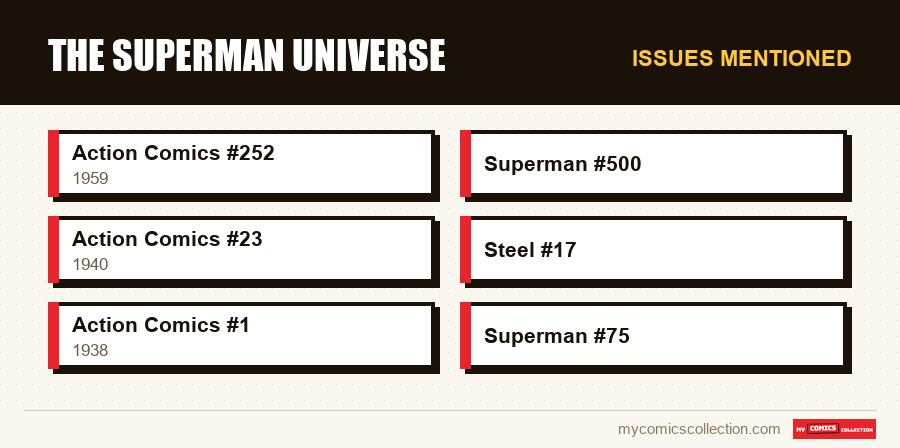
Superman's Kryptonian cousin, Supergirl first appears in Action Comics #252 (1959), a highly sought-after key issue of the Silver Age. His multiple solo series (1972, 1996, 2005, 2011, 2016) offer varied entry points for the collector depending on the budget.
Superboy: from Kon-El to Jon Kent
The concept of Superboy evolved from young Clark Kent (Adventure Comics) to clone Kon-El (introduced in Adventures of Superman #500) and then to Superman's son, Jon Kent. Each incarnation has its own key numbers and its community of collectors.
Lois Lane and Jimmy Olsen
Superman's Girl Friend Lois Lane (1958-1974) and Superman's Pal Jimmy Olsen (1954-1974) are Silver Age series with a unique vintage charm. The Jimmy Olsen issues by Jack Kirby (#133-148) are of particular value. The modern mini-series by Tom King (Lois Lane) and Matt Fraction (Jimmy Olsen) are quality recent collectibles.
The major antagonists
Lex Luthor
A sworn enemy since Action Comics #23 (1940), Luthor is omnipresent in the Superman universe. His key appearances punctuate each era: from the Golden Age mad scientist to the corporate billionaire of the 1980s, to his presidency in the 2000s. His Lex Luthor: Man of Steel series by Brian Azzarello is a must-see.
Doomsday: Superman's Killer
Created specifically for "The Death of Superman" (1992), Doomsday first appears in Superman: Man of Steel #17 (cameo) and #18 (full). The Death/Funeral/Reign/Return saga remains one of the most collected events of the 1990s, despite high print runs.
Superman Family Titles
During the 1990s, the Superman universe operated in "triangle numbers": four interconnected weekly series (Superman, Action Comics, Adventures of Superman, Superman: Man of Steel). Collecting this period requires following the triangular numbering for reading order. Steel, introduced in the "Reign of the Supermen", had his own series (1994-1998).
Collection strategy
Action Comics #1 (1938) is the absolute Holy Grail of comics, but the Superman universe offers entries for all budgets. Target the first appearances: Action Comics #252 (Supergirl), Superman #75 (Death of Superman, affordable in standard edition), Adventures of Superman #500 (Superboy Kon-El). For modern titles, Tomasi/Gleason's runs on Superman (Rebirth) and the Jon Kent series offer excellent value for money. Check out our guide to history of comics by ages to contextualize your acquisitions.
The Superman universe spans 85+ years of publication: manage your Action Comics, spin-offs and keys with issue-by-issue tracking suitable for large collections.
Organize my Superman collectionWhere to look: landmarks for following the Superman family
The difficulty of this universe is its sheer size: more than eighty years of publication, with titles that change name, numbering and role. A simple method is to think by character rather than by series, then note for each one the issue that fixes their origin.
A list of first appearances to remember
- Action Comics #1 (1938): the starting point of all superhero comics.
- Action Comics #23 (1940): the first appearance of Lex Luthor, the archenemy present in every era.
- Action Comics #252 (1959): the first appearance of Supergirl, a Silver Age key issue.
- Adventures of Superman #500: the introduction of Superboy as Kon-El.
- Superman: Man of Steel #17 and #18: Doomsday appears first in a cameo, then in a full appearance, ahead of The Death of Superman (1992).
- Superman #75: the issue of Superman's death, affordable in standard edition.
Reading by eras
The Silver Age series have a charm of their own. Superman's Pal Jimmy Olsen (1954-1974) and Superman's Girl Friend Lois Lane (1958-1974) ran almost in parallel, and the Jimmy Olsen issues by Jack Kirby (#133-148) have a special value. At the other end, Tom King's modern miniseries on Lois Lane and Matt Fraction's on Jimmy Olsen offer recent, inexpensive entry points. For Supergirl, the solo series of 1972, 1996, 2005, 2011 and 2016 let you pick your era according to your budget.
The triangle numbering trap
In the 1990s, the Superman universe works with triangle numbers: interconnected series (Superman, Action Comics, Adventures of Superman, Superman: Man of Steel) whose reading order does not follow the order of the issue numbers. To reconstruct the Death, Funeral, Reign and Return saga, you therefore have to read by cover date and not series by series. If you buy a saga from this period, check off each issue in chronological order rather than in the order of each title.
Where to put your budget
Action Comics #1 is the ultimate grail of comics, but the Superman universe opens up to every budget. The most accessible keys are those whose value rests on a single event: Superman #75 in standard edition, Adventures of Superman #500, or the modern runs by Tomasi and Gleason on Superman (Rebirth) and the Jon Kent series. The death saga remains one of the most collected events of the 1990s, despite high print runs: it is easy to complete, but it is the quality of preservation that makes the difference.
Finally, keep one list per character in your tracker (Supergirl, Superboy, Lois, Jimmy, Luthor, Doomsday): you will see at once which branch of the family is complete and which remains to explore.
Frequently Asked Questions
Supergirl (Kara Zor-El), Superboy (Kon-El then Jon Kent), Lois Lane, Jimmy Olsen, Steel, Krypto, as well as antagonists such as Lex Luthor and Doomsday. The family titles include Action Comics, Superman, Supergirl, Superboy, Superman's Pal Jimmy Olsen and Superman's Girl Friend Lois Lane.
In Action Comics #252 (1959), a highly sought-after Silver Age key issue. Her solo series of 1972, 1996, 2005, 2011 and 2016 offer varied entry points depending on budget.
The concept went from the young Clark Kent (Adventure Comics) to the clone Kon-El, introduced in Adventures of Superman #500, then to Superman's son, Jon Kent. Each incarnation has its own key issues and its own community of collectors.
Doomsday was created specifically for The Death of Superman (1992) and first appears in Superman: Man of Steel #17 (cameo) and #18 (full appearance). The Death, Funeral, Reign and Return saga remains one of the most collected events of the 1990s.
During the 1990s, the Superman universe works with interconnected series (Superman, Action Comics, Adventures of Superman, Superman: Man of Steel). Collecting this period requires following the triangle numbering to recover the reading order.