
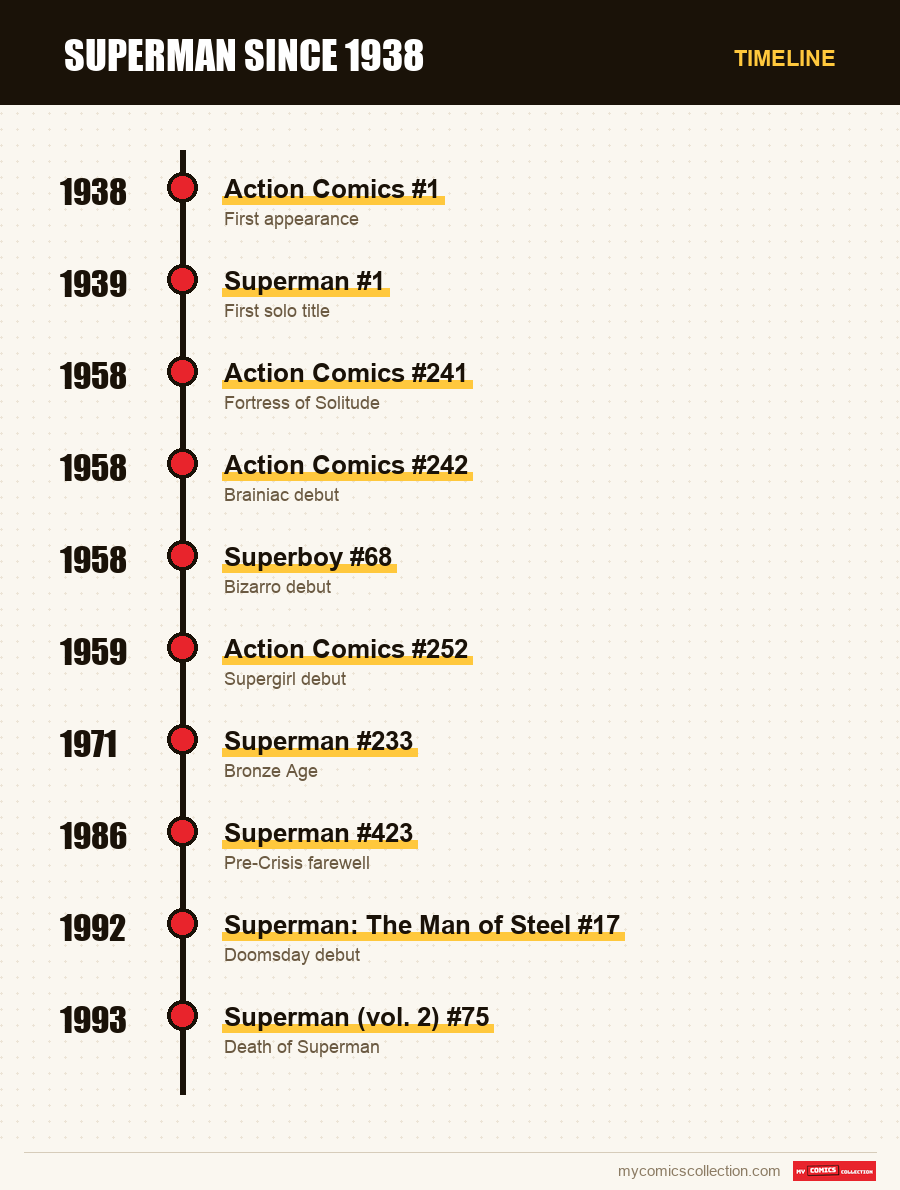
Superman has existed since 1938, moving from Fleischer Studios cartoons (1941-1943, 17 revolutionary short films) to modern comics, crossing each era of the medium, and the comics of each period reflect these developments, with a direct impact on their current popularity among collectors.
Superman's history spans nearly 90 years, since his creation by Jerry Siegel and Joe Shuster in Action Comics #1 (June 1938) until the current DC Comics series. But Superman is not just a comic book character: starting in 1941, Fleischer Studios produced cartoons of astonishing technical quality that helped define the character's visual identity for generations.
This guide traces the evolution of Superman through all eras of comic books and animation, highlighting the impact of each period on the collectible market. Understanding this story means understanding why some numbers are worth millions while others languish in the dollar bins.
1938-1941: The birth of a myth
In June 1938, two young creators from Cleveland:Jerry Siegel (screenwriter) and Joe Shuster (cartoonist): see their creation published in Action Comics #1 after years of rejections. Superman is a revolutionary concept: a superhuman being from another planet who uses his powers to protect the weak and challenge the powerful.
The success was immediate and dazzling. Action Comics goes from modest print runs to 500,000 copies per month in less than a year. In 1939, Superman got his own title (Superman #1, Summer 1939), becoming the first superhero to have an eponymous series. Combined sales of Superman titles exceeded one million monthly copies by 1940.
Impact on the collection
Issues from this founding period (1938-1941) are the rarest and most expensive in the hobby. Action Comics #1-20 and Superman #1-10 are museum pieces with prices in the tens of thousands, if not millions, of dollars. Even "mainstream" issues from this period (Action Comics #30-50) are worth $500-3,000 depending on grade.
1941-1943: The Fleischer cartoons: Superman on screen
In 1941, Fleischer Studios (then Famous Studios) began producing Superman cartoons for Paramount Pictures. These 17 short films (1941-1943) are considered masterpieces of American animation, with a budget of $100,000 per episode: four times the average budget for a cartoon of the time.
The Fleischers established visual elements that have become canonical: Superman flying (in the comics, he only jumped), the phrase "It's a bird! It's a plane! It's Superman!", the final colors of the costume and the Art Deco style of Metropolis. Comics from the same period reflect the influence of these cartoons, with more dynamic covers and more cinematic poses.
Impact on the collection
Issues of Action Comics and Superman from 1941-1943 benefit from the Fleischer aesthetic in their covers. Collectors of “Golden Age animation art” seek out the original Fleischer cels ($10,000-$50,000 each) alongside comics from the same period. The two markets feed each other.
1944-1956: Post-war and decline
After the war, Superman remained popular but lost in subversion. The character becomes more conservative, the stories more fanciful (time travel, imaginary worlds). The Comics Code Authority (1954) imposed censorship which further watered down the content. Sales gradually declined, falling below 500,000 monthly copies.
The television series “Adventures of Superman” with George Reeves (1952-1958) kept the character in popular culture, but comics from this period are the least sought after of the Golden Age: which paradoxically makes them purchasing opportunities for discerning collectors.
Impact on the collection
Issues Superman #50-100 and Action Comics #150-250 from this period are between $100 and $1,000 in medium grades (3.0-5.0), much cheaper than the 1938-1943 issues. This is the most realistic "Golden Age entry point" for most collectors.
1956-1970: The Silver Age: Krypton, Supergirl and the Legion
The Silver Age transformed Superman into a truly cosmic character. The Kryptonian mythology is enriched (Kandor, the Phantom Zone, the different colors of kryptonite), Supergirl arrives in 1959, and the Legion of Super-Heroes becomes a major spin-off. Artists Curt Swan and Wayne Boring defined the character's look for two decades.
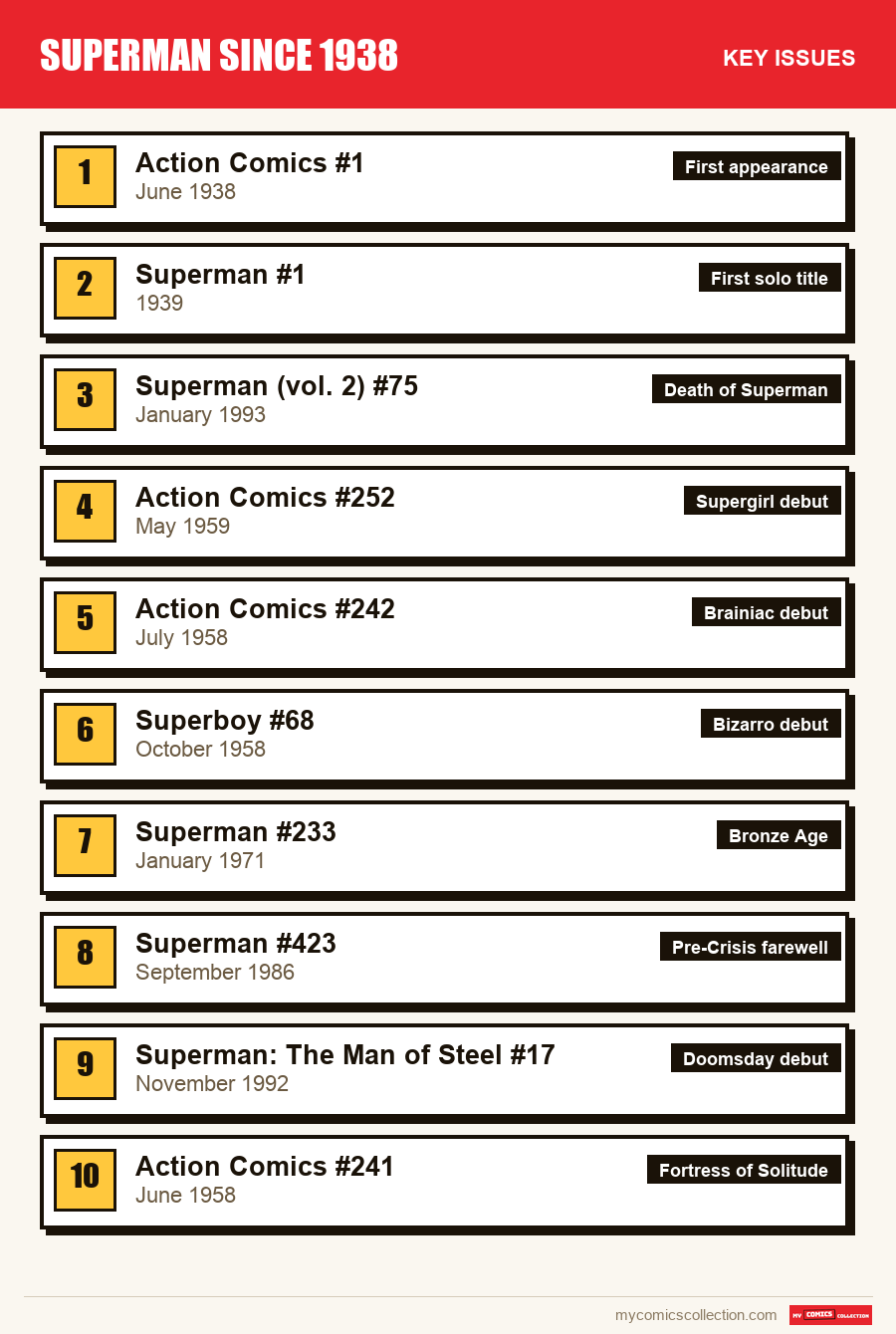
The first appearances of characters in this period remain in high demand: Supergirl (Action Comics #252, 1959), Brainiac (Action Comics #242, 1958), Bizarro (Superboy #68, 1958), the Fortress of Solitude (Action Comics #241, 1958).
Impact on the collection
The Silver Age offers the best balance between accessibility and historical significance. Common issues are worth $10-50 in mid grades, while key issues fetch $1,000-5,000. This is the most "collectible" era of Superman for the majority of serious budgets.
1970-1986: The Bronze Age: Maturity and experimentation
The 70s brought narrative maturity to Superman comics. Screenwriters like Elliot S! Maggin and designers like Neal Adams modernized the character. The film "Superman" (1978) starring Christopher Reeve created a global cultural phenomenon that revitalized comic book sales.
The era concluded with Crisis on Infinite Earths (1985-86) and Alan Moore's farewell diptych ("Whatever Happened to the Man of Tomorrow?"), marking the end of 48 years of uninterrupted continuity.
Impact on the collection
The Bronze Age Superman issues (Action Comics #400-583, Superman #233-423) are the most affordable to build volume: $3-15 per issue in VF/NM. Key issues like Superman #233 (iconic cover by Neal Adams, CGC 9.8: $2,000-3,500) remain solid investments.
1986-2011: The Modern Era: Byrne, Death and Renewal
John Byrne reimagines Superman starting in 1986 with "The Man of Steel" and a complete reboot of the continuity. This era saw the death of Superman (1992), his marriage to Lois Lane (1996), and numerous reinventions. The television series "Lois & Clark" (1993-97) and "Smallville" (2001-2011) kept the character in popular culture.
Impact on the collection
Issues from this period are the most affordable of the series ($1-5 for non-keys), but some modern key issues like Superman: The Man of Steel #17 (first Doomsday, CGC 9.8: $100-180) and Action Comics #775 (CGC 9.8: $80-150) are recognized investments.
2011-present: New 52, Rebirth and current era
The New 52 reboot (2011) rejuvenated Superman and removed his marriage to Lois. Rebirth (2016) restores optimism and installs Jon Kent as Superboy. The current era sees Superman in cinema in James Gunn's DCU (2025), reviving interest in classic key issues.
Impact on the collection
Today's era is the time to buy the modern runs before the movie blows up prices. The first appearances of characters likely to appear in the cinema (Jon Kent, modern Mongul, the characters of PKJ) are still at rock bottom prices.
Key issues to know
Action Comics #1
After years of rejections, Jerry Siegel and Joe Shuster, two young creators from Cleveland, finally see their Superman in print, a visitor from a distant planet who defends the weak. Everything the Fleischer cartoons bring to the screen three years later starts with this issue. The centerpiece of any Superman collection.
Superman #1
Only a year after his debut, Superman gets a title of his own by Siegel and Shuster. The issue expands his origin: the child sent from Krypton before the planet exploded is taken in by the Kents. It is one of the great Golden Age keys.
Superman (vol. 2) #75
Written and drawn by Dan Jurgens, this final chapter of "Death of Superman" pits the hero against Doomsday in a last battle in the heart of Metropolis, where Superman dies. The polybagged edition included a black memorial armband. The most publicized moment of the modern era.
Action Comics #252
This Silver Age issue introduces Supergirl, Kara Zor-El, Superman's cousin and a survivor of Argo City, along with Metallo in the lead story. It illustrates the expansion of the Kryptonian family that defines the period.
Action Comics #242
Otto Binder (script) and Al Plastino (art) introduce Brainiac, a collector of shrunken cities, and the Kryptonian city of Kandor, miniaturized and sealed in a bottle. The villain becomes one of Superman's most recurring foes. A landmark of Silver Age cosmic mythology.
Superboy #68
Otto Binder and George Papp show how a faulty duplicating ray creates a grotesque, clumsy copy of Superboy with all his powers. This first Bizarro launches one of the most enduring concepts in Superman's world.
Superman #233
Denny O'Neil (script) and Curt Swan (art) open "Superman Breaks Loose", which rids Earth of kryptonite and sets out to modernize the hero. Neal Adams's cover is one of the character's most famous. A milestone of the move into the Bronze Age.
Superman #423
Alan Moore (script) and Curt Swan (art) deliver the first part of "Whatever Happened to the Man of Tomorrow?", concluded in Action Comics #583. Presented as an imaginary story, this last chapter closes the classic continuity before the 1986 reboot. The series' final issue under its original title.
Superman: The Man of Steel #17
Louise Simonson (script) and Jon Bogdanove (art) slip in Doomsday's very first appearance, as a brief cameo. The creature kills Superman a few weeks later. A modern key tied directly to the hero's death.
Action Comics #241
Jerry Coleman (script) and Wayne Boring (art) feature the Fortress of Solitude in the Arctic, Superman's secret retreat opened by a giant key. The place becomes a permanent part of the myth. A Silver Age landmark for Superman collectors.
The story of Superman is the story of the comic book itself. Each era has its treasures, its opportunities and its pitfalls for the collector. Knowing this timeline means having a map to navigate a market that spans nearly a century of publications.
Frequently Asked Questions
Seventeen shorts produced from 1941 to 1943, regarded as masterpieces of American animation. They established elements that became canon: Superman flying, the line "It's a bird! It's a plane! It's Superman!", the definitive costume colors and the Art Deco style of Metropolis.
Action Comics #1-20 and Superman #1-10 are museum pieces. Superman #1 (summer 1939) made him the first superhero with a self-titled series, only a year after his debut.
The postwar issues (1944-1956), such as Superman #50-100 and Action Comics #150-250. They are the least sought-after of the Golden Age, which makes them opportunities for informed collectors.
The Silver Age (1956-1970), when Superman becomes cosmic. First appearances remain in strong demand there: Brainiac (Action Comics #242), Bizarro (Superboy #68), Supergirl (Action Comics #252) and the Fortress of Solitude (Action Comics #241).
Superman: The Man of Steel #17 (November 1992), the first appearance of Doomsday, and Superman (vol. 2) #75 (January 1993), the death of Superman by Dan Jurgens. On the farewell side, Superman #423 (September 1986), by Alan Moore and Curt Swan, closes the classic continuity.
Do you own Superman comics? Estimate the value of your collection for free to know their current rating.