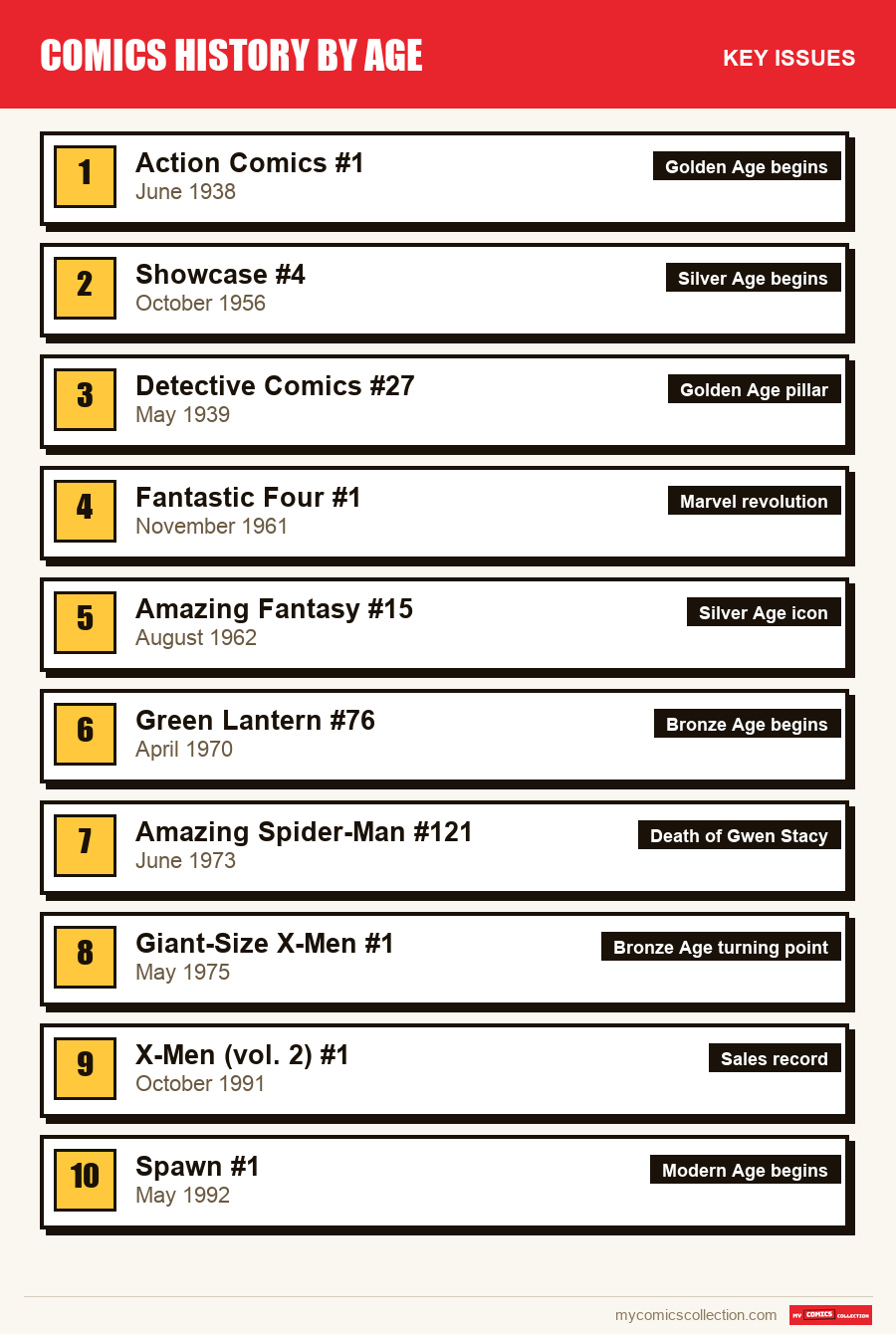
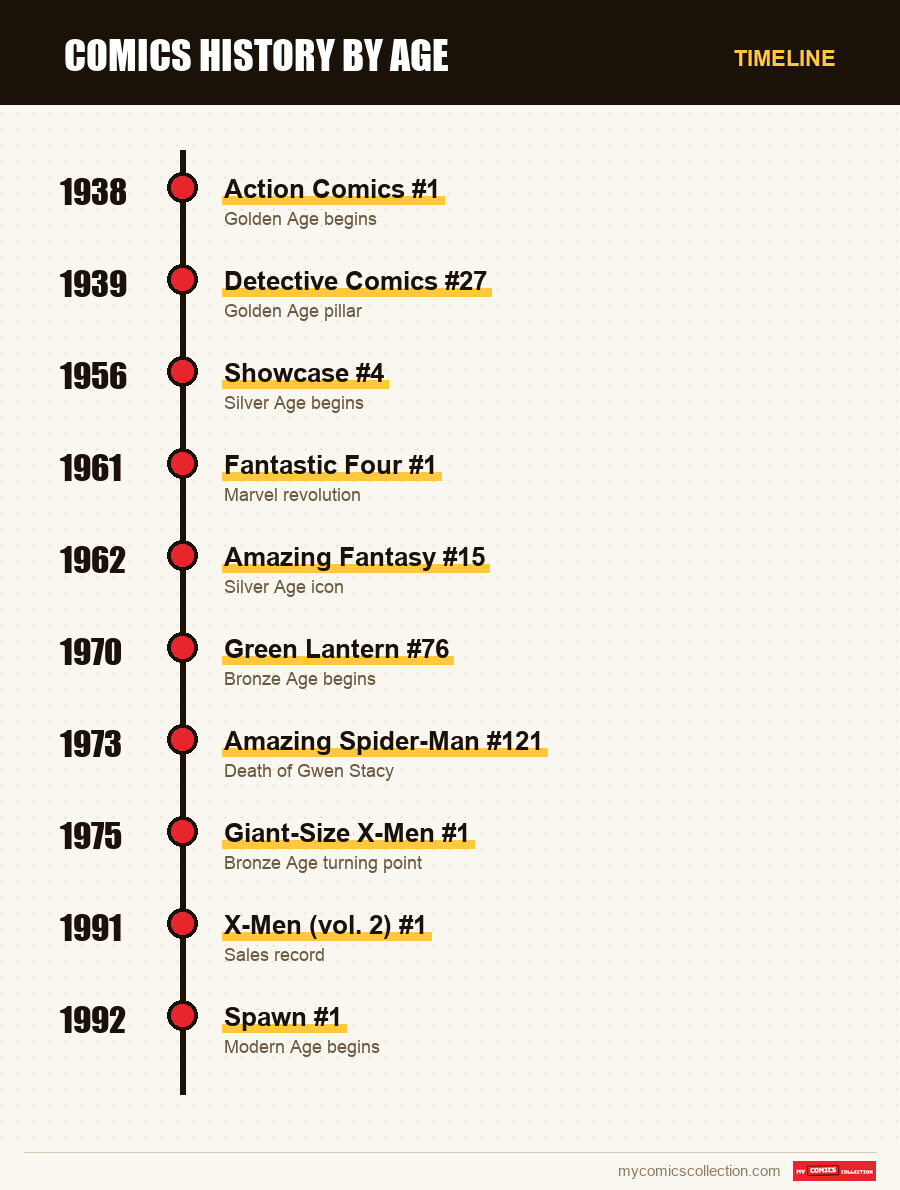
The history of American comics is divided into five major periods that collectors call "ages": the Golden Age (1938-1956), inaugurated by Superman in Action Comics #1; the Silver Age (1956-1970), launched by the return of the Flash in Showcase #4; the Bronze Age (1970-1985), darker and more social; the Copper Age (1984-1991), marked by the rise of the direct market and star artists; and the Modern Age, opened in 1992 by the founding of Image Comics and still ongoing. This informal division, born in the fanzines of the 1960s, today structures the estimation of the rarity and price of any old comic.
When you open an auction catalog or talk to a seller of old comics, one vocabulary keeps coming up: “Golden Age”, “Silver Age”, “Bronze Age”. These terms are not recent marketing inventions or official categories decreed by Marvel or DC. These are benchmarks gradually constructed by the collectors themselves, starting in the 1960s, to give chronological meaning to a century of American comic book production, and above all to understand why a given issue published in 1939 sells for seven figures while an issue released in 1991, printed in several million copies, is often worth only a few euros despite its notoriety.
Understanding this timeline is not an exercise in pure historical curiosity. It is a tool for reading the market. Each age corresponds to a radically different context of manufacturing, distribution and conservation: acid pulp paper and newsstands for the Golden Age, the rise of comic shops and the direct market for the Bronze and Copper Ages, speculative printing and industrialized grading for the Modern Age. These differences explain, much more than the simple number of years that have passed, why rarity and value do not follow a linear curve over time.
In this article, we retrace each age with its dates, its creators, its founding issues and the editorial or societal events which caused the transition from one period to the other: supported by real data of circulation, CGC census and documented auction sales. We end with the impact of audiovisual adaptations on the rating of these key issues, then with a buying guide designed to avoid the most common pitfalls depending on the age of the comic we are targeting.
At the origins of the classification: who invented the “ages” of comics?
No publisher has ever stamped an issue saying "this is a Golden Age comic." Periodization is a retrospective construction of fans, appearing in the fanzines of the first generation of organized collectors-amateur publications like those that circulated in correspondence circles in the 1960s, at the very moment when the market for the resale of old issues was beginning to organize itself. The limits were then refined, discussed and sometimes contested for decades, before being taken up as the de facto standard by grading houses, specialist auction houses and listing guides.
What makes this division useful is not its academic precision (the boundaries between ages remain blurred and debated, including among historians of the medium) but its ability to link a given issue to a precise industrial context: who distributed it, how it was printed, what percentage of copies have survived, and what type of collector was originally seeking it. It is this reading grid that allows us to understand why the rarity of a comic from 1939 has absolutely nothing to do with that of a comic from 1991, even if both are considered “classics” today.
The Golden Age (1938-1956): the birth of the American superhero
The Golden Age conventionally began in June 1938, with the publication of Action Comics #1 at National Allied Publications, the forerunner of DC Comics. This issue introduces Superman, created by writers and artists Jerry Siegel and Joe Shuster, two young Cleveland authors who had pitched the character to several publishers for years before being published. The commercial success was such that it triggered a wave of immediate imitation throughout the American pulp industry, which shifted massively towards the costumed superhero genre.
Less than a year later, in May 1939, Detective Comics #27 introduces Batman, created by Bob Kane with the essential contribution, long uncredited, of screenwriter Bill Finger. In 1941, Wonder Woman made her debut in All Star Comics #8, designed by psychologist William Moulton Marston. The same year, even before the United States entered the war (December 1941), the war in Europe inspired a wave of patriotic heroes, the most emblematic of which remains Captain America, created by Joe Simon and Jack Kirby for the publisher Timely Comics (future Marvel), whose cover of the first issue shows the hero punching Hitler in the face: an image that has become iconic of the period.
The extreme rarity of Golden Age comics is not only due to their age. These booklets were printed on cheap pulp paper, with high acidity, intended for disposable reading and sold on newsstands in the same way as a newspaper. Much of the print run was lost as a result of paper drives during the war effort, and the rest either degraded naturally or was simply thrown away, no one imagining at the time that a ten-cent issue could one day be worth a fortune. The CGC census clearly illustrates this structural rarity: for Detective Comics #27, the CGC census database only has around 77 examples certified for all grades, including only a handful above grade 7.0, and a single copy graded 9.2 which has never been put up for public sale.
This rarity is directly reflected in the auctions. A copy of Detective Comics #27 certified CGC had already reached $1.82 million in a record sale reported by CGC; a more recent sale, relayed by the specialized site Nerdbeak, mentions a copy sold for 2.3 million dollars, compared to 1.5 million six years earlier for a comparable copy: an increase which testifies to the constant appetite of collectors for the very first appearance of Batman. For Superman, the pinnacle was reached with a copy of Action Comics #1 rated CGC 9.0, sold in a private transaction for $15 million, an all-time record for a comic book, while a copy rated CGC 8.5 set a record at public auction at $6 million. Only two copies of Action Comics #1 are listed in note CGC 9.0, which alone explains these amounts.
The Golden Age did not end simply because of public weariness. After the war, the superheroic genre declined sharply in favor of horror, crime and romance comics, a movement driven in particular by the publisher EC Comics and its titles like Tales from the Crypt. This more violent and more adult production attracted the wrath of psychiatrist Fredric Wertham, whose essay Seduction of the Innocent, published on April 19, 1954, accused comic books of corrupting American youth and encouraging juvenile delinquency. The work triggered hearings in the US Senate on April 21 and 22 and then on June 4, 1954. Under pressure, the publishers created the Comics Code Authority in September 1954, a self-censorship body which imposed strict rules on the representation of violence, crime and horror. The consequences were brutal for the industry: the number of titles published fell from 650 to 250 between 1954 and 1956, and more than 800 creators left the profession. It is this break, more than any arbitrary date, which marks the conventional end of the Golden Age around 1956.
The Silver Age (1956-1970): the superheroic revival and the Marvel explosion
The Silver Age begins with the publication of Showcase #4 in October 1956, where editor Julius Schwartz, writer Robert Kanigher and artist Carmine Infantino relaunched the character of Flash under an entirely new identity, that of Barry Allen. The success of this issue convinced DC Comics to gradually reintroduce its entire pantheon of superheroes in a modernized form, with a pseudo-scientific explanation of their powers more in line with the imagination of the emerging space conquest. The movement is confirmed with Justice League of America #1 in 1960, which popularized the principle of grouping heroes into teams.
It is this dynamic that pushes the competing publisher Timely, now Atlas and soon Marvel Comics, to respond. In November 1961, Stan Lee and Jack Kirby published Fantastic Four #1, which introduces a team of heroes with powers assumed as a curse as much as a gift, endowed with faults, internal tensions and a very concrete New York anchorage. This issue lays the foundation for what will become the Marvel Shared Universe. In August 1962, Stan Lee and Steve Ditko published in Amazing Fantasy #15 the first appearance of Spider-Man: a character who contrasts radically with the adult and infallible heroes of the time by offering a clumsy teenager, riddled with financial and family problems. Unlike the Golden Age comics, this issue sold very well upon its release, making it relatively less rare in circulation than other Marvel titles from the early 1960s, but its cultural value ended up far exceeding its physical rarity: a copy rated CGC 9.6 sold for $3.6 million in 2021.
This decade also saw the birth of the Avengers, the X-Men and much of the modern Marvel pantheon, in a climate of intense creative rivalry between the two major publishers. Stan Lee himself popularized the expression "Marvel Age of Comics" to designate this excitement, proof that the awareness of belonging to a distinct period already existed among the actors of the time, even if the definitive terminology of "Silver Age" would only stabilize a posteriori. The end of this period is generally associated with the editorial turn of the early 1970s, when Stan Lee published, at the request of the US Department of Health, Education and Welfare, a history of Amazing Spider-Man tackling drug addiction head-on without obtaining approval from the Comics Code Authority: a move that then forces a revision of the Code itself and symbolizes the shift toward more adult narratives.
The Bronze Age (1970-1985): thematic maturity and diversification
The Bronze Age, which historians generally place between 1970 and 1985, is characterized by an assumed desire to address social subjects hitherto avoided by superhero comics: addiction, racism, urban poverty, ecology. The series Green Lantern/Green Arrow, written by Denny O'Neil and drawn by Neal Adams in the early 1970s, perfectly embodies this shift, by literally confronting the two heroes with the social realities of America at the time. This evolution of tone also results in moments of narrative rupture that have become legendary, such as the death of Gwen Stacy in The Amazing Spider-Man #121 in 1973, often cited by historians of the medium as a symbolic shift towards more adult writing, where the main characters are no longer sheltered from dramatic consequences.
On an editorial level, the most structuring event of the period probably remains Giant-Size X-Men #1, published in 1975 by screenwriter Len Wein and artist Dave Cockrum. This issue revives a previously flagging X-Men franchise by introducing an entirely new and international team (Wolverine, Storm, Colossus, Nightcrawler) which will become the basis of the franchise's phenomenal success in the following decades. The relative rarity of this issue, combined with the cultural importance of the character of Wolverine, makes it one of the most sought-after Bronze Age comics today: a copy graded CGC 9.8 has sold for more than $500,000.
It was also during this period that the direct distribution market was born, which will gradually transform the way in which comics are sold and therefore preserved. Rather than going through traditional press channels, with their system of returns and destruction of unsold items, publishers are starting to sell directly to specialized stores on a non-refundable basis. This change of circuit, initiated at the beginning of the 1970s, will have considerable consequences on the material conservation of comics published from the middle of the decade, since copies no longer pass through the newsstand displays which so damaged the covers of the Golden and Silver Ages.
The Copper Age (1984-1991): direct market, star artists and speculative boom
The Copper Age is the least consensually defined period of this entire chronology, some historians merge it with the end of the Bronze Age or the beginning of the Modern Age, but usage generally places it between the launch of the crossover event Secret Wars at Marvel in 1984 and the launch, in 1991, of the new series X-Men drawn by Jim Lee, without a distinctive subtitle. This period is marked by two works which lastingly redefine what a superhero comic can tell: Watchmen, by Alan Moore and Dave Gibbons (1986-1987), and The Dark Knight Returns, by Frank Miller (1986), both published by DC Comics and often cited as pivotal works that pushed the genre towards an unprecedented narrative and graphic maturity.
On the commercial level, the Copper Age is also that of the full maturity of the direct market and the emergence of artists as true loss leaders: a phenomenon which culminates with the launch of X-Men #1 in 1991, written by Chris Claremont and drawn by Jim Lee. Available in five separate covers (1A to 1E), this issue sold 8.1 million copies according to Guinness World Records, making it to date the best-selling single edition comic book of all time. This colossal print run alone illustrates the speculative logic that then took hold in the market: collectors, but also simple speculators with no real interest in the medium, bought multiple copies of each new issue in the hope of rapid capital gains, a dynamic that publishers happily maintained with variant covers, embossing and metallic inks.
The Modern Age (since 1992): Image Comics, the bursting of the speculative bubble and the era of grading
The Modern Age began in 1992 with the founding of Image Comics by a group of star Marvel cartoonists (Jim Lee, Todd McFarlane, Rob Liefeld, Erik Larsen, Marc Silvestri and Jim Valentino) who left the publisher to create a structure where the creators retained the intellectual property of their characters, unlike the "work for hire" model dominant until then. The launch of Spawn, created by Todd McFarlane, immediately illustrates the commercial viability of this new model and propels Image among the main American publishers in its first year of existence.
But this Modern Age also begins on the rubble of the speculative bubble that began in the Copper Age. In the mid-1990s, the market collapsed: millions of copies of "event" issues drawn to excess between 1991 and 1993 found themselves unsold or stored by disappointed speculators, revealing that the abundance of circulation automatically canceled any future scarcity. This contrast is instructive for any collector: the value of a comic never depends on its “number 1” status or its notoriety at the time of its release, but rather on the relationship between the number of surviving copies and the demand from collectors decades later.
The creation of Certified Guaranty Company (CGC) in 2000 profoundly changed the structure of the old comics market. By offering a third-party rating, standardized and sealed under a protective shell, CGC establishes new confidence in remote transactions and allows the creation of precise censuses: these famous “census” mentioned above for Action Comics #1 or Detective Comics #27: which become the absolute reference for evaluating the real rarity of a given number, all generations combined. It is this infrastructure of trust which largely explains the surge in prices of the great classics of the Golden Age and Silver Age observed since the beginning of the 2000s.
Collecting this series?
Track what you own, what you are missing and what your collection is worth. 7 day trial.
Start my trial →The impact of adaptations on the rating
Each of these ages continues to be re-evaluated in real time by the audiovisual entertainment industry, which draws from its own catalog of first appearances to fuel films and series. The character of Superman, whose first appearance in Action Comics #1 remains the most expensive object in the entire history of the comic book, has benefited from almost continuous exposure in cinema and television for almost a century, which maintains an undeniable fundamental demand for this founding issue, as evidenced by the successive records of 6 million dollars in public sales and 15 million dollars in private transactions.
The case of Spider-Man illustrates well how cinematic notoriety can increase the popularity of an issue which was not initially rare. Amazing Fantasy #15, released in relatively large quantities in 1962 by Golden Age standards, has reached new heights today: $3.6 million for a CGC 9.6 copy in 2021: driven by decades of continuous adaptations, from the Sam Raimi films of the early 2000s to the character's integration into the Marvel cinematic universe since 2016. Likewise, Giant-Size X-Men #1 directly benefits from the prolonged success of the X-Men film franchise launched in 2000 and the enduring popularity of the Wolverine character, which explains why a copy rated CGC 9.8 exceeds $500,000 even though this issue does not belong to the Golden Age and therefore did not benefit from the same massive destruction of print runs.
This dynamic must, however, be put into perspective: a successful adaptation does not transform a massive circulation into a rarity. This is precisely what demonstrates X-Men #1 from 1991: despite considerable cultural recognition and decades of X-Men films, its 8.1 million copies in circulation structurally preclude any surge comparable to that of Golden or Silver Age issues, except for extremely high preservation grades or signed copies. Before any purchase motivated by the release of a film or series, it therefore remains essential to check the actual circulation and the recorded population of the issue in question rather than relying solely on the media buzz of the moment: this is precisely what allows the free estimator based on current eBay listings.
Buying guide: invest according to the age of the comic
Each age imposes its own purchasing reflexes, as the conditions of manufacturing, distribution and speculation differ from one period to another. Here are the points of vigilance to adapt depending on the period in question:
- On the Golden Age (before 1956): systematically examine the presence of restoration (spine regluing, color retouching, replacement of pages) a very common phenomenon on these acid paper booklets more than 80 years old; on a graded copy, the wording of the CGC label (universal or restored) makes all the difference in the final value.
- On the Silver Age (1956-1970): favor the very first appearances of characters still active today (Spider-Man, X-Men, Avengers) rather than the flavor issues of the same series, because the difference in value between a first appearance and a neighboring issue can be considerable.
- On the Bronze Age (1970-1985): check if the number corresponds to a real first appearance or a simple significant return of the character: confusion between the two is a frequent source of overvaluation by lax sellers.
- On the Copper Age and the Modern Age (since 1984): be wary of mass-drawn “1” numbers, often resulting from commercial relaunches without real rarity; a print run announced at several million copies, like that of X-Men #1 from 1991, will never become a rare item, no matter how popular it is.
- For prints with variant covers (common since the Copper Age): the actual distribution ratio of the variant (1:25, 1:50, 1:100...) matters much more than the outcome number itself to assess its rarity.
- Before any significant purchase: consult the population census of the grading house in question rather than relying on the “rare” mention of an ad, and cross-reference with comparable sales actually concluded rather than with displayed prices.
- To track your collection over time, whatever the age of your numbers, a collection management application allows you to centralize purchase dates, condition and estimated value for each part.
Key issues to know
Action Comics #1
With Superman, conceived by Jerry Siegel and drawn by Joe Shuster, this National Allied Publications issue conventionally marks the start of the Golden Age. Its instant success sets off a wave of costumed imitators across the industry. It is the reference point against which every other period is dated.
Showcase #4
Under editor Julius Schwartz, writer Robert Kanigher and artist Carmine Infantino give the Flash a new identity, Barry Allen, and a scientific origin. This successful comeback for a costumed hero after the slump of the 1950s serves as the marker for the start of the Silver Age.
Detective Comics #27
Barely a year after Superman, Bob Kane and long-uncredited writer Bill Finger launch Batman. The vigilante without superpowers shows that the new genre can also work as dark crime fiction. Alongside Action Comics #1, it is one of the two issues that sum up the Golden Age and its scarcity.
Fantastic Four #1
In response to DC's success, Stan Lee and Jack Kirby launch a team whose powers feel as much like a curse as a gift. These fallible, New York-based heroes lay the foundations of Marvel's shared universe. It is the Silver Age's second engine after Showcase #4.
Amazing Fantasy #15
Stan Lee and Steve Ditko introduce Spider-Man, an ordinary teenager haunted by guilt. Printed in large numbers for its day, this issue shows that a character's fame, fed by decades of adaptations, can carry a comic to the top even without original scarcity.
Green Lantern #76
Denny O'Neil and Neal Adams pair Green Lantern with Green Arrow and confront the heroes with racial and social inequality in America. This turn toward social issues is one of the most cited markers of the shift into the Bronze Age.
Amazing Spider-Man #121
Gerry Conway (script) and Gil Kane (art) deliver "The Night Gwen Stacy Died": the Green Goblin kidnaps Gwen, and Spider-Man fails to save her. This death of a central character is often described as the end of the Silver Age's innocence.
Giant-Size X-Men #1
Len Wein and Dave Cockrum relaunch a flagging X-Men franchise with an international team bringing together Wolverine, Storm, Colossus and Nightcrawler. This renewal becomes the foundation of the X-Men's success for decades to come. One of the defining issues of the Bronze Age.
X-Men (vol. 2) #1
Written by Chris Claremont and drawn by Jim Lee, this issue, released with five covers, sold more than 8.1 million copies according to Guinness World Records. It embodies the peak of star artists and the speculative boom at the end of the Copper Age, and shows that a massive print run rules out true scarcity.
Spawn #1
Written and drawn by Todd McFarlane, Spawn #1 is among the first titles from Image Comics, founded in 1992 by star artists who left Marvel. Its hero is Al Simmons, back from hell with no memory. Image's birth serves as the marker for the start of the Modern Age.