Before Supergirl became Supergirl, an earlier version of the character circulated under a different spelling. The sellers know this: on the statement of August 30, 2026 relating to Superman No. 123 (1958), the five least expensive ads all refer to the same issue, but with three distinct wordings: the modern name, the hyphenated name in quotation marks, and the word "prototype." A search that uses only one of these spellings only sees a fraction of what is proposed. The very thin statement (twenty-one ordinary advertisements, sixteen verified ones counted separately) does not allow any firm conclusion on a price level.
A comic book character is almost never born all at once, under his definitive name, in an issue that everyone agrees is the first. It often appears first in an essay form: a nearby silhouette, a tested idea, a name still floating that the editor will write differently a few months later. This intermediate phase does not disappear from the market however. It survives there in the form of a booklet that some sellers present as the true first appearance, which others present as a simple prototype, and which many buyers never find because they search with today's spelling.
The case of Supergirl illustrates this mechanism in a particularly clear way, because ancient spelling and modern spelling only differ by a hyphen and a capital letter. This tiny difference is enough to separate two sets of ads that don't intersect. We noted on August 30, 2026, on a general auction site in the American market, the status of current advertisements for the query “Supergirl Superman 123 1958”. The following amounts are those that sellers are claiming on this date, on advertisements still open: these are not concluded transactions, and a photograph taken on a single day says nothing about the evolution of the market.
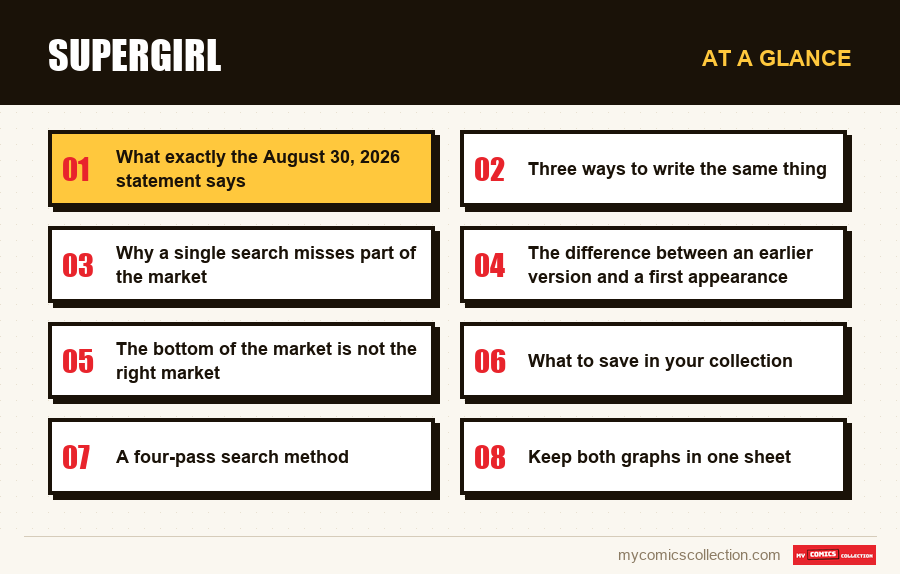
What exactly the August 30, 2026 statement says
The query "Supergirl Superman 123 1958" returns twenty-one current unverified listings. The lowest amount claimed is $35.00, the median is $225.00, the highest is $500.00. The copies accompanied by verification by a third party are counted separately, because they do not come from the same market: there are sixteen of them, the lowest at $170.00, the central value at $665.00, the highest at $3,500.00. This $3,500.00 maximum is an isolated request: it reflects what a seller hopes to get, not what a buyer paid.
Twenty-one announcements on one side, sixteen on the other: these numbers are too small to establish anything. A handful of listings is enough to move the median by several dozen dollars, and the gap between the bottom and top of each set is explained as much by the declared condition of the copies as by the temperament of those offering them. We will therefore not draw any price level from this reading. What it shows, on the other hand, and which does not depend on the number of announcements, is the way in which this booklet is named.
Three ways to write the same thing
The modern name, without special mention
Two of the five cheapest ads simply use the current spelling. The first, at $35.00, describes a copy in very poor condition and without a cover, with the mention of first appearance. The second, at $117.00, also indicates a missing cover. These two come up in any research conducted on the character's name as it is written today.
Period spelling, in quotation marks
A $145.00 ad hyphens the name and surrounds it with quotation marks. The seller thus indicates that he is reproducing an original designation rather than a common name. This announcement escapes any search relating to modern spelling, even though it relates to the same number and the same year.
The word « prototype »
An ad for $179.99 does not speak of a first appearance but of the first appearance of a prototype of the character. The vocabulary completely changes register: it no longer describes an object, it describes content. A buyer who filters his searches on the established expression for a first appearance is missing out.
Both at once
The fifth ad, also $179.99, combines the old hyphenated spelling and the word "prototype", adding a low status statement. It is the most complete announcement of the lot on a descriptive level, and paradoxically the most difficult to reach: it only appears if the query used includes one of these two terms.
Five ads, three wordings. None of these three formulations is wrong, none is misleading, and none is more legitimate than the others. They describe the same 1958 issue with different vocabularies, because the character himself did not yet have a stable vocabulary when it appeared. The practical consequence is immediate: a single request is not enough. You have to search several times, changing the spelling, adding then removing the word “prototype”, and also querying the number alone with its year.
Two copies have exactly the same major defect, the cover is missing, and cost $35.00 and $117.00. More than three times the difference, for an identical shortage and on announcements noted on the same day.
Out of twenty-one advertisements, this difference measures nothing other than the disagreement of two sellers on what a mutilated copy is worth. It does not draw a range, nor a trend, nor a good deal on one side and an excess on the other. It simply reminds us that such a narrow market has no reference price to offer.
Why a single search misses part of the market
The current name doesn't cover everything
A query based solely on modern spelling mechanically excludes advertisements written with period spelling. The engine of an auction site compares character strings: a hyphen inserted in the middle of a word makes it another word.
Year is a better entry point
The 1958 vintage appears in the five least expensive ads, regardless of the spelling chosen for the character. Combined with the fascicle number, it constitutes the most stable benchmark for scanning all the advertisements without depending on the seller's vocabulary.
“Prototype” is not a defect
The term describes the content of the booklet, not its material state. It signals an earlier and distinct version of the established character. Confusing it with a mention of damage leads to the exclusion of advertisements which relate precisely to what we are looking for.
Missing coverage is not standardized
The same defect is expressed in several ways depending on the advertisements noted: absence of coverage indicated at the end of the description, mention of very low condition, minimum numerical note. There is no guarantee that a state filter will bring up these three cases together.
The number is written in two ways
The statement shows the issue designated sometimes by the crosshair followed by the number, sometimes by the abbreviation of the word “number”. Here again, two entries for the same data, and two search results which do not entirely overlap.
The title is not that of the character
The booklet appears in a series in the name of another character. Searching for the character you are looking for without mentioning this title is like searching a catalog for a word that does not appear on the cover.
The difference between an earlier version and a first appearance
The word “prototype”, used by two of the five advertisements noted, deserves to be taken seriously rather than treated as a commercial exaggeration. It describes a real editorial situation: a character was shown for the first time in a form which resembled the one he would subsequently take, without this initial appearance being intended to establish the lasting character. The different spelling is not an accident of composition, it accompanies this difference in status.
For the buyer, the consequence is concrete: there is a booklet prior to the one he believes to be the first. If he does not know this, he will build his collection around a starting point which is not quite one, and he will ignore the existence of an older object, often rarer, and offered under labels that he will never see pass. It is not a question of value, the survey is far too thin to discuss it, but of completeness. You can't decide not to buy something you don't know exists.
This mechanism is not specific to a single character. Each time a figure is fixed after a trial phase, the same configuration replays itself: an old spelling remains in the sellers' descriptions, a vocabulary of nuance appears to distinguish the two states, and the market splits into two sets of announcements linked by nothing other than the buyer's knowledge of them. The method that applies here applies elsewhere: list the possible designations before searching, and not the other way around.
This caution also applies to the founding issues of the same editorial family, whose questions of value are documented separately, and for the bearer title itself, of which editorial history explains why a secondary character was introduced at this precise moment.
Collecting this series?
Track what you own, what you are missing and what your collection is worth. 7 day trial.
Start my trial →The bottom of the market is not the right market
The five cheapest ads in the survey share a trait that must be faced: they all describe very damaged copies. Two of them no longer have coverage. A third carries the lowest condition rating that exists, coupled with the minimum numerical rating. A fourth explicitly presents itself as a low-end copy. This is not a coincidence of sorting: on an old and scarce booklet, the bottom of the list is occupied by degraded copies, not by distracted sellers.
A beginner who sorts by ascending price and stops at the first line thinks he has found an opportunity. In reality, he found the only segment of the market where a booklet of this age remains accessible: that of copies whose condition excludes any other transaction. It's not necessarily a bad purchase (a copy without a cover is still a copy, and can be read) but it's a purchase that you have to make knowing what you're getting, and not thinking you're circumventing the market.
The difference between $35.00 and $117.00 for two copies without cover illustrates the opposite and complementary point. Even within this degraded segment, there is no shared tariff. Two sellers looking at the same type of shortage draw requests that vary by a factor of three. On only twenty-one advertisements, this dispersion does not allow any interpretation; Above all, it discourages the idea that a “market price” would exist for this issue in this state.
The same logic applies to reading verified sets. Sixteen announcements, a minimum of $170.00 and a peak of $3,500.00: the amplitude is considerable, but the number of observations is derisory. Comparing the two sets to deduce what an audit “reports” would amount to talking about four or five advertisements. We abstain from it, and we invite people to abstain from it. To situate this booklet in a reading trajectory rather than in a scale, the reading guide dedicated to the character is a better point of support.
What to save in your collection
The “character” field must accept several spellings for the same entry. If your file only accepts one wording, you will have to choose between the modern name and the period spelling, and you will lose the other. Now it is precisely the other which will allow you to find your copy when you look, six months later, for what you have from before the fixation of the character. Provide a main label and one or more entry variants associated with the same document.
The period designation is noted as it is written in the booklet, not as it is written today. The hyphen and the inner capital letter noted in one of the ads dated August 30, 2026 are not typos by the seller: they are information. Standardizing them upon entry destroys the only trace that distinguishes, in your own inventory, the previous version from the one that followed.
The mention “prototype” belongs to the description of the content, never to that of the state. File it with narrative information (first appearance, past version, character status) not with material flaws. A sheet that mixes the two makes any search of the “my copies in poor condition” type impossible without bringing up intact documents whose content was simply described as preparatory.
Lack of coverage should be recorded as a fact, not a status note. Two copies of the statement share this lack and claim to be simple or triple; no numerical scale accounts for this situation in a comparable manner from one seller to another. Note the gap clearly in the form, independently of any note, so that your own inventory remains readable without having to reinterpret a graduation.
The supporting series must appear in the file in the same way as the character sought. The 1958 booklet appears under the title of another character: if your entry only mentions the one you collect, your inventory will become silent as soon as you query it by title. Informing both (the series in which the play appeared, and the character(s) it introduces) is what allows an old collection to remain searchable in both directions.
A four-pass search method
The practical conclusion of this survey comes down to a habit: never consider that a request has made the rounds in an old booklet. A first pass uses the character's modern name along with the series title, number and year. It will bring back the most conventional ads, those that everyone sees, and probably the most numerous.
A second pass repeats the same query by substituting the period spelling for the modern name. It is this which reveals the advertisements written by sellers attentive to the designation of origin: often the best described, sometimes the least consulted, therefore the least disputed. A third pass replaces the character's name with the word "prototype" associated with the title and number: it captures the descriptive register which speaks of status rather than identity.
A fourth pass, finally, drops the character name completely and only queries the series title, number and year. This is the broadest and most reliable pass, since it does not depend on any choice of vocabulary; it is also the noisiest, since it brings back everything that bears this number, without distinction. It serves as a safety net: what it contains that the other three did not bring indicates exactly which formulations you were missing.
These four passes only take a few minutes and do not require any special tools. They replace a belief (“I looked, there is nothing”) with a verifiable observation. On a booklet whose market is made up of around twenty open advertisements, the difference between the two is not small: it is the difference between seeing the market and only seeing a quarter of it. And for a buyer who keeps in mind that the prices recorded are requests and not sales, this complete panorama is better than any average calculated on too few observations, as our approach to pricing reminds us. purchases with a contained budget on this family of titles.
Because the character first existed in an earlier form, bearing a different spelling from that which subsequently emerged. Sellers who reproduce the original designation write the name with a hyphen; those who use the common name write the modern version. Both describe the same 1958 issue.
No. It is an indication of the content, not the object. He points out that the version of the character presented in this booklet is earlier and distinct from that which was established subsequently. A copy can be described as a prototype and be in perfect condition, or it can be in very poor condition without this word appearing.
These are amounts claimed by sellers on August 30, 2026, on advertisements still in progress, and not amounts actually paid. The statement includes twenty-one ordinary advertisements and sixteen verified advertisements, counted separately. These numbers are too low to establish a price level, and a measurement taken on a single date shows no movement.
Nothing in the statement explains it. Both announcements describe the same major lack and were observed on the same day. On such a small set, this difference of more than three times only measures the divergence of appreciation between two sellers: it does not draw a range of value and does not designate one of the two as a good deal.
Yes, and also the carrier series. A file which only retains the current name of the character becomes impossible to query on the documents prior to the fixing of this name. Retaining the designation as the door fascicle, alongside the modern wording, is what keeps an ancient inventory truly searchable.
Keep both graphs in one sheet
My Comics Collection records for each copy the carrying series, number, year and character designations, including old spellings. Your oldest pieces can still be found no matter what name you look for them under.